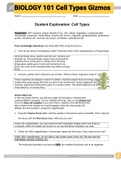
BIOLOGY 101 Cell Types Gizmos
Name: Date:
Student Exploration: Cell Types
Vocabulary: ATP, bacteria, carbon dioxide (CO2), cell, cellular respiration, compound light
microscope, eukaryote, multicellular, muscle cell, neuron, organelle, photosynthesis, prokaryote,
protist, red blood cell, root hair cell, tissue, unicellular, white blood cell
Prior Knowledge Questions (Do these BEFORE using the Gizmo.)
1. How do you know if something is alive? Describe some of the characteristics of living things.
All living things move, plants track the sun, humans and
animals run. All living things require food and therefore
anything that is living eats or creates food. All living
things grow, plants grow in size and humans do too.
these are some of the characteristics that define a living
thing.
2. Humans, plants and mushrooms are all alive. What do these organisms have in common?
These organims are always in need of nutrition. Humans require food as energy, plants
create food using energy from the sun and so do mushrooms. These organisms are growing.
Humans, plants and mushrooms grow to a certain extent. The listed organisms all fulfill the
characteristics of a living thing.
Gizmo Warm-up
In the Cell Types Gizmo, you will use a light microscope to compare and
contrast different samples. On the LANDSCAPE tab, click on the Elodea leaf.
(Turn on Show all samples if you can’t find it.) Switch to the MICROSCOPE
tab to observe the sample as it would appear under the microscope. By
default, this microscope is using 40x magnification.
1. Drag the Coarse focus slider until the sample is focused as well as possible. Then, improve
the focus with the Fine focus slider. What do you see?
Under 40x magnification, you see several small rectangular shapes which are lined up
compactly. When the labels are turned on, we see that these chambers are cells.
2. Select the 400x magnification. If necessary, adjust the fine focus. Now, what do you see?
Under 400x magnification, we are able to see certain parts of this cell. We also see the
chloroplast, vacuole, nucleus, etc.
The individual chambers you see are cells, the smallest functional unit of an organism.
2018
, Get the Gizmo ready:
Activity A: On the LANDSCAPE tab, click on the woman’s
Observing cells right arm to choose the Human skin sample.
Select the MICROSCOPE tab.
Introduction: Complex organisms are made up of smaller units, called cells. Most cells are too
small to be seen by the naked eye. Microscopes are used to magnify small objects, so here you
will use a compound light microscope to observe the cells of different organisms.
Question: What are similarities and differences between cells from different organisms?
1. Match: Read about each microscope part. Match the description to the part on the diagram.
B Stage: Platform where a slide is placed.
A Eye piece: Lens at the top of the microscope
that the user looks though. This lens most commonly
magnifies a sample by 10x.
C Coarse focus knob: Large knob that moves
the stage up and down to focus the sample.
D Fine focus knob: Small knob that moves the
stage over a short distance to refine the focus.
E Objective lens: A second lens that further
magnifies the sample. Microscopes usually have
several objective lenses with different magnifications.
The total magnification is the product of the eyepiece
magnification and the objective lens magnification.
F Slide: A rectangular piece of glass upon which
a sample is mounted for viewing under a microscope.
2. Manipulate: With 40x selected, use the Coarse and Fine focus sliders to focus on the
sample. Then, choose 400x and focus on the sample using the Fine focus slider.
A. Which focus knob is easier to use at 40x? Coarse 400x? Fine
B. Turn on Show labels. What structures can you see in human skin cells?
Cytoplasm, Nucleus and Cell Membrane
C. Turn off Show labels and turn on Show scale bars. The scale bar has a width of 20
micrometers, or 20 μm. (There are 1,000 micrometers in a millimeter.)
Using the scale bar, about how wide is a human skin cell? 30
(Activity A continued on next page)
Activity A (continued from previous page)
2018
Name: Date:
Student Exploration: Cell Types
Vocabulary: ATP, bacteria, carbon dioxide (CO2), cell, cellular respiration, compound light
microscope, eukaryote, multicellular, muscle cell, neuron, organelle, photosynthesis, prokaryote,
protist, red blood cell, root hair cell, tissue, unicellular, white blood cell
Prior Knowledge Questions (Do these BEFORE using the Gizmo.)
1. How do you know if something is alive? Describe some of the characteristics of living things.
All living things move, plants track the sun, humans and
animals run. All living things require food and therefore
anything that is living eats or creates food. All living
things grow, plants grow in size and humans do too.
these are some of the characteristics that define a living
thing.
2. Humans, plants and mushrooms are all alive. What do these organisms have in common?
These organims are always in need of nutrition. Humans require food as energy, plants
create food using energy from the sun and so do mushrooms. These organisms are growing.
Humans, plants and mushrooms grow to a certain extent. The listed organisms all fulfill the
characteristics of a living thing.
Gizmo Warm-up
In the Cell Types Gizmo, you will use a light microscope to compare and
contrast different samples. On the LANDSCAPE tab, click on the Elodea leaf.
(Turn on Show all samples if you can’t find it.) Switch to the MICROSCOPE
tab to observe the sample as it would appear under the microscope. By
default, this microscope is using 40x magnification.
1. Drag the Coarse focus slider until the sample is focused as well as possible. Then, improve
the focus with the Fine focus slider. What do you see?
Under 40x magnification, you see several small rectangular shapes which are lined up
compactly. When the labels are turned on, we see that these chambers are cells.
2. Select the 400x magnification. If necessary, adjust the fine focus. Now, what do you see?
Under 400x magnification, we are able to see certain parts of this cell. We also see the
chloroplast, vacuole, nucleus, etc.
The individual chambers you see are cells, the smallest functional unit of an organism.
2018
, Get the Gizmo ready:
Activity A: On the LANDSCAPE tab, click on the woman’s
Observing cells right arm to choose the Human skin sample.
Select the MICROSCOPE tab.
Introduction: Complex organisms are made up of smaller units, called cells. Most cells are too
small to be seen by the naked eye. Microscopes are used to magnify small objects, so here you
will use a compound light microscope to observe the cells of different organisms.
Question: What are similarities and differences between cells from different organisms?
1. Match: Read about each microscope part. Match the description to the part on the diagram.
B Stage: Platform where a slide is placed.
A Eye piece: Lens at the top of the microscope
that the user looks though. This lens most commonly
magnifies a sample by 10x.
C Coarse focus knob: Large knob that moves
the stage up and down to focus the sample.
D Fine focus knob: Small knob that moves the
stage over a short distance to refine the focus.
E Objective lens: A second lens that further
magnifies the sample. Microscopes usually have
several objective lenses with different magnifications.
The total magnification is the product of the eyepiece
magnification and the objective lens magnification.
F Slide: A rectangular piece of glass upon which
a sample is mounted for viewing under a microscope.
2. Manipulate: With 40x selected, use the Coarse and Fine focus sliders to focus on the
sample. Then, choose 400x and focus on the sample using the Fine focus slider.
A. Which focus knob is easier to use at 40x? Coarse 400x? Fine
B. Turn on Show labels. What structures can you see in human skin cells?
Cytoplasm, Nucleus and Cell Membrane
C. Turn off Show labels and turn on Show scale bars. The scale bar has a width of 20
micrometers, or 20 μm. (There are 1,000 micrometers in a millimeter.)
Using the scale bar, about how wide is a human skin cell? 30
(Activity A continued on next page)
Activity A (continued from previous page)
2018