Key concept and summarize
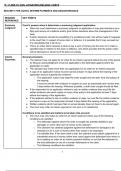
Chapter 1-The Fundamentals of Managerial Economics
Study Outline
I. Introduction
A. The Manager
B. Economics
C. Managerial Economics Defined
II. The Economics of Effective Management
A. Identify Goals and Constraints
B. Recognize the Nature and Importance of Profits
1. Economic versus Accounting Profits
2. The Role of Profits
C. Understand Incentives
D. Understand Markets
1. Consumer-Producer Rivalry
2. Consumer-Consumer Rivalry
3. Producer-Producer Rivalry
4. Government and the Market
E. Recognize the Time Value of Money
1. Present Value Analysis
2. Present Value of Indefinitely-Lived Assets
F. Use Marginal Analysis
1. Discrete Decisions
2. Continuous Decisions
3. Incremental Decisions
III. Learning Managerial Economics
, Manager – person who directs resources to achieve a stated goal. This includes all the people
who:
direct the efforts of others
purchase inputs to be used in the production of goods and services
are in charge of making other decisions
The manager generally isn’t only responsible for his or her own actions, but also for the actions
of individuals, machines and other inputs under his or her control.
Economics - the science of making decisions in the presence of scarce resources.
Scarcity - involves making choice from alternatives available.
Resources – anything used to achieve a goal or produce a service or good.
Managerial economics – the study of how to direct scarce resources in the way that most
efficiently achieves a managerial goal
Opportunity cost refers to the cost of the explicit and implicit resources that are foregone
When a decision is made.
Economic profit is the difference between the total revenue and total opportunity cost.
Profits signal resource holders where resources are most highly valued by society.
Effective Managers must:
1. Identify goals and constraints you have to decide what you want to achieve and allocate
your resources accordingly. The scarcity of the resources is the constraint. It is important
to have well-defined goals.
2. Recognize the nature and importance of profits
Accounting profits – Profits that appear on the income statement of a firm. Total
Revenue (TR) – Total Cost (TC)
Economic profits – Total Revenue (TR) – Total Opportunity Cost (TOC)
Opportunity cost – Explicit Cost (accounting costs) + Implicit Cost (cost of giving up
the best alternative use of the resource)
The TOC is generally higher than the accounting costs, because implicit resources (the
alternative uses of a resource) are taken into account. Example: the opportunity cost of studying
at university is the cost of tuition fee, books, living and food (explicit cost) plus the cost of
giving up the alternative to work and earn money (implicit cost).
Chapter 1-The Fundamentals of Managerial Economics
Study Outline
I. Introduction
A. The Manager
B. Economics
C. Managerial Economics Defined
II. The Economics of Effective Management
A. Identify Goals and Constraints
B. Recognize the Nature and Importance of Profits
1. Economic versus Accounting Profits
2. The Role of Profits
C. Understand Incentives
D. Understand Markets
1. Consumer-Producer Rivalry
2. Consumer-Consumer Rivalry
3. Producer-Producer Rivalry
4. Government and the Market
E. Recognize the Time Value of Money
1. Present Value Analysis
2. Present Value of Indefinitely-Lived Assets
F. Use Marginal Analysis
1. Discrete Decisions
2. Continuous Decisions
3. Incremental Decisions
III. Learning Managerial Economics
, Manager – person who directs resources to achieve a stated goal. This includes all the people
who:
direct the efforts of others
purchase inputs to be used in the production of goods and services
are in charge of making other decisions
The manager generally isn’t only responsible for his or her own actions, but also for the actions
of individuals, machines and other inputs under his or her control.
Economics - the science of making decisions in the presence of scarce resources.
Scarcity - involves making choice from alternatives available.
Resources – anything used to achieve a goal or produce a service or good.
Managerial economics – the study of how to direct scarce resources in the way that most
efficiently achieves a managerial goal
Opportunity cost refers to the cost of the explicit and implicit resources that are foregone
When a decision is made.
Economic profit is the difference between the total revenue and total opportunity cost.
Profits signal resource holders where resources are most highly valued by society.
Effective Managers must:
1. Identify goals and constraints you have to decide what you want to achieve and allocate
your resources accordingly. The scarcity of the resources is the constraint. It is important
to have well-defined goals.
2. Recognize the nature and importance of profits
Accounting profits – Profits that appear on the income statement of a firm. Total
Revenue (TR) – Total Cost (TC)
Economic profits – Total Revenue (TR) – Total Opportunity Cost (TOC)
Opportunity cost – Explicit Cost (accounting costs) + Implicit Cost (cost of giving up
the best alternative use of the resource)
The TOC is generally higher than the accounting costs, because implicit resources (the
alternative uses of a resource) are taken into account. Example: the opportunity cost of studying
at university is the cost of tuition fee, books, living and food (explicit cost) plus the cost of
giving up the alternative to work and earn money (implicit cost).