

The proof of the Pythagoras Theorem is very interesting. It involves the
concept of similarity of the triangle.
In a right-angled triangle, the square of the hypotenuse is equal to the sum
of the squares of the other two sides.
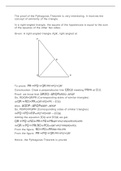
Given: A right-angled triangle PQR, right angled at
P
D
Q R
To prove: PR =PQ +QR PR2=PQ2+QR2
2 2 2
Construction: Draw a perpendicular line QDQD meeting PRPR at D.D.
Proof: we know that ΔRDQ∼ΔRQPΔRDQ∼ΔRQP
So, RD/QR=QR/PR (Corresponding sides of similar triangles)
⇒QR =RD×PR⇒QR2=RD×PR — (i)(i)
2
Also, ΔQDP∼ΔRQPΔQDP∼ΔRQP
So, PD/PQ=PQ/PR (Corresponding sides of similar triangles)
⇒PQ =PD×RP⇒PQ2=PD×RP — (ii)(ii)
2
Adding the equation (i)(i) and (ii)(ii) we get,
QR +PQ =RD×PR+PD×PRQR2+PQ2=RD×PR+PD×PR
2 2
⇒QR +PQ =PR(RD+PD)⇒QR2+PQ2=PR(RD+PD)
2 2
From the figure, RD+PD=PRRD+PD=PR
From the figure, PR =PQ +QR PR2=PQ2+QR2
2 2 2
Hence, the Pythagoras Theorem is proved
concept of similarity of the triangle.
In a right-angled triangle, the square of the hypotenuse is equal to the sum
of the squares of the other two sides.
Given: A right-angled triangle PQR, right angled at
P
D
Q R
To prove: PR =PQ +QR PR2=PQ2+QR2
2 2 2
Construction: Draw a perpendicular line QDQD meeting PRPR at D.D.
Proof: we know that ΔRDQ∼ΔRQPΔRDQ∼ΔRQP
So, RD/QR=QR/PR (Corresponding sides of similar triangles)
⇒QR =RD×PR⇒QR2=RD×PR — (i)(i)
2
Also, ΔQDP∼ΔRQPΔQDP∼ΔRQP
So, PD/PQ=PQ/PR (Corresponding sides of similar triangles)
⇒PQ =PD×RP⇒PQ2=PD×RP — (ii)(ii)
2
Adding the equation (i)(i) and (ii)(ii) we get,
QR +PQ =RD×PR+PD×PRQR2+PQ2=RD×PR+PD×PR
2 2
⇒QR +PQ =PR(RD+PD)⇒QR2+PQ2=PR(RD+PD)
2 2
From the figure, RD+PD=PRRD+PD=PR
From the figure, PR =PQ +QR PR2=PQ2+QR2
2 2 2
Hence, the Pythagoras Theorem is proved

