

Coordinate Geometry : Practice Exams
Q.1. Find a relation between x and y such that the point (x, y) is equidistant
from the points (7, 1) and (3, 5).
Solution:
Let P(x, y) be equidistant from the points A(7, 1) and B(3, 5).
Then, AP = BP
AP2 = BP2
Using distance formula,
(x – 7)2 + (y – 1)2 = (x – 3)2 + (y – 5)2
x2 – 14x + 49 + y2 – 2y + 1 = x2 – 6x + 9 + y2 – 10y + 25
x–y=2
Hence, the relation between x and y is x – y = 2.
Q.2. Line L is perpendicular to line K whose equation is 3y = 4x + 12; Lines L
and K intersect at (p, q). Is p + q > 0?
1. x intercept of Line L is less than that of Line K
2. y intercept of Line L is less than that of Line K
Solution:
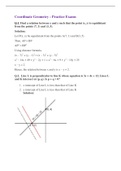
, The red line represents the scenario where lines L and K, both have the same
x - intercept i.e., (-3, 0)
However, as per statement 1, the x intercept of line L is less than that of line
K.
So, the dotted line represents line L. If the x intercept of line L is less than
that of line K, the point of intersection of the two lines will be further to the
left of (-3, 0).
It is quite evident from the diagram that the two lines will therefore, intersect
in the III quadrant.
Any point in the III quadrant will have negative x and y values.
Therefore, p + q < 0.
Hence, statement 1 alone is sufficient.
Q.3. Set S contains points whose abscissa and ordinate are both natural numbers.
Point P, an element in set S has the property that the sum of the distances from
point P to the point (8, 0) and the point (0, 12) is the lowest among all elements in
set S. How many such points P exist in set S?
Solution:
The sum of the distances from point P to the other two points will be at its lowest
only when point P lies on the line segment joining the points (8, 0) and (0, 12).
(8, 0) and (0, 12) are the coordinates of the x and y intercepts of the line
respectively.
So, the equation of the line segment joining the points (8, 0) and (0, 12)
is x/8 + y/12 = 1
Or the equation of the line is 12x + 8y = 96 or 3x + 2y = 24.
The question states that the elements of set S contain points whose abscissa and
ordinate are both natural numbers. i.e., their x and y coordinates are both positive
integers.
The equation of the line is 3x + 2y = 24. Positive integer values that satisfy the
equation will be such that their 'x' values will be even and their 'y' values will be
multiples of 3.
The values are
1. x = 2, y = 9
2. x = 4, y = 6
Q.1. Find a relation between x and y such that the point (x, y) is equidistant
from the points (7, 1) and (3, 5).
Solution:
Let P(x, y) be equidistant from the points A(7, 1) and B(3, 5).
Then, AP = BP
AP2 = BP2
Using distance formula,
(x – 7)2 + (y – 1)2 = (x – 3)2 + (y – 5)2
x2 – 14x + 49 + y2 – 2y + 1 = x2 – 6x + 9 + y2 – 10y + 25
x–y=2
Hence, the relation between x and y is x – y = 2.
Q.2. Line L is perpendicular to line K whose equation is 3y = 4x + 12; Lines L
and K intersect at (p, q). Is p + q > 0?
1. x intercept of Line L is less than that of Line K
2. y intercept of Line L is less than that of Line K
Solution:
, The red line represents the scenario where lines L and K, both have the same
x - intercept i.e., (-3, 0)
However, as per statement 1, the x intercept of line L is less than that of line
K.
So, the dotted line represents line L. If the x intercept of line L is less than
that of line K, the point of intersection of the two lines will be further to the
left of (-3, 0).
It is quite evident from the diagram that the two lines will therefore, intersect
in the III quadrant.
Any point in the III quadrant will have negative x and y values.
Therefore, p + q < 0.
Hence, statement 1 alone is sufficient.
Q.3. Set S contains points whose abscissa and ordinate are both natural numbers.
Point P, an element in set S has the property that the sum of the distances from
point P to the point (8, 0) and the point (0, 12) is the lowest among all elements in
set S. How many such points P exist in set S?
Solution:
The sum of the distances from point P to the other two points will be at its lowest
only when point P lies on the line segment joining the points (8, 0) and (0, 12).
(8, 0) and (0, 12) are the coordinates of the x and y intercepts of the line
respectively.
So, the equation of the line segment joining the points (8, 0) and (0, 12)
is x/8 + y/12 = 1
Or the equation of the line is 12x + 8y = 96 or 3x + 2y = 24.
The question states that the elements of set S contain points whose abscissa and
ordinate are both natural numbers. i.e., their x and y coordinates are both positive
integers.
The equation of the line is 3x + 2y = 24. Positive integer values that satisfy the
equation will be such that their 'x' values will be even and their 'y' values will be
multiples of 3.
The values are
1. x = 2, y = 9
2. x = 4, y = 6


