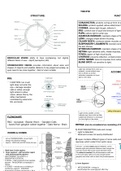
THE EYE
STRUCTURE: FUNCT
CONJUNCTIVA: protects cornea at front of e
SCLERA: protects eyeball, allows attachment
CORNEA: allows light trough, refracts it,
IRIS: controls size of pupil and amount of light
PUPIL: allows light to enter eye,
AQUEOUS HUMOUR: maintains shape of fro
LENS: changes shape allows focusing,
CILIARY BODY: contracts relaxes muscles co
SUSPENSORY LIGAMENTS: transfers tens
the lens thinner,
VITREOUS HUMOUR: maintains shape of re
RETINA: light sensitive cells, initiate impulses,
FOVEA: region of high visual acuity,
BINOCULAR VISION: ability to have overlapping, but slightly CHOROID: prevents re ection, contains blood
di erent elds of view - depth perception (3D) OPTIC NERVE: transmit impulses from retina
BLIND SPOT: not sensitive to light,
STEREOSCOPIC VISION: provides information about sizes and
shapes of objects and enables distance to be judged accurately, as
Light rays diverge from close up
eyes need to be close together - eld of vision smaller subjects, cornea refracts rays,
lens is thicker as further
ACCOMO
refraction necessary to focus
light on the retina
IRIS:
- FUNCTION: too much
light does not enter the
eye = damage receptor
cells in retina, enough
light enters to allow
vision, allows this by the
re ex mechanism
controlled by autonomic
NS. and brain.
Light arrives parallel, cornea
refracts rays, lens is thin as little
FLOWCHART: additional refraction is necessary
to focus light on the retina.
R&C - (synapse) - Bipolar Vision - Ganglion Cells
- Axons from ganglion collect together - Optic Nerve - Brain RETINA: (can be considered as consisting of 2
1) PHOTORECEPTOR (rods and cones):
RODES & CONES:
- Light is detected,
- Rods and cones not evenly distributed
- Act as TRANSDUCERS, convert light
2) Layer contains di erent types of nerve cells and
energy into electrical energy,
- Approx. 120M rods and 6M cones per eye, neurones which collect from optic nerve.
Choroid - contains black pigment Melanin, which
absorbs light and prevents re ection back trough the
- Both have 3 main regions: rods and cones that would cause distorted vision.
1. Outer segment - light sensitive region The retina is inverted, the photoreceptors cells are
with photoreceptive pigment. in the outer layer, light as to pass trough bipolar
- LIGHT ENERGY converted to a ganglion and other cells to reach the photoreceptors.
GENERATOR POTENTIAL,
- In RODS = 1000 membrane lined vesicles,
pigment - RHODOPSIN is embedded in 2. Inner Segment
vesicle,
- In CONES = vesicles are on infolding of - MITOCHONDRIA = energy to
membrane, pigment - IODOPSIN resynthesises the visual pigment after they
-
STRUCTURE: FUNCT
CONJUNCTIVA: protects cornea at front of e
SCLERA: protects eyeball, allows attachment
CORNEA: allows light trough, refracts it,
IRIS: controls size of pupil and amount of light
PUPIL: allows light to enter eye,
AQUEOUS HUMOUR: maintains shape of fro
LENS: changes shape allows focusing,
CILIARY BODY: contracts relaxes muscles co
SUSPENSORY LIGAMENTS: transfers tens
the lens thinner,
VITREOUS HUMOUR: maintains shape of re
RETINA: light sensitive cells, initiate impulses,
FOVEA: region of high visual acuity,
BINOCULAR VISION: ability to have overlapping, but slightly CHOROID: prevents re ection, contains blood
di erent elds of view - depth perception (3D) OPTIC NERVE: transmit impulses from retina
BLIND SPOT: not sensitive to light,
STEREOSCOPIC VISION: provides information about sizes and
shapes of objects and enables distance to be judged accurately, as
Light rays diverge from close up
eyes need to be close together - eld of vision smaller subjects, cornea refracts rays,
lens is thicker as further
ACCOMO
refraction necessary to focus
light on the retina
IRIS:
- FUNCTION: too much
light does not enter the
eye = damage receptor
cells in retina, enough
light enters to allow
vision, allows this by the
re ex mechanism
controlled by autonomic
NS. and brain.
Light arrives parallel, cornea
refracts rays, lens is thin as little
FLOWCHART: additional refraction is necessary
to focus light on the retina.
R&C - (synapse) - Bipolar Vision - Ganglion Cells
- Axons from ganglion collect together - Optic Nerve - Brain RETINA: (can be considered as consisting of 2
1) PHOTORECEPTOR (rods and cones):
RODES & CONES:
- Light is detected,
- Rods and cones not evenly distributed
- Act as TRANSDUCERS, convert light
2) Layer contains di erent types of nerve cells and
energy into electrical energy,
- Approx. 120M rods and 6M cones per eye, neurones which collect from optic nerve.
Choroid - contains black pigment Melanin, which
absorbs light and prevents re ection back trough the
- Both have 3 main regions: rods and cones that would cause distorted vision.
1. Outer segment - light sensitive region The retina is inverted, the photoreceptors cells are
with photoreceptive pigment. in the outer layer, light as to pass trough bipolar
- LIGHT ENERGY converted to a ganglion and other cells to reach the photoreceptors.
GENERATOR POTENTIAL,
- In RODS = 1000 membrane lined vesicles,
pigment - RHODOPSIN is embedded in 2. Inner Segment
vesicle,
- In CONES = vesicles are on infolding of - MITOCHONDRIA = energy to
membrane, pigment - IODOPSIN resynthesises the visual pigment after they
-