Grade 11 Trigonometric Functions
Document 6: Graph interpretation
Worked Example 1:
3
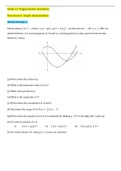
The functions 𝑓(𝑥) = −2 sin(𝑥 + 𝑝) and 𝑔(𝑥) = cos 2 𝑥 for the interval − 30° ≤ 𝑥 ≤ 180° are
sketched below. 𝐴 is a turning point of 𝑓 and 𝐵 is a turning point of 𝑔 and a point of intersection
between 𝑓 and 𝑔.
(a) Write down the value of 𝑝.
(b) What is the minimum value of 𝑓(𝑥)?
(c) What is the period of 𝑔?
(d) What is the amplitude of 𝑓?
(e) Write down the coordinates of 𝐴 and 𝐵.
1
(f) Determine the range of ℎ if ℎ(𝑥) = 2 𝑓(𝑥) − 1?
(g) Write down the equation of 𝑚 if 𝑚 is obtained by shifting 𝑔 15° to the right and 2 units up.
(h) For which value(s) of 𝑥 is
i) 𝑓(𝑥) = 𝑔((𝑥) ? ii) 𝑓(𝑥) > 𝑔((𝑥) ? iii) 𝑓(𝑥). 𝑔((𝑥) ≤ 0 ?
(i) For which values of 𝑘 will 𝑔(𝑥) = 𝑘 have one solution?
Document 6: Graph interpretation
Worked Example 1:
3
The functions 𝑓(𝑥) = −2 sin(𝑥 + 𝑝) and 𝑔(𝑥) = cos 2 𝑥 for the interval − 30° ≤ 𝑥 ≤ 180° are
sketched below. 𝐴 is a turning point of 𝑓 and 𝐵 is a turning point of 𝑔 and a point of intersection
between 𝑓 and 𝑔.
(a) Write down the value of 𝑝.
(b) What is the minimum value of 𝑓(𝑥)?
(c) What is the period of 𝑔?
(d) What is the amplitude of 𝑓?
(e) Write down the coordinates of 𝐴 and 𝐵.
1
(f) Determine the range of ℎ if ℎ(𝑥) = 2 𝑓(𝑥) − 1?
(g) Write down the equation of 𝑚 if 𝑚 is obtained by shifting 𝑔 15° to the right and 2 units up.
(h) For which value(s) of 𝑥 is
i) 𝑓(𝑥) = 𝑔((𝑥) ? ii) 𝑓(𝑥) > 𝑔((𝑥) ? iii) 𝑓(𝑥). 𝑔((𝑥) ≤ 0 ?
(i) For which values of 𝑘 will 𝑔(𝑥) = 𝑘 have one solution?