Partim mycology
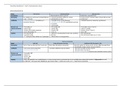
Bacteria Fungi
Size 0,1 – 10 µ >1 - >>10µ
Cell type Prokaryote Eukaryote
Plasmids Yes No
Chromosomes (#) One More
Spores Endospores Sexual and Asexual
Cytoplasmic organelles None ER, golgi, mitochondria
Cytoplasmic membrane No sterols Sterols
Cell membrane Complex: peptidoglycans etc Simple: chitin, glucan, mannan
- Filamentous: hyphae have apical growth and can form a network, mycelium
- Some are unicellular: yeasts (non-filamentous)
- Rigid wall: primarily chitin & glucans, sometimes cellulose
- Achlorophyllous: not capable of photosynthesis
- Chemoheterotrophic: nutrients are collected from outside
- May be free-living or in intimate relationships with other organisms
General structure of fungi and yeast
Fungi
Aspergillus niger (black): hyphae, black spores. The colour is used for
speciation.
- Vegetative hyphae: feeding (grow into the agar)
- Aerial hyphae: reproduction
The mycelium contains the hyphae. These can be multi-nucleated,
and segmented or non-segmented.
Yeasts
These are unicellular and non-filamentous (diameter 3-15 µ). They can grow in aerobe
conditions but are also facultative anaerobe.
- Fission: yeasts divide symmetrically
- Budding: yeasts divide asymmetrically (eg. candida albicans)
o Budding scar where the budding has happened
o If they don’t separate: pseudohyphae
o Bud = blastospore
Dimorphic fungi
Can grow both as fungus or yeast, depending on environmental factors (temp, CO 2, nutrients).
Pathogenicity can be different, for example the yeast can be pathogenic while the fungus is not.
- Termal dimorphism: eg. Histoplasma & Coccidioides immitis
, Subcellular structure
Outside to inside
Capsule (sometimes): consists of polysaccharides
o Virulence factor: not recognized by phagocyting cells
Cell wall
Cell membrane
Cytoplasm: nucleus, nuclear membrane, ER, mitochondria, vacuoles…
Antifungals mainly focus on the cell wall and the phospholipid bilayer cell membrane. The cell wall
consists of mannoproteins, glucans and chitin. The cell membrane does not contain cholesterol but
ergosterol which is the result of the ergosterol synthesis pathway which starts with squalene.
The type and relative composition of chitin and glucan are dependent on the fungal species. They all
contain these elements so most anti-fungals have a broad spectrum, but in different ways.
Life cycle
Asexual reproduction: hyphae prod. conidiophores. Conidia
are released from the conidiophore from which vegetative
mycelium grows.
Sexual reproduction: a mycelium has haploid nuclei, and 2
nuclei come together: karyogamy. Then first meiosis, then
mitosis.
Some fungi have a sexual reproduction but most happens as
asexual multiplication.
Filamentous fungi:
- Asexual by fragmentation of hyphae
Fungal spores of aerial hyphae: don’t know terminology by heart
- Asexual spores
o Conidiospore: unicellular/multicellular spore, not packed in a sac (eg Aspergillus spp.)
o Chlamydospore: thick walled spore formed in hyphal segment (eg C. albicans)
o Sporangiospore: asexual spore in sac (sporangium) (eg Rhizopus)
o Macro- & microconidia: typical for dermatophytes
- Sexual spores
o Formed by fusion of nuclei of different haploid gametes
Conidiospore: Pseudohyphae: Blastoconidia/blastospores:
Chlamydospores: Sporangiospores:
Key for identification but
rather difficult, real expert
work.
Bacteria Fungi
Size 0,1 – 10 µ >1 - >>10µ
Cell type Prokaryote Eukaryote
Plasmids Yes No
Chromosomes (#) One More
Spores Endospores Sexual and Asexual
Cytoplasmic organelles None ER, golgi, mitochondria
Cytoplasmic membrane No sterols Sterols
Cell membrane Complex: peptidoglycans etc Simple: chitin, glucan, mannan
- Filamentous: hyphae have apical growth and can form a network, mycelium
- Some are unicellular: yeasts (non-filamentous)
- Rigid wall: primarily chitin & glucans, sometimes cellulose
- Achlorophyllous: not capable of photosynthesis
- Chemoheterotrophic: nutrients are collected from outside
- May be free-living or in intimate relationships with other organisms
General structure of fungi and yeast
Fungi
Aspergillus niger (black): hyphae, black spores. The colour is used for
speciation.
- Vegetative hyphae: feeding (grow into the agar)
- Aerial hyphae: reproduction
The mycelium contains the hyphae. These can be multi-nucleated,
and segmented or non-segmented.
Yeasts
These are unicellular and non-filamentous (diameter 3-15 µ). They can grow in aerobe
conditions but are also facultative anaerobe.
- Fission: yeasts divide symmetrically
- Budding: yeasts divide asymmetrically (eg. candida albicans)
o Budding scar where the budding has happened
o If they don’t separate: pseudohyphae
o Bud = blastospore
Dimorphic fungi
Can grow both as fungus or yeast, depending on environmental factors (temp, CO 2, nutrients).
Pathogenicity can be different, for example the yeast can be pathogenic while the fungus is not.
- Termal dimorphism: eg. Histoplasma & Coccidioides immitis
, Subcellular structure
Outside to inside
Capsule (sometimes): consists of polysaccharides
o Virulence factor: not recognized by phagocyting cells
Cell wall
Cell membrane
Cytoplasm: nucleus, nuclear membrane, ER, mitochondria, vacuoles…
Antifungals mainly focus on the cell wall and the phospholipid bilayer cell membrane. The cell wall
consists of mannoproteins, glucans and chitin. The cell membrane does not contain cholesterol but
ergosterol which is the result of the ergosterol synthesis pathway which starts with squalene.
The type and relative composition of chitin and glucan are dependent on the fungal species. They all
contain these elements so most anti-fungals have a broad spectrum, but in different ways.
Life cycle
Asexual reproduction: hyphae prod. conidiophores. Conidia
are released from the conidiophore from which vegetative
mycelium grows.
Sexual reproduction: a mycelium has haploid nuclei, and 2
nuclei come together: karyogamy. Then first meiosis, then
mitosis.
Some fungi have a sexual reproduction but most happens as
asexual multiplication.
Filamentous fungi:
- Asexual by fragmentation of hyphae
Fungal spores of aerial hyphae: don’t know terminology by heart
- Asexual spores
o Conidiospore: unicellular/multicellular spore, not packed in a sac (eg Aspergillus spp.)
o Chlamydospore: thick walled spore formed in hyphal segment (eg C. albicans)
o Sporangiospore: asexual spore in sac (sporangium) (eg Rhizopus)
o Macro- & microconidia: typical for dermatophytes
- Sexual spores
o Formed by fusion of nuclei of different haploid gametes
Conidiospore: Pseudohyphae: Blastoconidia/blastospores:
Chlamydospores: Sporangiospores:
Key for identification but
rather difficult, real expert
work.