

Development economics
Definitions
- Economic growth is the increase in real national income in a country over a period
of time.
- Economic development refers to a multi-dimensional process involving
improvements in living standards manifested in terms of higher income per head,
lower poverty, increased employment opportunities, lower income in equality, better
education and healthcare, a better environment and empowerment of people.
- Sustainable development refers to the development which meets the needs of the
present without compromising the ability of future generations to meet their own
needs.
- Absolute poverty occurs when people live below a certain level of income that is
necessary to purchase items such as basic clothing, food and shelter.
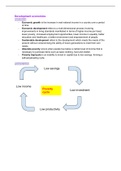
- Poverty trap/cycle is an inability to invest in capital due to low savings, forming a
self-perpetuating cycle.
Poverty cycle
Low savings
Low income
Poverty Low investment
cycle
Low productivity
, Measuring development
GDP per capita
The output produced per person within the geographical boundary in a country, regardless of
ownership of resources.
GNI per capita
The income received by a resident of the country, regardless of where the resources are
located.
GNI = GDP + Income paid abroad - income received from abroad
Comparing GDP and GNI per capita, GNI per capita is a better indicator of the material
standard of living of a country because it represents income per person received by the
residents. GDP per capita is a better indicator of output level per person produced in a
country.
Using common currency may be misleading due to different price levels in a country. For a
more meaningful comparison between countries, PPP exchange rate should be used
instead of the standard exchange rate.
PPP exchange rate measures the quantity of goods an individual can buy in their
respective country with their income.
PPP exchange rate = (cost of living in A) / (cost of living in B)
Health indicators
Health indicators include life expectancy at birth, infant mortality index and maternal mortality
rate.
Education indicators
Education indicators include adult literacy rates, primary school enrollment and secondary
school enrolment.
Health and education indicators are usually influenced by level of income as well as
government intervention and provision.
Human development Index (HDI)
A composite index which measures:
- Life expectancy at birth
- Mean and expected years of schooling
- GNI per capita (using PPP)
HDI ranges from a value of 0 to 1:
(according to the United Nation)
- 0-0.5 low human development countries
- 0.5-0.8 medium human development countries
- 0.8-1 high human development countries
Definitions
- Economic growth is the increase in real national income in a country over a period
of time.
- Economic development refers to a multi-dimensional process involving
improvements in living standards manifested in terms of higher income per head,
lower poverty, increased employment opportunities, lower income in equality, better
education and healthcare, a better environment and empowerment of people.
- Sustainable development refers to the development which meets the needs of the
present without compromising the ability of future generations to meet their own
needs.
- Absolute poverty occurs when people live below a certain level of income that is
necessary to purchase items such as basic clothing, food and shelter.
- Poverty trap/cycle is an inability to invest in capital due to low savings, forming a
self-perpetuating cycle.
Poverty cycle
Low savings
Low income
Poverty Low investment
cycle
Low productivity
, Measuring development
GDP per capita
The output produced per person within the geographical boundary in a country, regardless of
ownership of resources.
GNI per capita
The income received by a resident of the country, regardless of where the resources are
located.
GNI = GDP + Income paid abroad - income received from abroad
Comparing GDP and GNI per capita, GNI per capita is a better indicator of the material
standard of living of a country because it represents income per person received by the
residents. GDP per capita is a better indicator of output level per person produced in a
country.
Using common currency may be misleading due to different price levels in a country. For a
more meaningful comparison between countries, PPP exchange rate should be used
instead of the standard exchange rate.
PPP exchange rate measures the quantity of goods an individual can buy in their
respective country with their income.
PPP exchange rate = (cost of living in A) / (cost of living in B)
Health indicators
Health indicators include life expectancy at birth, infant mortality index and maternal mortality
rate.
Education indicators
Education indicators include adult literacy rates, primary school enrollment and secondary
school enrolment.
Health and education indicators are usually influenced by level of income as well as
government intervention and provision.
Human development Index (HDI)
A composite index which measures:
- Life expectancy at birth
- Mean and expected years of schooling
- GNI per capita (using PPP)
HDI ranges from a value of 0 to 1:
(according to the United Nation)
- 0-0.5 low human development countries
- 0.5-0.8 medium human development countries
- 0.8-1 high human development countries


