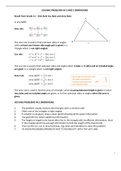
SOLVING PROBLEMS IN 2 AND 3 DIMENSIONS
Recall from Grade 11 – Sine Rule Cos Rule and Area Rule:
A
In any ΔABC
𝑠𝑖𝑛 𝐴 𝑠𝑖𝑛 𝐵 𝑠𝑖𝑛 𝐶
Sine rule: = = c b
𝑎 𝑏 𝑐
𝑎 𝑏 𝑐
= 𝑠𝑖𝑛 𝐵 = 𝑠𝑖𝑛 𝐶
𝑠𝑖𝑛 𝐴
The sine rule is used to find unknown sides or angles B C
a
when at least one known side-angle pair is given in a
triangle which is not right-angled.
Cos rule: 𝑎2 = 𝑏 2 + 𝑐 2 − 2𝑏𝑐 𝑐𝑜𝑠 𝐴
𝑏 2 = 𝑎2 + 𝑐 2 − 2𝑎𝑐 𝑐𝑜𝑠 𝐵
𝑐 2 = 𝑎2 + 𝑏 2 − 2𝑎𝑏 𝑐𝑜𝑠 𝐶
The cos rule is used to find unknown sides and angles when 3 sides or 2 sides and an included angle
are given in a triangle which is not right-angled.
1
Area rule: area Δ𝐴𝐵𝐶 = 2 𝑎𝑏 𝑠𝑖𝑛 𝐶 Remember for the area rule
1
area Δ𝐴𝐵𝐶 = 2 𝑏𝑐 𝑠𝑖𝑛 𝐴 the angle concerned is
1 included (between) the
area Δ𝐴𝐵𝐶 = 2 𝑎𝑐 𝑠𝑖𝑛 𝐵 two adjacent sides.
The area rule is used to find the area of a triangle, when no perpendicular height is given or when
two sides and an included angle are given, or to find unknown sides or angles when the area is
given.
SOLVING PROBLEMS IN 2 DIMENSIONS:
1. The problem usually involves two triangles with a common side.
2. Often one of the triangles is right-angled.
3. If a sketch is not given, draw a clear sketch showing all the given information.
4. Use geometry to obtain additional information.
5. The height or length to be found often lies in the triangle with insufficient information. Start
in the triangle which has enough information to find the length of the shared side.
6. Then use the sin, cos or area formulae, trig ratios and identities to solve the problem.
7. TO AVOID ROUNDING ERRORS DO NOT TO ROUND OFF UNTIL THE LAST LINE.
1
, e.g.1. Determine PR P
Solution: 1 2
̂
P1 = 28° (ext. ∠ of ∆PQS)
PS 10
= sin 28° 40° 68°
sin 40° R
Q
10 sin 40° 10 S
PS = sin 28°
PS = 13,69 … units store without rounding in your calculator or leave out this line
PR
= sin 68° Alternative method:
PS
Do not work out PS above,
PR = (13,69 … )( sin 68°) using stored value of PS or substitute in the PS formula, so
𝑃𝑅 = 𝑃𝑆. 𝑠𝑖𝑛 68° becomes
PR = 12,69 units 𝑃𝑅 =
10 𝑠𝑖𝑛 40°
. 𝑠𝑖𝑛 68°
𝑠𝑖𝑛 28°
𝑃𝑅 = 12,69 𝑢𝑛𝑖𝑡𝑠
(this means that you do not store
values and round only once at the
end!)
e.g.2. Prove that in quadrilateral PQRS
P
𝑑.sin(𝑥+𝑦).cos θ
PS = sin 𝑥
Solution:
In ∆QRS
Q x S
̂ = 180° − (𝑥 + 𝑦) y
R (∠ sum in ∆)
QS 𝑑 d
= sin 𝑥 sine rule
sin(180°−(𝑥+𝑦))
QS 𝑑 R
= sin 𝑥 180°rule (note we want sin(𝑥 + 𝑦) in the answer so leave as 180 −( )
sin(𝑥+𝑦)
don’t multiply out!)
𝑑.sin(𝑥+𝑦)
QS = rearrange
sin 𝑥
In ∆PQS
PS
cos θ = QS remember ∆𝑃𝑄𝑆 is right-angled so the sine rule is not necessary
PS = QS. cos θ rearrange
𝑑.sin(𝑥+𝑦).cos θ
PS = only now sub in QS from above
sin 𝑥
Do:
Pg 154 Ex 6.1 #1a and 2
Heights and Distances - Worksheet 1 #2
2
Recall from Grade 11 – Sine Rule Cos Rule and Area Rule:
A
In any ΔABC
𝑠𝑖𝑛 𝐴 𝑠𝑖𝑛 𝐵 𝑠𝑖𝑛 𝐶
Sine rule: = = c b
𝑎 𝑏 𝑐
𝑎 𝑏 𝑐
= 𝑠𝑖𝑛 𝐵 = 𝑠𝑖𝑛 𝐶
𝑠𝑖𝑛 𝐴
The sine rule is used to find unknown sides or angles B C
a
when at least one known side-angle pair is given in a
triangle which is not right-angled.
Cos rule: 𝑎2 = 𝑏 2 + 𝑐 2 − 2𝑏𝑐 𝑐𝑜𝑠 𝐴
𝑏 2 = 𝑎2 + 𝑐 2 − 2𝑎𝑐 𝑐𝑜𝑠 𝐵
𝑐 2 = 𝑎2 + 𝑏 2 − 2𝑎𝑏 𝑐𝑜𝑠 𝐶
The cos rule is used to find unknown sides and angles when 3 sides or 2 sides and an included angle
are given in a triangle which is not right-angled.
1
Area rule: area Δ𝐴𝐵𝐶 = 2 𝑎𝑏 𝑠𝑖𝑛 𝐶 Remember for the area rule
1
area Δ𝐴𝐵𝐶 = 2 𝑏𝑐 𝑠𝑖𝑛 𝐴 the angle concerned is
1 included (between) the
area Δ𝐴𝐵𝐶 = 2 𝑎𝑐 𝑠𝑖𝑛 𝐵 two adjacent sides.
The area rule is used to find the area of a triangle, when no perpendicular height is given or when
two sides and an included angle are given, or to find unknown sides or angles when the area is
given.
SOLVING PROBLEMS IN 2 DIMENSIONS:
1. The problem usually involves two triangles with a common side.
2. Often one of the triangles is right-angled.
3. If a sketch is not given, draw a clear sketch showing all the given information.
4. Use geometry to obtain additional information.
5. The height or length to be found often lies in the triangle with insufficient information. Start
in the triangle which has enough information to find the length of the shared side.
6. Then use the sin, cos or area formulae, trig ratios and identities to solve the problem.
7. TO AVOID ROUNDING ERRORS DO NOT TO ROUND OFF UNTIL THE LAST LINE.
1
, e.g.1. Determine PR P
Solution: 1 2
̂
P1 = 28° (ext. ∠ of ∆PQS)
PS 10
= sin 28° 40° 68°
sin 40° R
Q
10 sin 40° 10 S
PS = sin 28°
PS = 13,69 … units store without rounding in your calculator or leave out this line
PR
= sin 68° Alternative method:
PS
Do not work out PS above,
PR = (13,69 … )( sin 68°) using stored value of PS or substitute in the PS formula, so
𝑃𝑅 = 𝑃𝑆. 𝑠𝑖𝑛 68° becomes
PR = 12,69 units 𝑃𝑅 =
10 𝑠𝑖𝑛 40°
. 𝑠𝑖𝑛 68°
𝑠𝑖𝑛 28°
𝑃𝑅 = 12,69 𝑢𝑛𝑖𝑡𝑠
(this means that you do not store
values and round only once at the
end!)
e.g.2. Prove that in quadrilateral PQRS
P
𝑑.sin(𝑥+𝑦).cos θ
PS = sin 𝑥
Solution:
In ∆QRS
Q x S
̂ = 180° − (𝑥 + 𝑦) y
R (∠ sum in ∆)
QS 𝑑 d
= sin 𝑥 sine rule
sin(180°−(𝑥+𝑦))
QS 𝑑 R
= sin 𝑥 180°rule (note we want sin(𝑥 + 𝑦) in the answer so leave as 180 −( )
sin(𝑥+𝑦)
don’t multiply out!)
𝑑.sin(𝑥+𝑦)
QS = rearrange
sin 𝑥
In ∆PQS
PS
cos θ = QS remember ∆𝑃𝑄𝑆 is right-angled so the sine rule is not necessary
PS = QS. cos θ rearrange
𝑑.sin(𝑥+𝑦).cos θ
PS = only now sub in QS from above
sin 𝑥
Do:
Pg 154 Ex 6.1 #1a and 2
Heights and Distances - Worksheet 1 #2
2