
New Grade 12 Stuff:
COMPOUND-ANGLE IDENTITIES
There are 4 new identities called the compound angle identities:
𝐜𝐨𝐬( 𝐀 − 𝐁) = 𝐜𝐨𝐬 𝐀 𝐜𝐨𝐬 𝐁 + 𝐬𝐢𝐧 𝐀 𝐬𝐢𝐧 𝐁
These are on the
𝐜𝐨𝐬( 𝐀 + 𝐁) = 𝐜𝐨𝐬 𝐀 𝐜𝐨𝐬 𝐁 − 𝐬𝐢𝐧 𝐀 𝐬𝐢𝐧 𝐁 formula sheet.
𝐬𝐢𝐧( 𝐀 − 𝐁) = 𝐬𝐢𝐧 𝐀 𝐜𝐨𝐬 𝐁 − 𝐜𝐨𝐬 𝐀 𝐬𝐢𝐧 𝐁 𝑥
cos 𝐴 =
1
𝐬𝐢𝐧( 𝐀 + 𝐁) = 𝐬𝐢𝐧 𝐀 𝐜𝐨𝐬 𝐁 + 𝐜𝐨𝐬 𝐀 𝐬𝐢𝐧 𝐁 ∴ 𝑥 = 𝑐𝑜𝑠𝐴
𝑦
sin 𝐴 =
1
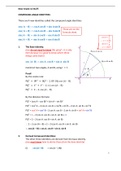
1. The Base Identity: Y ∴ 𝑦 = sin 𝐴
(you do not need to know this proof – it is only
P(cos A; sin A)
here because it is good to know where these
things come from!)
𝐜𝐨𝐬 (𝐀– 𝐁) = 𝐜𝐨𝐬 𝐀 . 𝐜𝐨𝐬 𝐁 + 𝐬𝐢𝐧 𝐀 . 𝐬𝐢𝐧 𝐁 1
Q(cos B; sin B)
Construct two angles, A and B, using 𝑟 = 1 (A - B)
1
Proof: A B
By the cosine rule:
O X
PQ2 = OP 2 + OQ2 – 2. OP. OQ. cos (A – B)
PQ2 = 12 + 12 – 2.1.1. cos (A – B)
PQ2 = 2 – 2. cos (A – B)
By the distance formula:
PQ2 = (cos A – cos B)2 + (sin A – sin B)2
PQ2 = cos2 A – 2.cos A. cos B + cos2B + sin2A – 2.sin A. sin B + sin2 B
PQ2 = cos2 A + cos2 B – 2.cos A. cos B – 2.sin A. sin B + sin2 A + sin2 B
PQ2 = 1 – 2 (cos A. cos B + sin A. sin B) + 1
PQ2 = 2 – 2 (cos A. cos B + sin A. sin B)
2 – 2.cos (A – B) = 2 – 2 (cos A. cos B + sin A. sin B)
cos (A – B) = cos A. cos B + sin A. sin B
2. Derived Compound Identities:
The other three identities are derived from the base identity.
(you must know how to derive these from the base identity)
(i) cos (A + B) = cos (A – (-B))
1
COMPOUND-ANGLE IDENTITIES
There are 4 new identities called the compound angle identities:
𝐜𝐨𝐬( 𝐀 − 𝐁) = 𝐜𝐨𝐬 𝐀 𝐜𝐨𝐬 𝐁 + 𝐬𝐢𝐧 𝐀 𝐬𝐢𝐧 𝐁
These are on the
𝐜𝐨𝐬( 𝐀 + 𝐁) = 𝐜𝐨𝐬 𝐀 𝐜𝐨𝐬 𝐁 − 𝐬𝐢𝐧 𝐀 𝐬𝐢𝐧 𝐁 formula sheet.
𝐬𝐢𝐧( 𝐀 − 𝐁) = 𝐬𝐢𝐧 𝐀 𝐜𝐨𝐬 𝐁 − 𝐜𝐨𝐬 𝐀 𝐬𝐢𝐧 𝐁 𝑥
cos 𝐴 =
1
𝐬𝐢𝐧( 𝐀 + 𝐁) = 𝐬𝐢𝐧 𝐀 𝐜𝐨𝐬 𝐁 + 𝐜𝐨𝐬 𝐀 𝐬𝐢𝐧 𝐁 ∴ 𝑥 = 𝑐𝑜𝑠𝐴
𝑦
sin 𝐴 =
1
1. The Base Identity: Y ∴ 𝑦 = sin 𝐴
(you do not need to know this proof – it is only
P(cos A; sin A)
here because it is good to know where these
things come from!)
𝐜𝐨𝐬 (𝐀– 𝐁) = 𝐜𝐨𝐬 𝐀 . 𝐜𝐨𝐬 𝐁 + 𝐬𝐢𝐧 𝐀 . 𝐬𝐢𝐧 𝐁 1
Q(cos B; sin B)
Construct two angles, A and B, using 𝑟 = 1 (A - B)
1
Proof: A B
By the cosine rule:
O X
PQ2 = OP 2 + OQ2 – 2. OP. OQ. cos (A – B)
PQ2 = 12 + 12 – 2.1.1. cos (A – B)
PQ2 = 2 – 2. cos (A – B)
By the distance formula:
PQ2 = (cos A – cos B)2 + (sin A – sin B)2
PQ2 = cos2 A – 2.cos A. cos B + cos2B + sin2A – 2.sin A. sin B + sin2 B
PQ2 = cos2 A + cos2 B – 2.cos A. cos B – 2.sin A. sin B + sin2 A + sin2 B
PQ2 = 1 – 2 (cos A. cos B + sin A. sin B) + 1
PQ2 = 2 – 2 (cos A. cos B + sin A. sin B)
2 – 2.cos (A – B) = 2 – 2 (cos A. cos B + sin A. sin B)
cos (A – B) = cos A. cos B + sin A. sin B
2. Derived Compound Identities:
The other three identities are derived from the base identity.
(you must know how to derive these from the base identity)
(i) cos (A + B) = cos (A – (-B))
1


