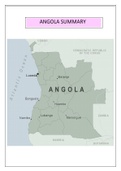
ANGOLA SUMMARY
, Angola
Cold war: What was the impact of internal and external forces on Africa
How Africa was drawn into the cold war
• African states became independent after colonial rule in 1950s/60s
• Superpowers tried to gain alliances among new African states by supplying aid and
weapons
• USSR: overthrow colonial government – supplying aid to national liberation
movement/ anti-western governments
• USA: protect trade links and support pro-western governments
• African states suspicious west – ties with colonialism and apartheid
• After the Sino-Soviet split, China became more involved in Africa as well, often
aimed at preventing Soviet alliances here.
• China: communism better suited for large peasant population countries
Competing spheres of influence: trade, conflict and aid
• Superpowers compete for influence/ control
• Did so establishing trading partnerships
o Arms/ aid
o Governments in power
o Rebel groups against government
o Opposing sides civil wars
• US foreign policy: counteract soviet influence
• The USA: protect their capitalist ally governments in Africa in order to protect their
trade of: uranium, diamonds, manganese, cobalt and chromium.
• The USSR sent aid to anti- Western governments in Mozambique, Angola, Ethiopia
and Somalia.
• Many Cuban troops were sent to Africa in order to accompany this Soviet aid, and in
the 1980’s one quarter of Cuba’s armed forces had been posted in Africa.
• In the 1970s China’s aid to Africa outstripped that of the USSR’S, and China sent
technicians and workers to work alongside African workers on major projects.
• There were some African governments who accepted aid from both superpowers
and avoided committing themselves to either side.
, Angola
Cold war: What was the impact of internal and external forces on Africa
How Africa was drawn into the cold war
• African states became independent after colonial rule in 1950s/60s
• Superpowers tried to gain alliances among new African states by supplying aid and
weapons
• USSR: overthrow colonial government – supplying aid to national liberation
movement/ anti-western governments
• USA: protect trade links and support pro-western governments
• African states suspicious west – ties with colonialism and apartheid
• After the Sino-Soviet split, China became more involved in Africa as well, often
aimed at preventing Soviet alliances here.
• China: communism better suited for large peasant population countries
Competing spheres of influence: trade, conflict and aid
• Superpowers compete for influence/ control
• Did so establishing trading partnerships
o Arms/ aid
o Governments in power
o Rebel groups against government
o Opposing sides civil wars
• US foreign policy: counteract soviet influence
• The USA: protect their capitalist ally governments in Africa in order to protect their
trade of: uranium, diamonds, manganese, cobalt and chromium.
• The USSR sent aid to anti- Western governments in Mozambique, Angola, Ethiopia
and Somalia.
• Many Cuban troops were sent to Africa in order to accompany this Soviet aid, and in
the 1980’s one quarter of Cuba’s armed forces had been posted in Africa.
• In the 1970s China’s aid to Africa outstripped that of the USSR’S, and China sent
technicians and workers to work alongside African workers on major projects.
• There were some African governments who accepted aid from both superpowers
and avoided committing themselves to either side.