Chapter 3
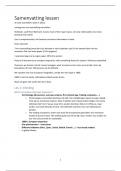
Independent assortment of genes
The combination of alleles in the offspring depends on whether the genes are on the
same chromosome. If they are not, then the chromosome pairs act independently at
meiosis, this is called:
The independent assortment of genes states that the alleles of 2 or more genes get
sorted into gametes independently of each other.
Continuous phenotypes that do not fall into specific categories (e.g. weight or
length). Are influenced by polygenes, which is a group of genes that produces a
specific phenotype or trait only when expressed together.
3.1 Mendel’s law of independent assortment.
Symbolism in two gene genotypes:
A/a ; B/b is used when the genes are on different chromosomes(note the
semicolon).
Ab/ab is used when the genes are on the same chromosome.
Monohybrid: name sometimes used for a heterozygote for a single gene.
Dihybrid(cross): name sometimes used for a double heterozygote (cross).
Mendel came up with his second law (law of independent assortment) by studying
these dihybrid crosses.
The independent assortment of 2 genes causes a 9:3:3:1 phenotypic ratio.
Test Crossing a dihybrid (with a homozygote) would result in a 1:1:1:1 ratio.
In haploids a ratio of 1:1 (instead of 3:1 in diploids) and 1:1:1:1 (instead of 9:3:3:1 in
diploids) is observed because haploids have only one gene for a particular trait and
will express the phenotype of any kind of mutation because there can be no
dominance.
3.2 Working with independent assortment.
We can use genetics to:
1. Predict genotypes of parents by observing the phenotype(ratio) of their
progeny.
2. Predict the phenotype of progeny (ratios) with known genotype parents.
For trihybrid crosses branch diagrams are preferred over punnett squares because
they are less time consuming.
For predicting genotypes we can use the:
Independent assortment of genes
The combination of alleles in the offspring depends on whether the genes are on the
same chromosome. If they are not, then the chromosome pairs act independently at
meiosis, this is called:
The independent assortment of genes states that the alleles of 2 or more genes get
sorted into gametes independently of each other.
Continuous phenotypes that do not fall into specific categories (e.g. weight or
length). Are influenced by polygenes, which is a group of genes that produces a
specific phenotype or trait only when expressed together.
3.1 Mendel’s law of independent assortment.
Symbolism in two gene genotypes:
A/a ; B/b is used when the genes are on different chromosomes(note the
semicolon).
Ab/ab is used when the genes are on the same chromosome.
Monohybrid: name sometimes used for a heterozygote for a single gene.
Dihybrid(cross): name sometimes used for a double heterozygote (cross).
Mendel came up with his second law (law of independent assortment) by studying
these dihybrid crosses.
The independent assortment of 2 genes causes a 9:3:3:1 phenotypic ratio.
Test Crossing a dihybrid (with a homozygote) would result in a 1:1:1:1 ratio.
In haploids a ratio of 1:1 (instead of 3:1 in diploids) and 1:1:1:1 (instead of 9:3:3:1 in
diploids) is observed because haploids have only one gene for a particular trait and
will express the phenotype of any kind of mutation because there can be no
dominance.
3.2 Working with independent assortment.
We can use genetics to:
1. Predict genotypes of parents by observing the phenotype(ratio) of their
progeny.
2. Predict the phenotype of progeny (ratios) with known genotype parents.
For trihybrid crosses branch diagrams are preferred over punnett squares because
they are less time consuming.
For predicting genotypes we can use the: