Ecology is the study of the interactions of organisms with their physical and biological environments
and how these determine the distribution and make up populations within an ecosystem, Population
ecology is concerned with fluctuations in the size of a population and the factors, both physical and
social that regulates these fluctuations.
Definitions:
o Species -group of organisms with similar characteristics which produce fertile offspring
o Population - group of organisms of the same species that occur in a particular area and are
able to interbreed freely.
o Community - group of populations occurring in a particular area
o Ecosystem - interaction of biotic (plant and animal) and abiotic factors with in an
environment.
o Environmental Resistance - the sum of the environmental factors (such as drought, mineral
deficiencies, and competition) that tend to restrict the biotic potential of an organism or
kind of organism and impose a limit on numerical increase. These are called limiting factors
and display environmental resistance on a population.
o Carryint capacity - maximum number of individuals the environment can support
fhe size of the poprrlation is effected by: (Poprrlation patarneters)
. Natalityiti.th rrt" in animals or the production of seeds in plants.
o Mortaliry: death rate.
o lmmigrationi:rindividuals move into a population and stay.
o Emigration:'r'individuals leave a population and do not return.
The population size fluctuates seasonally and annually depending on resource availability.
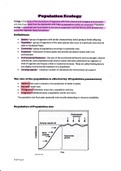
Regrrlation of Poprrlation size
Envirpnmental
lli,l
rrrlrtancr
('
hl
s
t
s
t
CL
o
o-
Tlmr
!4*-e..*
llPage
, The factors that help to regulate the growth of a population are known as limiting factors:
Densitv dependont foctors:
o Density dependent factors are biological factors used by the population as a resource. These
can be things like food, shelter, or other limited resources. Density dependent factors cause
variable changes in the population as its density changes. Therefore these factors depend on
the popultation E.g.:
o Competition for food / space / shelter
1. INTRASPECIFIC - competition between individuals of the SAME species.
E€r. , l''"rr .rrpeting for a female to mate with
2. INTERSPECIFIC - competition between individuals of DIFFERENT species.
E.g.: Hyena's and vultures competing for the same food source
o Predation
o Disease
Density Independent foctors:
o Density-independent factors, such as weather and climate, exert their influences on
population size regardless of the population's density. ln contrast, the effects of density-
dependent factors intensifo as the population increases in size. These factors regulate
population size, however, they are NOT dependant on how big or small a population is.
o Drastic changes in temperature
o Natural disasters E.g.: floods, droughts, fires, earthquake.
These limiting factors collectively build up environmental resistance.
A stable and unstabte population:
o Stable population is one in which numbers decrease when its size exceeds the carrying
capacity but increase again when numbers fall below the carrying capacity. Therefore, it
fluctuates around the carrying capacity.
29
Eao
t
!'o
E
I't
I
=30
o
l0ta5t12t?01
'tlm lr yis
Unstable population: develops if the population far exceeds the carrying capacity. This
results in the habitat either:
Deteriorating rapidly, which lowers the carrying capacity OR
Eventually not being able to support the population, which will lower the carrying capacity
rapidly and the population will possibly become extinct.
2lPage
and how these determine the distribution and make up populations within an ecosystem, Population
ecology is concerned with fluctuations in the size of a population and the factors, both physical and
social that regulates these fluctuations.
Definitions:
o Species -group of organisms with similar characteristics which produce fertile offspring
o Population - group of organisms of the same species that occur in a particular area and are
able to interbreed freely.
o Community - group of populations occurring in a particular area
o Ecosystem - interaction of biotic (plant and animal) and abiotic factors with in an
environment.
o Environmental Resistance - the sum of the environmental factors (such as drought, mineral
deficiencies, and competition) that tend to restrict the biotic potential of an organism or
kind of organism and impose a limit on numerical increase. These are called limiting factors
and display environmental resistance on a population.
o Carryint capacity - maximum number of individuals the environment can support
fhe size of the poprrlation is effected by: (Poprrlation patarneters)
. Natalityiti.th rrt" in animals or the production of seeds in plants.
o Mortaliry: death rate.
o lmmigrationi:rindividuals move into a population and stay.
o Emigration:'r'individuals leave a population and do not return.
The population size fluctuates seasonally and annually depending on resource availability.
Regrrlation of Poprrlation size
Envirpnmental
lli,l
rrrlrtancr
('
hl
s
t
s
t
CL
o
o-
Tlmr
!4*-e..*
llPage
, The factors that help to regulate the growth of a population are known as limiting factors:
Densitv dependont foctors:
o Density dependent factors are biological factors used by the population as a resource. These
can be things like food, shelter, or other limited resources. Density dependent factors cause
variable changes in the population as its density changes. Therefore these factors depend on
the popultation E.g.:
o Competition for food / space / shelter
1. INTRASPECIFIC - competition between individuals of the SAME species.
E€r. , l''"rr .rrpeting for a female to mate with
2. INTERSPECIFIC - competition between individuals of DIFFERENT species.
E.g.: Hyena's and vultures competing for the same food source
o Predation
o Disease
Density Independent foctors:
o Density-independent factors, such as weather and climate, exert their influences on
population size regardless of the population's density. ln contrast, the effects of density-
dependent factors intensifo as the population increases in size. These factors regulate
population size, however, they are NOT dependant on how big or small a population is.
o Drastic changes in temperature
o Natural disasters E.g.: floods, droughts, fires, earthquake.
These limiting factors collectively build up environmental resistance.
A stable and unstabte population:
o Stable population is one in which numbers decrease when its size exceeds the carrying
capacity but increase again when numbers fall below the carrying capacity. Therefore, it
fluctuates around the carrying capacity.
29
Eao
t
!'o
E
I't
I
=30
o
l0ta5t12t?01
'tlm lr yis
Unstable population: develops if the population far exceeds the carrying capacity. This
results in the habitat either:
Deteriorating rapidly, which lowers the carrying capacity OR
Eventually not being able to support the population, which will lower the carrying capacity
rapidly and the population will possibly become extinct.
2lPage