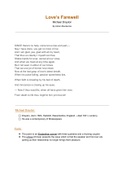
Love’s Farewell
Michael Drayton
By Adrian Mackenzie
SINCE there's no help, come let us kiss and part,—
Nay I have done, you get no more of me;
And I am glad, yea, glad with all my heart,
That thus so cleanly I myself can free;
Shake hands for ever, cancel all our vows,
And when we meet at any time again,
Be it not seen in either of our brows
That we one jot of former love retain.
Now at the last gasp of love's latest breath,
When his pulse failing, passion speechless lies,
When faith is kneeling by his bed of death,
And innocence is closing up his eyes,
— Now if thou would'st, when all have given him over,
From death to life thou might'st him yet recover!
Michael Drayton:
Drayton, (born 1563, Hartshill, Warwickshire, England —died 1631, London),
He was a contemporary of Shakespeare.
Form:
➔ The poem is an Elizabethan sonnet with three quatrains and a rhyming couplet.
➔ The octave (8 lines) presents the issue which is that the speaker and his lover are
parting as their relationship no longer brings them pleasure.
Michael Drayton
By Adrian Mackenzie
SINCE there's no help, come let us kiss and part,—
Nay I have done, you get no more of me;
And I am glad, yea, glad with all my heart,
That thus so cleanly I myself can free;
Shake hands for ever, cancel all our vows,
And when we meet at any time again,
Be it not seen in either of our brows
That we one jot of former love retain.
Now at the last gasp of love's latest breath,
When his pulse failing, passion speechless lies,
When faith is kneeling by his bed of death,
And innocence is closing up his eyes,
— Now if thou would'st, when all have given him over,
From death to life thou might'st him yet recover!
Michael Drayton:
Drayton, (born 1563, Hartshill, Warwickshire, England —died 1631, London),
He was a contemporary of Shakespeare.
Form:
➔ The poem is an Elizabethan sonnet with three quatrains and a rhyming couplet.
➔ The octave (8 lines) presents the issue which is that the speaker and his lover are
parting as their relationship no longer brings them pleasure.