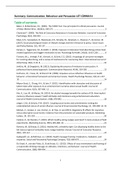
Summary: Communication, Behaviour and Persuasion LET-CIWM414
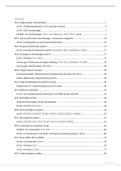
Table of contents
Baker, S. & Martinson, D.L. (2001). The TARES Test: Five principles for ethical persuasion. Journal
of Mass Media Ethics, 16(2&3), 148-175. ........................................................................................3
Chartrand T. (2005). The Role of Conscious Awareness in Consumer Behavior. Journal of Consumer
Psychology 15(3), 203-210. .............................................................................................................4
Maio, G.R., Verplanken, B., Manstead, A.R., Stroebe, W., Abraham, C., Sheeran, P., & Conner, M.
(2007). Social psychological factors in lifestyle change and their relevance to policy. Social Issues
and Policy Review, 1(1), 99-137. ......................................................................................................4
Kemps, E., Tiggemann, M., & Hollitt, S. (2014). Exposure to television food advertising primes food-
related cognitions and triggers motivation to eat. Psychology & Health, 29(10), 1192-1205. ...........9
Fransen, M.L., Verlegh, P.W., Kirmani, A., & Smit, E.G. (2015). A typology of consumer strategies
for resisting advertising, and a review of mechanisms for countering them. International Journal of
Advertising, 34(1), 6-16. 8. ............................................................................................................ 10
Jenkins, M., & Dragojevic, M. (2013). Explaining the process of resistance to persuasion: A
politeness theory-based approach. Communication Research, 40 (4), 559-590. ............................ 13
Hofmann, W., Friese, M., & Wiers R.W. (2008). Impulsive versus reflective influences on health
behavior: a theoretical framework and empirical review. Health Psychology Review, 2(2),111-137.
10. ................................................................................................................................................ 14
Moyer-Gusé, E., Chung, A.H., & Jain, P. (2011). Identification with characters and discussion of
taboo topics after exposure to an entertainment narrative about sexual health. Journal of
Communication, 61(3), 387-406. 12. ............................................................................................. 17
Kim, K., Lee, M., & Macias, W. (2014). An alcohol message beneath the surface of ER: How implicit
memory influences viewers’ health attitudes and intentions using entertainment-education.
Journal of Health Communication, 19(8), 876-892. ........................................................................ 18
Jaeger, C.M., & Schultz, P.W. (2017). Coupling social norms and commitments: testing the
underdetected nature of social influence. Journal of Environmental Psychology, 51, 199-208. 14. 19
Melnyk, V., Herpen, E. van, Fischer, A., & Trijp, H. van (2013). Regulatory fit effects for injunctive
versus descriptive social norms: Evidence from the promotion of sustainable products. Marketing
Letters, 24, 191-203. ..................................................................................................................... 20
Cadario, R., & Chandon, P. (2020). Which healthy eating nudges work best? A meta-analysis of field
experiments. Marketing Science, 39(3), 465-486. 16. .................................................................... 21
Romero, M., & Biswas, D. (2016). Healthy-left, unhealthy-right: Can displaying healthy items to the
left (versus right) of unhealthy items nudge healthier choices? Journal of Consumer Research,
43(1), 103-112. ............................................................................................................................. 23
Updegraff, J.A., & Rothman, A.J. (2013). Health message framing: moderators, mediators, and
mysteries. Social and Personality Psychology Compass, 7(9), 668-679. .......................................... 24
De Graaf, A., van den Putte, B., & de Bruijn, G.J. (2015). Effects of issue involvement and framing of
a responsible drinking message on attitudes, intentions, and behavior. Journal of Health
Communication, 20(8), 989-994. ................................................................................................... 26
1
,McQuarrie, E.F., & Phillips, B.J. (2005). Indirect persuasion in advertising: how consumers process
metaphors presented in pictures and words. Journal of Advertising, 34(2), 7-20. .......................... 28
Van Mulken, M., van Hooft A., & Nederstigt, U. (2014). Finding the tipping point: Visual metaphor
and conceptual complexity in advertising. Journal of Advertising, 43(4), 333- 343. ........................ 32
2
,Baker, S. & Martinson, D.L. (2001). The TARES Test: Five principles for ethical
persuasion. Journal of Mass Media Ethics, 16(2&3), 148-175.
Advertisers and public relations practitioners are distrusted because the public—with good
reason—has come to recognize that too frequently the goal in persuasive communication
centers around exploiting them in a manner that is, in fact, “detrimental to … [the public’s] own
preferences, interests, or well being” (Jaksa & Pritchard, 1994, p. 76). Wells, Burnett, and
Moriarty (1992) stated that the goal (end) of product advertising is “to inform or stimulate the
market about the sponsor’s product(s). The intent is clearly to sell a particular product, to the
exclusion of competitors’ products”.
The last end in persuasive communication (relative to the context of this discussion) must
center around respect for that individual to whom the particular persuasive effort is directed.
Although the short-term—or immediate—goal, in the case of advertising for example, may
well be increased sales, the ethical persuader will only utilize those messages and methods that
demonstrate genuine respect for those to whom the particular advertisement is directed.
Our goal in this article was to articulate a set of prima facie principles for persuasion that would
operationalize ethical theory, facilitate ethical thinking, be useful pedagogically, and engender
the ethical practice of persuasion.
We propose a five-part test of prima facie duties that defines the moral boundaries of
persuasive communications and serves as a set of action-guiding principles directed toward a
moral consequence in persuasion. The TARES-
Test is an acronym that consists of the five
principles:
1. Truthfulness (of the message): requires
that it be not only true, but truthful. This
principle requires the persuader’s
intention not to deceive, the intention to
provide others with the truthful
information they legitimately need to
make good decisions about their lives.
2. Authenticity (of the persuader): centers on issues related to the persuader. Including
integrity and personal virtue in action and motivation; genuineness and sincerity in
promoting particular products and services to particular persuadees; loyalty to
appropriate persons, causes, duties, and institutions; and moral independence and
commitment to principle.
3. Respect (for the persuadee): requires that professional persuaders regard other
human beings as worthy of dignity, that they not violate their rights, interests, and well-
being for raw self-interest or purely client-serving purposes. This principle is at the heart
of the TARES-Test and is the underlying foundation and motivation for all of its other
principles.
4. Equity (of the persuasive appeal): focuses on the persuasive appeal. This principle
requires either that there be parity between the persuader and persuadee in terms of
information, understanding, insight, capacity, and experience, or that accommodations
be made to adjust equitably for the disparities and to level the playing field (the lack of
parity must be fairly accounted for and not unfairly exploited).
3
, 5. Social Responsibility (for the common good): focuses on the need for professional
persuaders to be sensitive to and concerned about the wider public interest or common
good. Persuaders acting in harmony with this principle would not promote products,
causes, or ideas that they know to be harmful to individuals or to society and will
consider contributing their time and talents to promoting products, causes, and ideas
that clearly will result in a positive contribution to the common good and to the
community of mankind. This principle requires moral conduct by professional
persuaders at macrolevels as well as microlevels.
Chartrand T. (2005). The Role of Conscious Awareness in Consumer Behavior. Journal
of Consumer Psychology 15(3), 203-210.
There are four components of automaticity (awareness, control, efficiency, and intent, but not
all four need to be present for any given process to be automatic (and rarely are).
One of the most frequent scenarios in
consumer settings is one in which the
consumer is aware of the environmental
trigger and the outcome, but not the
automatic process.
If one is aware of the environmental trigger (A) that sets off an unwanted automatic process,
then he or she can avoid that trigger whenever possible, or perhaps associate that situation
with a more constructive behavior (which should become automatic over time and replace or
override the old automatic association). But if the consumer is not aware of the environmental
trigger, then the influential situations will not be avoided or even noticed and will, instead, be
encountered over and over. In the case of the automatic process itself (B), the consumer needs
to either eliminate the automatic association or override it with a conscious and deliberate new
behavior or with another competing automatic behavior. If consumers become aware of the
automatic process, however (e.g., notice that parties tend to lead to more alcohol consumption,
or that the presence of one's mother always leads to eating fatty foods), then they can try to
change or stop the automatic association. Finally, awareness of an outcome (C) can often lead
consumers to attempt to understand why that outcome occurred.
Maio, G.R., Verplanken, B., Manstead, A.R., Stroebe, W., Abraham, C., Sheeran, P., &
Conner, M. (2007). Social psychological factors in lifestyle change and their relevance
to policy. Social Issues and Policy Review, 1(1), 99-137.
A habit is frequent behavior that is conducted with little conscious awareness and intention, is
mentally efficient, and may sometimes be difficult to control (Wood, Tam, & Wit, 2005). In
addition, a habit is cued by the environment in which the behavior is conducted. These two
elements of habit— automaticity and being environment-cued—make habits particularly
difficult to change. Although the behaviors we are interested in are often complex and may
contain moments of deliberate thinking, the critical habitual aspect is often the moment a
decision is made to instigate the behavior, such as the decision to take either a fatty snack or
a piece of fruit.
4
Table of contents
Baker, S. & Martinson, D.L. (2001). The TARES Test: Five principles for ethical persuasion. Journal
of Mass Media Ethics, 16(2&3), 148-175. ........................................................................................3
Chartrand T. (2005). The Role of Conscious Awareness in Consumer Behavior. Journal of Consumer
Psychology 15(3), 203-210. .............................................................................................................4
Maio, G.R., Verplanken, B., Manstead, A.R., Stroebe, W., Abraham, C., Sheeran, P., & Conner, M.
(2007). Social psychological factors in lifestyle change and their relevance to policy. Social Issues
and Policy Review, 1(1), 99-137. ......................................................................................................4
Kemps, E., Tiggemann, M., & Hollitt, S. (2014). Exposure to television food advertising primes food-
related cognitions and triggers motivation to eat. Psychology & Health, 29(10), 1192-1205. ...........9
Fransen, M.L., Verlegh, P.W., Kirmani, A., & Smit, E.G. (2015). A typology of consumer strategies
for resisting advertising, and a review of mechanisms for countering them. International Journal of
Advertising, 34(1), 6-16. 8. ............................................................................................................ 10
Jenkins, M., & Dragojevic, M. (2013). Explaining the process of resistance to persuasion: A
politeness theory-based approach. Communication Research, 40 (4), 559-590. ............................ 13
Hofmann, W., Friese, M., & Wiers R.W. (2008). Impulsive versus reflective influences on health
behavior: a theoretical framework and empirical review. Health Psychology Review, 2(2),111-137.
10. ................................................................................................................................................ 14
Moyer-Gusé, E., Chung, A.H., & Jain, P. (2011). Identification with characters and discussion of
taboo topics after exposure to an entertainment narrative about sexual health. Journal of
Communication, 61(3), 387-406. 12. ............................................................................................. 17
Kim, K., Lee, M., & Macias, W. (2014). An alcohol message beneath the surface of ER: How implicit
memory influences viewers’ health attitudes and intentions using entertainment-education.
Journal of Health Communication, 19(8), 876-892. ........................................................................ 18
Jaeger, C.M., & Schultz, P.W. (2017). Coupling social norms and commitments: testing the
underdetected nature of social influence. Journal of Environmental Psychology, 51, 199-208. 14. 19
Melnyk, V., Herpen, E. van, Fischer, A., & Trijp, H. van (2013). Regulatory fit effects for injunctive
versus descriptive social norms: Evidence from the promotion of sustainable products. Marketing
Letters, 24, 191-203. ..................................................................................................................... 20
Cadario, R., & Chandon, P. (2020). Which healthy eating nudges work best? A meta-analysis of field
experiments. Marketing Science, 39(3), 465-486. 16. .................................................................... 21
Romero, M., & Biswas, D. (2016). Healthy-left, unhealthy-right: Can displaying healthy items to the
left (versus right) of unhealthy items nudge healthier choices? Journal of Consumer Research,
43(1), 103-112. ............................................................................................................................. 23
Updegraff, J.A., & Rothman, A.J. (2013). Health message framing: moderators, mediators, and
mysteries. Social and Personality Psychology Compass, 7(9), 668-679. .......................................... 24
De Graaf, A., van den Putte, B., & de Bruijn, G.J. (2015). Effects of issue involvement and framing of
a responsible drinking message on attitudes, intentions, and behavior. Journal of Health
Communication, 20(8), 989-994. ................................................................................................... 26
1
,McQuarrie, E.F., & Phillips, B.J. (2005). Indirect persuasion in advertising: how consumers process
metaphors presented in pictures and words. Journal of Advertising, 34(2), 7-20. .......................... 28
Van Mulken, M., van Hooft A., & Nederstigt, U. (2014). Finding the tipping point: Visual metaphor
and conceptual complexity in advertising. Journal of Advertising, 43(4), 333- 343. ........................ 32
2
,Baker, S. & Martinson, D.L. (2001). The TARES Test: Five principles for ethical
persuasion. Journal of Mass Media Ethics, 16(2&3), 148-175.
Advertisers and public relations practitioners are distrusted because the public—with good
reason—has come to recognize that too frequently the goal in persuasive communication
centers around exploiting them in a manner that is, in fact, “detrimental to … [the public’s] own
preferences, interests, or well being” (Jaksa & Pritchard, 1994, p. 76). Wells, Burnett, and
Moriarty (1992) stated that the goal (end) of product advertising is “to inform or stimulate the
market about the sponsor’s product(s). The intent is clearly to sell a particular product, to the
exclusion of competitors’ products”.
The last end in persuasive communication (relative to the context of this discussion) must
center around respect for that individual to whom the particular persuasive effort is directed.
Although the short-term—or immediate—goal, in the case of advertising for example, may
well be increased sales, the ethical persuader will only utilize those messages and methods that
demonstrate genuine respect for those to whom the particular advertisement is directed.
Our goal in this article was to articulate a set of prima facie principles for persuasion that would
operationalize ethical theory, facilitate ethical thinking, be useful pedagogically, and engender
the ethical practice of persuasion.
We propose a five-part test of prima facie duties that defines the moral boundaries of
persuasive communications and serves as a set of action-guiding principles directed toward a
moral consequence in persuasion. The TARES-
Test is an acronym that consists of the five
principles:
1. Truthfulness (of the message): requires
that it be not only true, but truthful. This
principle requires the persuader’s
intention not to deceive, the intention to
provide others with the truthful
information they legitimately need to
make good decisions about their lives.
2. Authenticity (of the persuader): centers on issues related to the persuader. Including
integrity and personal virtue in action and motivation; genuineness and sincerity in
promoting particular products and services to particular persuadees; loyalty to
appropriate persons, causes, duties, and institutions; and moral independence and
commitment to principle.
3. Respect (for the persuadee): requires that professional persuaders regard other
human beings as worthy of dignity, that they not violate their rights, interests, and well-
being for raw self-interest or purely client-serving purposes. This principle is at the heart
of the TARES-Test and is the underlying foundation and motivation for all of its other
principles.
4. Equity (of the persuasive appeal): focuses on the persuasive appeal. This principle
requires either that there be parity between the persuader and persuadee in terms of
information, understanding, insight, capacity, and experience, or that accommodations
be made to adjust equitably for the disparities and to level the playing field (the lack of
parity must be fairly accounted for and not unfairly exploited).
3
, 5. Social Responsibility (for the common good): focuses on the need for professional
persuaders to be sensitive to and concerned about the wider public interest or common
good. Persuaders acting in harmony with this principle would not promote products,
causes, or ideas that they know to be harmful to individuals or to society and will
consider contributing their time and talents to promoting products, causes, and ideas
that clearly will result in a positive contribution to the common good and to the
community of mankind. This principle requires moral conduct by professional
persuaders at macrolevels as well as microlevels.
Chartrand T. (2005). The Role of Conscious Awareness in Consumer Behavior. Journal
of Consumer Psychology 15(3), 203-210.
There are four components of automaticity (awareness, control, efficiency, and intent, but not
all four need to be present for any given process to be automatic (and rarely are).
One of the most frequent scenarios in
consumer settings is one in which the
consumer is aware of the environmental
trigger and the outcome, but not the
automatic process.
If one is aware of the environmental trigger (A) that sets off an unwanted automatic process,
then he or she can avoid that trigger whenever possible, or perhaps associate that situation
with a more constructive behavior (which should become automatic over time and replace or
override the old automatic association). But if the consumer is not aware of the environmental
trigger, then the influential situations will not be avoided or even noticed and will, instead, be
encountered over and over. In the case of the automatic process itself (B), the consumer needs
to either eliminate the automatic association or override it with a conscious and deliberate new
behavior or with another competing automatic behavior. If consumers become aware of the
automatic process, however (e.g., notice that parties tend to lead to more alcohol consumption,
or that the presence of one's mother always leads to eating fatty foods), then they can try to
change or stop the automatic association. Finally, awareness of an outcome (C) can often lead
consumers to attempt to understand why that outcome occurred.
Maio, G.R., Verplanken, B., Manstead, A.R., Stroebe, W., Abraham, C., Sheeran, P., &
Conner, M. (2007). Social psychological factors in lifestyle change and their relevance
to policy. Social Issues and Policy Review, 1(1), 99-137.
A habit is frequent behavior that is conducted with little conscious awareness and intention, is
mentally efficient, and may sometimes be difficult to control (Wood, Tam, & Wit, 2005). In
addition, a habit is cued by the environment in which the behavior is conducted. These two
elements of habit— automaticity and being environment-cued—make habits particularly
difficult to change. Although the behaviors we are interested in are often complex and may
contain moments of deliberate thinking, the critical habitual aspect is often the moment a
decision is made to instigate the behavior, such as the decision to take either a fatty snack or
a piece of fruit.
4