electric
electric circuits
circuits
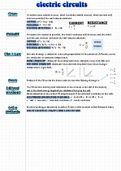
Series if resistors were added in series, total resistance would increase, total current will
decrease provided the emf remains constant
Current: I(T) = I(1) = I(2)
resistance: R = R1 + R2
Potential difference: V= V1 + V2
P!ralel If resistors are added in parallel, the total resistance will decrease and the total
current will increase, provided the emf remains constant.
current: I(T) = I1 + I2 POTENTIAL
Resistance: 1/R(T) = 1/R1 + 1/R2
DIFFERENCE
Potential difference: V(T) = V1 = V2
Ohm’s L aw Current through a conductor is directly proportional to the potential difference across
the conductor at constant temperature.
ohmic conductor: conductor that obeys ohm's law, constant ratio, nichrome wire
Non-ohmic conductor: conductor that does not obey ohm's law. Ratio changes
temperature, light bulb.
Power Product of the PD across the device and the current flowing through it
Internal The PD across a battery (not connected in the circuit) is the emf of the battery
emf is the total energy supplied per coulomb of large by the cell
resistance When connected in the circuit PD drops because of the internal resistance in the cells
Determining emf/internal resistance: e = I(r+R) OR e = IR + Ir OR e = V + Ir
e = emf, I = current, r = internal resistance, R = Load resistance
Cost of Electricity energy is measured in joules (J) but is sold in units called kilowatt hours
cost of electricty = power x time x cost per unit
Electricity
electric circuits
circuits
Series if resistors were added in series, total resistance would increase, total current will
decrease provided the emf remains constant
Current: I(T) = I(1) = I(2)
resistance: R = R1 + R2
Potential difference: V= V1 + V2
P!ralel If resistors are added in parallel, the total resistance will decrease and the total
current will increase, provided the emf remains constant.
current: I(T) = I1 + I2 POTENTIAL
Resistance: 1/R(T) = 1/R1 + 1/R2
DIFFERENCE
Potential difference: V(T) = V1 = V2
Ohm’s L aw Current through a conductor is directly proportional to the potential difference across
the conductor at constant temperature.
ohmic conductor: conductor that obeys ohm's law, constant ratio, nichrome wire
Non-ohmic conductor: conductor that does not obey ohm's law. Ratio changes
temperature, light bulb.
Power Product of the PD across the device and the current flowing through it
Internal The PD across a battery (not connected in the circuit) is the emf of the battery
emf is the total energy supplied per coulomb of large by the cell
resistance When connected in the circuit PD drops because of the internal resistance in the cells
Determining emf/internal resistance: e = I(r+R) OR e = IR + Ir OR e = V + Ir
e = emf, I = current, r = internal resistance, R = Load resistance
Cost of Electricity energy is measured in joules (J) but is sold in units called kilowatt hours
cost of electricty = power x time x cost per unit
Electricity