Unit 17 task 3
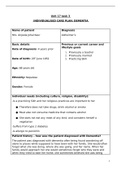
INDIVIDUALISED CARE PLAN: DEMENTIA
Name of patient Diagnosis
Mrs. Anjeela Johal Kaur Alzheimer’s
Basic details Previous or current career and
lifestyle goals
Date of diagnosis: 4 years prior
1. Previously a teacher
2. Previously married
Date of birth: 20th June 1952 3. Practicing Sikh
Age: 68 years old
Ethnicity: Nepalese
Gender: Female
Individual needs (including culture, religion, disability):
-Is a practicing Sikh and her religious practices are important to her
● Therefore does not take drugs, drink alcohol or smoke
● Must also not consume medicine that contains alcohol
● She does not eat any meat of any kind, and considers herself a
vegetarian
-Suffers from type 2 diabetes
-Is allergic to penicillin
Patient history – how was the patient diagnosed with Dementia?
The patient was diagnosed with dementia after being found wandering off
alone to places while supposed to have been with her family. She would often
forget what she was doing, where she was going, and her name. When her
family would approach her she would sometimes forget who they were and
when they tried to take her home, she sometimes believed she was being
1
, taken against her will or kidnapped, causing an unpleasant outburst to occur
once or twice. Due to this situation her two sons both took her to go and get
memory tests done at the doctor, which is where she was diagnosed with
dementia. She had been suffering in between stages 3 and 4 which were for
mild decline and moderate decline.
Care Needs Assessment
Care Need How might this affect Outcome they are
the patient’s hoping to achieve
everyday life?
Protection and safety Protection and safety It is important that
may affect the person's family, friends and
daily life because health professionals help
symptoms such as the person with
confusion, memory loss dementia to feel and be
and disorientation are as secure as possible.
common, while limited
mobility and
coordination may affect
safety.
Diet and medication Regular, nutritious meals The only outcome is
may become a challenge hoping that the
for people living in the Alzheimer’s patient gets
middle and late stages of the nutrition and energy
Alzheimer’s. They may from food that she
become overwhelmed needs. Therefore making
with too many food mealtimes calm and
choices, forget to eat or comfortable,,
think they have already encouraging
eaten. independence and
minimising eating and
nutrition problems is
2
INDIVIDUALISED CARE PLAN: DEMENTIA
Name of patient Diagnosis
Mrs. Anjeela Johal Kaur Alzheimer’s
Basic details Previous or current career and
lifestyle goals
Date of diagnosis: 4 years prior
1. Previously a teacher
2. Previously married
Date of birth: 20th June 1952 3. Practicing Sikh
Age: 68 years old
Ethnicity: Nepalese
Gender: Female
Individual needs (including culture, religion, disability):
-Is a practicing Sikh and her religious practices are important to her
● Therefore does not take drugs, drink alcohol or smoke
● Must also not consume medicine that contains alcohol
● She does not eat any meat of any kind, and considers herself a
vegetarian
-Suffers from type 2 diabetes
-Is allergic to penicillin
Patient history – how was the patient diagnosed with Dementia?
The patient was diagnosed with dementia after being found wandering off
alone to places while supposed to have been with her family. She would often
forget what she was doing, where she was going, and her name. When her
family would approach her she would sometimes forget who they were and
when they tried to take her home, she sometimes believed she was being
1
, taken against her will or kidnapped, causing an unpleasant outburst to occur
once or twice. Due to this situation her two sons both took her to go and get
memory tests done at the doctor, which is where she was diagnosed with
dementia. She had been suffering in between stages 3 and 4 which were for
mild decline and moderate decline.
Care Needs Assessment
Care Need How might this affect Outcome they are
the patient’s hoping to achieve
everyday life?
Protection and safety Protection and safety It is important that
may affect the person's family, friends and
daily life because health professionals help
symptoms such as the person with
confusion, memory loss dementia to feel and be
and disorientation are as secure as possible.
common, while limited
mobility and
coordination may affect
safety.
Diet and medication Regular, nutritious meals The only outcome is
may become a challenge hoping that the
for people living in the Alzheimer’s patient gets
middle and late stages of the nutrition and energy
Alzheimer’s. They may from food that she
become overwhelmed needs. Therefore making
with too many food mealtimes calm and
choices, forget to eat or comfortable,,
think they have already encouraging
eaten. independence and
minimising eating and
nutrition problems is
2