iGCSE Computer Science Revision Notes
Paper 2
Exam Technique
Know what the examiners can ask you questions about
Have a look at the I GCSE Computer Science syllabus that you have been studying and are going
to be taking the exam for. The list of topics will make a great checklist for your revision. If you
find something that you don’t understand or haven’t made any notes about, then find out about
it. A
nything that is mentioned in the syllabus could be used in an examination question.
Read and understand examination questions
What are you being asked to do?
1. Read the question x3
2. Understand the type of instruction you are being given: Complete, Describe, Draw, Explain,
Give and State all require different actions.
3. If the question makes use of a specific scenario or context then make sure that all of your
answers are relevant to that context. For example, if the question is about security
measures for an offline device, then using an internet-based firewall would not be
appropriate!
4. Decide on the information required but remember that you are sitting an iGCSE
examination and most answers will require more than just a single word. If you have
finished well before the time allotted, you may well have fallen into this trap.
5. Always use correct technical terms and avoid the use of trade names. For example, talk
about the use of an operating system rather than the use of ‘Windows 10’.
6. Decide how much information is required to fulfil the number of marks available and if in
doubt, add more!
Help the examiner help you!
- Make sure your answers are easy to read (if in doubt, write it again, clearer!).
- Read through the entire question before you start to answer it, give yourself thinking time
and decide how you will format your answer before writing.
- Make it easy for the examiner to see where he/she should give you the marks. This also
helps you make sure that you will gain every mark available.
- Answer every question! There is no point leaving blank spaces, you will not lose marks for
incorrect answers, so you may as well have a guess.
- You have plenty of time in the exam. Use the first 5 minutes to read through the paper.
Maybe attempt some of the easier questions first to ease you into the problem-solving
frame of mind before tackling the harder ones.
, 2.1 - Algorithm design and problem-solving
2.1.1 Problem solving and design
a) show understanding that every computer system is made up of sub-systems, which in
turn are made up of further sub-systems
Breaking down a problem into many smaller problems is called decomposition and is one of the
cornerstones of computational thinking.
b) use top-down design, structure diagrams, flowcharts, pseudocode, library routines
and subroutines
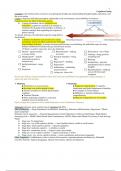
Top-down design is the process of
decomposing a system into smaller parts until
each sub-system performs just one task. This
can be shown in a s tructure diagram like the
one on the right.
Flowcharts and pseudocode are ways of
writing a solution to a problem (see 2.1.2).
Subroutines are blocks of code written by the
programmer that are designed to perform a
frequently used operation within a program.
They can be called back as many times as
necessary at any point in the program.
Library routines are blocks of pre-written code
that are stored in a program library. They can be called into other programs when necessary.
c) work out the purpose of a given algorithm
Algorithms are represented in either pseudocode or as a flowchart. You should pay close
attention to any mathematical operators and loops in order to work out the purpose of an
algorithm. It may have a real-world purpose related to context given a question (e.g. input all the
sales for one week in a shop and output the maximum, the minimum and the average sale), or
simply a theoretical/mathematical function (e.g. input a list of 50 numbers and output the
number of even numbers in the list).
d) explain standard methods of solution
You should be able to identify different types of loops (count-controlled/condition controlled),
describe comparison operators from their symbol (<, >, != etc). You should also be able to identify
why a specific type of loop is most applicable to a solution and which comparison operator to
use and why.
Paper 2
Exam Technique
Know what the examiners can ask you questions about
Have a look at the I GCSE Computer Science syllabus that you have been studying and are going
to be taking the exam for. The list of topics will make a great checklist for your revision. If you
find something that you don’t understand or haven’t made any notes about, then find out about
it. A
nything that is mentioned in the syllabus could be used in an examination question.
Read and understand examination questions
What are you being asked to do?
1. Read the question x3
2. Understand the type of instruction you are being given: Complete, Describe, Draw, Explain,
Give and State all require different actions.
3. If the question makes use of a specific scenario or context then make sure that all of your
answers are relevant to that context. For example, if the question is about security
measures for an offline device, then using an internet-based firewall would not be
appropriate!
4. Decide on the information required but remember that you are sitting an iGCSE
examination and most answers will require more than just a single word. If you have
finished well before the time allotted, you may well have fallen into this trap.
5. Always use correct technical terms and avoid the use of trade names. For example, talk
about the use of an operating system rather than the use of ‘Windows 10’.
6. Decide how much information is required to fulfil the number of marks available and if in
doubt, add more!
Help the examiner help you!
- Make sure your answers are easy to read (if in doubt, write it again, clearer!).
- Read through the entire question before you start to answer it, give yourself thinking time
and decide how you will format your answer before writing.
- Make it easy for the examiner to see where he/she should give you the marks. This also
helps you make sure that you will gain every mark available.
- Answer every question! There is no point leaving blank spaces, you will not lose marks for
incorrect answers, so you may as well have a guess.
- You have plenty of time in the exam. Use the first 5 minutes to read through the paper.
Maybe attempt some of the easier questions first to ease you into the problem-solving
frame of mind before tackling the harder ones.
, 2.1 - Algorithm design and problem-solving
2.1.1 Problem solving and design
a) show understanding that every computer system is made up of sub-systems, which in
turn are made up of further sub-systems
Breaking down a problem into many smaller problems is called decomposition and is one of the
cornerstones of computational thinking.
b) use top-down design, structure diagrams, flowcharts, pseudocode, library routines
and subroutines
Top-down design is the process of
decomposing a system into smaller parts until
each sub-system performs just one task. This
can be shown in a s tructure diagram like the
one on the right.
Flowcharts and pseudocode are ways of
writing a solution to a problem (see 2.1.2).
Subroutines are blocks of code written by the
programmer that are designed to perform a
frequently used operation within a program.
They can be called back as many times as
necessary at any point in the program.
Library routines are blocks of pre-written code
that are stored in a program library. They can be called into other programs when necessary.
c) work out the purpose of a given algorithm
Algorithms are represented in either pseudocode or as a flowchart. You should pay close
attention to any mathematical operators and loops in order to work out the purpose of an
algorithm. It may have a real-world purpose related to context given a question (e.g. input all the
sales for one week in a shop and output the maximum, the minimum and the average sale), or
simply a theoretical/mathematical function (e.g. input a list of 50 numbers and output the
number of even numbers in the list).
d) explain standard methods of solution
You should be able to identify different types of loops (count-controlled/condition controlled),
describe comparison operators from their symbol (<, >, != etc). You should also be able to identify
why a specific type of loop is most applicable to a solution and which comparison operator to
use and why.