Syllabus 3 Pre-Action Conduct: PD on Pre-Action Conduct and Protocols
and Consequence of Non-Compliance
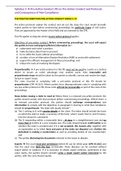
THE PRACTICE DIRECTION PRE-ACTION CONDUCT PARAS 1-17:
Pre-action protocols explain the conduct and set out the steps the court would normally
expect parties to take before commencing proceedings for particular types of civil claims.
They are approved by the Master of the Rolls and are annexed to the CPR.
This PD applies to disputes where no pre-action protocol applies.
Objectives of pre-action conduct: Before commencing proceedings, the court will expect
the parties to have exchanged sufficient information to—
a) understand each other’s position;
b) make decisions about how to proceed;
c) try to settle the issues without proceedings;
d) consider a form of Alternative Dispute Resolution (ADR) to assist with settlement;
e) support the efficient management of those proceedings; and
f) reduce the costs of resolving the dispute.
Proportionality A pre-action protocol or this PD must not be used by a party as a tactical
device to secure an unfair advantage over another party. Only reasonable and
proportionate steps should be taken by the parties to identify, narrow and resolve the legal,
factual or expert issues.
The costs incurred in complying with a pre-action protocol or this PD should be
proportionate (CPR 44.3(5)). Where parties incur disproportionate costs in complying with
any pre-action protocol or PD, those costs will not be recoverable as part of the costs of the
proceedings.
Steps before issuing a claim to court Where there is a relevant pre-action protocol, the
parties should comply with that protocol before commencing proceedings. Where there is
no relevant pre-action protocol, the parties should exchange correspondence and
information to comply with the objectives in paragraph 3, bearing in mind that compliance
should be proportionate. The steps will usually include—
(a) The C writing to D with concise details of the claim. The letter should include the basis
on which the claim is made, a summary of the facts, what C wants from D, and if money,
how the amount is calculated;
(b) The D responding within a reasonable time - 14 days in a straightforward case and no
more than 3 months in a very complex one. The reply should include confirmation as to
whether the claim is accepted and, if it is not accepted, the reasons why, together with
an explanation as to which facts and parts of the claim are disputed and whether the
defendant is making a counterclaim as well as providing details of any counterclaim;
and
(c) The parties disclosing key documents relevant to the issues in dispute.
Experts The court must give permission before EE can be relied upon (CPR 35.4(1)) and
that the court may limit the fees recoverable. Many disputes can be resolved without
expert advice or evidence. If it is necessary to obtain expert evidence, particularly in low
value claims, the parties should consider using a single expert jointly instructed by the
parties, with the costs shared equally.
and Consequence of Non-Compliance
THE PRACTICE DIRECTION PRE-ACTION CONDUCT PARAS 1-17:
Pre-action protocols explain the conduct and set out the steps the court would normally
expect parties to take before commencing proceedings for particular types of civil claims.
They are approved by the Master of the Rolls and are annexed to the CPR.
This PD applies to disputes where no pre-action protocol applies.
Objectives of pre-action conduct: Before commencing proceedings, the court will expect
the parties to have exchanged sufficient information to—
a) understand each other’s position;
b) make decisions about how to proceed;
c) try to settle the issues without proceedings;
d) consider a form of Alternative Dispute Resolution (ADR) to assist with settlement;
e) support the efficient management of those proceedings; and
f) reduce the costs of resolving the dispute.
Proportionality A pre-action protocol or this PD must not be used by a party as a tactical
device to secure an unfair advantage over another party. Only reasonable and
proportionate steps should be taken by the parties to identify, narrow and resolve the legal,
factual or expert issues.
The costs incurred in complying with a pre-action protocol or this PD should be
proportionate (CPR 44.3(5)). Where parties incur disproportionate costs in complying with
any pre-action protocol or PD, those costs will not be recoverable as part of the costs of the
proceedings.
Steps before issuing a claim to court Where there is a relevant pre-action protocol, the
parties should comply with that protocol before commencing proceedings. Where there is
no relevant pre-action protocol, the parties should exchange correspondence and
information to comply with the objectives in paragraph 3, bearing in mind that compliance
should be proportionate. The steps will usually include—
(a) The C writing to D with concise details of the claim. The letter should include the basis
on which the claim is made, a summary of the facts, what C wants from D, and if money,
how the amount is calculated;
(b) The D responding within a reasonable time - 14 days in a straightforward case and no
more than 3 months in a very complex one. The reply should include confirmation as to
whether the claim is accepted and, if it is not accepted, the reasons why, together with
an explanation as to which facts and parts of the claim are disputed and whether the
defendant is making a counterclaim as well as providing details of any counterclaim;
and
(c) The parties disclosing key documents relevant to the issues in dispute.
Experts The court must give permission before EE can be relied upon (CPR 35.4(1)) and
that the court may limit the fees recoverable. Many disputes can be resolved without
expert advice or evidence. If it is necessary to obtain expert evidence, particularly in low
value claims, the parties should consider using a single expert jointly instructed by the
parties, with the costs shared equally.