
Human anatomy and physiology
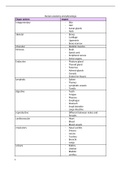
Organ system organs
Integumentary - Skin
- Hair
- Sweat glands
- Nails
Skeletal - Bones
- Cartilage
- Ligaments
- Bone marrow
Muscular - Skeletal muscles
Nervous - Brain
- Spinal cord
- Peripheral nerves
- Sense organs
Endocrine - Pituitary gland
- Thyroid gland
- Pancreas
- Adrenal glands
- Gonads
- Endocrine tissues
lymphatic - Spleen
- Thymus
- Lymphatic vessels
- Tonsils
digestive - Teeth
- Tongue
- Pharynx
- Esophagus
- Stomach
- Small intestine
- Large intestine
reproductive - Different between males and
females
cardiovascular - Heart
- Blood
- Blood vessels
respiratory - Nasal cavities
- Sinuses
- Larynx
- Trachea
- Bronchi
- Lungs
urinary - Kidney
- Urether
- Bladder
- urethra
1
,Learning objectives:
1. Define the terms anatomy and physiology
2. Be aware of different levels of organization
3. Use anatomical terms to describe areas, parts, and
relative position of the human body
4. Identify the most important bodily cavities and describe
the function
Anatomy: studying the structure of the body
- Macroscopic to microscopic
- Clinical anatomy
- Anatomical embryology
Physiology: studying bodily functions
- Genetics
- Biochemistry
- Biology
Lecture 1: anatomy of the heart
Position of the heart
- The apex (lowest point) lies between ribs 4
and 5 on the left side
- The major vessels are in the middle of the
ribcage
- Sternal angel (between rib 1 and 2 on the
sternum)
- 5th intercostal space next to the sternum on
the right
- 5th intercostal space midclavicular on the left.
Mediastinum
- The space between the left and right pleural cavity.
There is a superior (yellow) and inferior part, which
2
, consists of three parts. Front, middle back. The heart is part of the middle
mediastinum.
o Anterior mediastinum (green)
o Middle mediastinum (blue)
o Posterior mediastinum (pink)
Superior mediastinum
- Nerves
o Vagal nerves (from the brain down to the aorta, the lungs, and down to the
stomach and beyond). Helps with digestion and lowering the hearth rate.
o Left recurrent laryngeal nerve
o Phrenic nerves (from the neck to the diaphragm)
o Sympathetic trunk
- Thoracic duct
o Lymph drainage
- Thymus (anterior mediastinum)
o Lymphoid tissue
o Regression
- Trachea
Anterior mediastinum
- Vessels
o Aa. And vv. Throcacicae internae (can be handy to use during a bypass
surgery.)
Mediastinum posterius
- Vessels
- Esophagus
- Thoracic duct
- Vagal nerves
- Sympathic trunk
- No trachea, which is present in the superior mediastinum. The trachea branches into
bronchi at the sternal
angle.
The pericardial cavity
The pericardial cavity is enclosed by the
pericardium (or pericardial sac). There are two
types of pericardia:
3
Organ system organs
Integumentary - Skin
- Hair
- Sweat glands
- Nails
Skeletal - Bones
- Cartilage
- Ligaments
- Bone marrow
Muscular - Skeletal muscles
Nervous - Brain
- Spinal cord
- Peripheral nerves
- Sense organs
Endocrine - Pituitary gland
- Thyroid gland
- Pancreas
- Adrenal glands
- Gonads
- Endocrine tissues
lymphatic - Spleen
- Thymus
- Lymphatic vessels
- Tonsils
digestive - Teeth
- Tongue
- Pharynx
- Esophagus
- Stomach
- Small intestine
- Large intestine
reproductive - Different between males and
females
cardiovascular - Heart
- Blood
- Blood vessels
respiratory - Nasal cavities
- Sinuses
- Larynx
- Trachea
- Bronchi
- Lungs
urinary - Kidney
- Urether
- Bladder
- urethra
1
,Learning objectives:
1. Define the terms anatomy and physiology
2. Be aware of different levels of organization
3. Use anatomical terms to describe areas, parts, and
relative position of the human body
4. Identify the most important bodily cavities and describe
the function
Anatomy: studying the structure of the body
- Macroscopic to microscopic
- Clinical anatomy
- Anatomical embryology
Physiology: studying bodily functions
- Genetics
- Biochemistry
- Biology
Lecture 1: anatomy of the heart
Position of the heart
- The apex (lowest point) lies between ribs 4
and 5 on the left side
- The major vessels are in the middle of the
ribcage
- Sternal angel (between rib 1 and 2 on the
sternum)
- 5th intercostal space next to the sternum on
the right
- 5th intercostal space midclavicular on the left.
Mediastinum
- The space between the left and right pleural cavity.
There is a superior (yellow) and inferior part, which
2
, consists of three parts. Front, middle back. The heart is part of the middle
mediastinum.
o Anterior mediastinum (green)
o Middle mediastinum (blue)
o Posterior mediastinum (pink)
Superior mediastinum
- Nerves
o Vagal nerves (from the brain down to the aorta, the lungs, and down to the
stomach and beyond). Helps with digestion and lowering the hearth rate.
o Left recurrent laryngeal nerve
o Phrenic nerves (from the neck to the diaphragm)
o Sympathetic trunk
- Thoracic duct
o Lymph drainage
- Thymus (anterior mediastinum)
o Lymphoid tissue
o Regression
- Trachea
Anterior mediastinum
- Vessels
o Aa. And vv. Throcacicae internae (can be handy to use during a bypass
surgery.)
Mediastinum posterius
- Vessels
- Esophagus
- Thoracic duct
- Vagal nerves
- Sympathic trunk
- No trachea, which is present in the superior mediastinum. The trachea branches into
bronchi at the sternal
angle.
The pericardial cavity
The pericardial cavity is enclosed by the
pericardium (or pericardial sac). There are two
types of pericardia:
3


