Short Summary of articles from Cultural Industries
WEEK 1
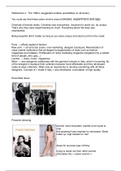
Article 1: Throsby, D (2008). Modeling the cultural industries.
What is it about? Definitions of cultural industries and examines 6 tools for economic analysis
that can be applied to cultural industries.
Cultural industries: Those industries that combine the creation, production and
commercialization of contents which are intangible or cultural in nature.
- Characteristics would be human creativity, symbolic messages and intellectual property.
- Used as cultural value and transcends purely economic valuation.
Creative industries: Those industries which have their origin in individual creativity, skill
and talent and which have a potential for wealth and job creation through the generation and
exploitation of intellectual property.
- Characteristics would be human creativity, goods and services, commercial use.
- Extends beyond cultural goods.
Distinction between creative and cultural industries
If only an economic perspective is being used to estimate the contribute defined by cultural
industries only those with high growth rates would be included. But by taking a cultural
perspective other groups are also included.
Concentric circle model: Only using the core of the cultural industries in their research.
WIPO: Includes all cultural industries that are indirectly or directly connected.
6 Economic approaches to analyzing the cultural industries
1. Industrial organization theory:
Focuses on standard economic variables (valued of production, business
concentration).
Also looks at organizational variables (such as seller and buyer differentiation,
marketing, competition). This is relevant to the models oriented towards the
commercial production of cultural goods and services.
2. Value Chain Analysis:
Production chain with value adding stages from initial idea, the production of
goods of services, their marketing and distribution, until consumption.
This is used by firms to analyze performance in different stages of the
production cycle.
3. Inter-Industry analysis: The ways in which output is produced in the economy. Used
to evaluate the economy impact of cultural policy.
a. Input-output analysis: output from one industrial sector as input to another
sector.
1
, b. Social accounting matrices: similar tool requiring less data for analyzing the
impact of the industries.
4. Locational analysis:
Demand side (tourist concentration will draw in industries to come there and to
localize close to the demand) and supply side (network and agglomeration
externalities in production).
This is used by governments to attract firms and develop (cultural) industries
clusters.
5. Contract theory and property rights:
Identifying property rights as a basis for contractual arrangements that can be
explained by the uniqueness of cultural industries.
a. Nobody knows: the final outcome can’t be predicted. Uncertainty of demand.
b. Art for art’s sake: irrational labor market
c. Infinite variety: All products are more or less differentiated.
d. Durability: ability to yield rents over a long period.
These peculiarities of the industry are used by firms to develop ‘optimal’ contracts
with (value chain) partners.
6. Trade and development:
Theory of comparative advantages to explain specialization of production in
different countries. Assertion: free trade maximizes world welfare.
Article 2: Svejenova, S., Planellas, M., & Vives, L. (2010). An individual business model
in the making: A chef’s quest for creative freedom.
What is it about? Study of business model in 3 different ways. Restaurant owner Ferran Adria.
Business model: Organizational device that reveals three things:
- The logic for creating and capturing value
- The organizations approach to renewal.
- Enhances the understanding of organizations operations.
Adria’s business model:
1. Main trigger: Quest for
creative freedom.
2. Employee pre-stage of
business model.
3. Quest for authenticity leads to
owner manager.
4. Quest for recognition leads to
entrepreneur.
5. Quest for influence leads to
leader.
2
WEEK 1
Article 1: Throsby, D (2008). Modeling the cultural industries.
What is it about? Definitions of cultural industries and examines 6 tools for economic analysis
that can be applied to cultural industries.
Cultural industries: Those industries that combine the creation, production and
commercialization of contents which are intangible or cultural in nature.
- Characteristics would be human creativity, symbolic messages and intellectual property.
- Used as cultural value and transcends purely economic valuation.
Creative industries: Those industries which have their origin in individual creativity, skill
and talent and which have a potential for wealth and job creation through the generation and
exploitation of intellectual property.
- Characteristics would be human creativity, goods and services, commercial use.
- Extends beyond cultural goods.
Distinction between creative and cultural industries
If only an economic perspective is being used to estimate the contribute defined by cultural
industries only those with high growth rates would be included. But by taking a cultural
perspective other groups are also included.
Concentric circle model: Only using the core of the cultural industries in their research.
WIPO: Includes all cultural industries that are indirectly or directly connected.
6 Economic approaches to analyzing the cultural industries
1. Industrial organization theory:
Focuses on standard economic variables (valued of production, business
concentration).
Also looks at organizational variables (such as seller and buyer differentiation,
marketing, competition). This is relevant to the models oriented towards the
commercial production of cultural goods and services.
2. Value Chain Analysis:
Production chain with value adding stages from initial idea, the production of
goods of services, their marketing and distribution, until consumption.
This is used by firms to analyze performance in different stages of the
production cycle.
3. Inter-Industry analysis: The ways in which output is produced in the economy. Used
to evaluate the economy impact of cultural policy.
a. Input-output analysis: output from one industrial sector as input to another
sector.
1
, b. Social accounting matrices: similar tool requiring less data for analyzing the
impact of the industries.
4. Locational analysis:
Demand side (tourist concentration will draw in industries to come there and to
localize close to the demand) and supply side (network and agglomeration
externalities in production).
This is used by governments to attract firms and develop (cultural) industries
clusters.
5. Contract theory and property rights:
Identifying property rights as a basis for contractual arrangements that can be
explained by the uniqueness of cultural industries.
a. Nobody knows: the final outcome can’t be predicted. Uncertainty of demand.
b. Art for art’s sake: irrational labor market
c. Infinite variety: All products are more or less differentiated.
d. Durability: ability to yield rents over a long period.
These peculiarities of the industry are used by firms to develop ‘optimal’ contracts
with (value chain) partners.
6. Trade and development:
Theory of comparative advantages to explain specialization of production in
different countries. Assertion: free trade maximizes world welfare.
Article 2: Svejenova, S., Planellas, M., & Vives, L. (2010). An individual business model
in the making: A chef’s quest for creative freedom.
What is it about? Study of business model in 3 different ways. Restaurant owner Ferran Adria.
Business model: Organizational device that reveals three things:
- The logic for creating and capturing value
- The organizations approach to renewal.
- Enhances the understanding of organizations operations.
Adria’s business model:
1. Main trigger: Quest for
creative freedom.
2. Employee pre-stage of
business model.
3. Quest for authenticity leads to
owner manager.
4. Quest for recognition leads to
entrepreneur.
5. Quest for influence leads to
leader.
2