MAN5 Summary
Chapter 6
Current assets are also called working capital (they require financial resources à
limit them)
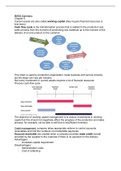
Cash flow cycle is the transformation process that is related to the production and
sales process from the moment of purchasing raw materials up to the moment of the
delivery of an end product to the customer
This chain is used by production organization, trade business and service industry
but the steps can vary per industry.
Not every investment in current assets requires a lot of financial resources
Process cash flow cycle
The objective of working capital management is to reduce investments in working
capital but this should not negatively affect the progress of the production and sales
process, for example, not be able to sell due to insufficient inventory.
Credit management: company takes appropriate actions to control accounts
receivables and limit the numbers of uncollectible payments
Account receivable are created when a company provides trade credit àcredit
provided by the supplier to the customer if there is no payment on the delivery
Advantages:
- Increases capital requirement
Disadvantages:
- Administration costs
- Cost of collecting
, If you grant credit a payment term or net term must be determined, this is the
number of days after the item is purchased when payment is due in full
Some companies persuade consumers with a cash discount this can be deducted
from the invoice amount in the event of the payment within the stipulated number of
days; the discount term
Default of payment: non-payment partially payment or overdue payment of
receivables
Credit management company take appropriate action to control accounts receivables
are limited numbers of uncollectible payments
Good credit management start before sales and delivery by a creditworthiness
assessment (if the costumer will pay)
- Sales representatives
- Personal visits to the customer
- Financial statements of the customer
- Credit reporting agencies
Credit limit: the maximum credit the customer is granted during a period
Credit montoring:
Collection policy: concerns or measures applied to speed up or guarantee payment
If a customer has not paid us after several reminders the involvement of a collection
agency all the way up to legal proceedings can be considered
Factoring: taking over the administration and collection of the companies accounts
receivable by factoring company
And advantage of factoring can be that the factoring company takes over the risk of
uncontrollable debts. In such an event the factoring company is obliged to pay the
receivable to the company regardless whether it’s received payments from its
customer.
Cash management
Disadvantages:
- It creates capital requirements that needs financing
- Investment in cash and cash equivalents hardly generates any income
The three motives:
1. The transaction motive means that sufficient cash and cash equivalents are
kept to allow payments and guarantee the continuity of the production
process. It concernes the payment of salaries and the purchasing of raw
materials, the purchasing of fixed assets, tax payment, interest payments,
repayment of loan etc.
2. The precautionary motive means that additional cash and cash equivalents
are kept using the uncertainty concerning the size and the time of the cash
payments and receipts. This avoids problems in the event of an unforeseen
expenditure
3. The speculative motive means that additional cash and cash equivalents are
kept to benefit from price changes of production factors
Line of credit: Credit provided by a bank allowing the company to overdrawn his
current account up to a maximum amount (credit limit)
Cash flow forecast: overview of all expect to get inflows and cash outflows for the
common period
Chapter 6
Current assets are also called working capital (they require financial resources à
limit them)
Cash flow cycle is the transformation process that is related to the production and
sales process from the moment of purchasing raw materials up to the moment of the
delivery of an end product to the customer
This chain is used by production organization, trade business and service industry
but the steps can vary per industry.
Not every investment in current assets requires a lot of financial resources
Process cash flow cycle
The objective of working capital management is to reduce investments in working
capital but this should not negatively affect the progress of the production and sales
process, for example, not be able to sell due to insufficient inventory.
Credit management: company takes appropriate actions to control accounts
receivables and limit the numbers of uncollectible payments
Account receivable are created when a company provides trade credit àcredit
provided by the supplier to the customer if there is no payment on the delivery
Advantages:
- Increases capital requirement
Disadvantages:
- Administration costs
- Cost of collecting
, If you grant credit a payment term or net term must be determined, this is the
number of days after the item is purchased when payment is due in full
Some companies persuade consumers with a cash discount this can be deducted
from the invoice amount in the event of the payment within the stipulated number of
days; the discount term
Default of payment: non-payment partially payment or overdue payment of
receivables
Credit management company take appropriate action to control accounts receivables
are limited numbers of uncollectible payments
Good credit management start before sales and delivery by a creditworthiness
assessment (if the costumer will pay)
- Sales representatives
- Personal visits to the customer
- Financial statements of the customer
- Credit reporting agencies
Credit limit: the maximum credit the customer is granted during a period
Credit montoring:
Collection policy: concerns or measures applied to speed up or guarantee payment
If a customer has not paid us after several reminders the involvement of a collection
agency all the way up to legal proceedings can be considered
Factoring: taking over the administration and collection of the companies accounts
receivable by factoring company
And advantage of factoring can be that the factoring company takes over the risk of
uncontrollable debts. In such an event the factoring company is obliged to pay the
receivable to the company regardless whether it’s received payments from its
customer.
Cash management
Disadvantages:
- It creates capital requirements that needs financing
- Investment in cash and cash equivalents hardly generates any income
The three motives:
1. The transaction motive means that sufficient cash and cash equivalents are
kept to allow payments and guarantee the continuity of the production
process. It concernes the payment of salaries and the purchasing of raw
materials, the purchasing of fixed assets, tax payment, interest payments,
repayment of loan etc.
2. The precautionary motive means that additional cash and cash equivalents
are kept using the uncertainty concerning the size and the time of the cash
payments and receipts. This avoids problems in the event of an unforeseen
expenditure
3. The speculative motive means that additional cash and cash equivalents are
kept to benefit from price changes of production factors
Line of credit: Credit provided by a bank allowing the company to overdrawn his
current account up to a maximum amount (credit limit)
Cash flow forecast: overview of all expect to get inflows and cash outflows for the
common period