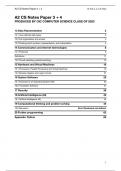
1 Standard mark allocation 2 6 Financing 39 Explain the financial reporting
2 Conceptual Framework 3 IAS 17: Leases......................... 39 treatment ............................................. 125
3 Reporting Financial Performance 3
5.2 IFRIC 4 Determining whether an Adjust the financial statements
IAS 1 ......................................... 3 Arrangement contains a Lease .................. 42 125
IFRS 8: Segmental Reporting .... 4 Financial Instruments (IAS 32, Perform financial statement
IAS 39, IFRS 7, IFRS 9, IFRS 13) ................ 43 analysis 126
IAS 34: Interim Financial
Statements ............................................... 5 6.3.1 IAS 32: Financial 11.3.1 Key Ratios.................. 127
IFRS 5: Assets Held for Sale and Instruments: Presentation ................ 43 11.3.2 Generating ideas ....... 132
Discontinued Operations .......................... 6 6.3.2 IAS 39: Financial 11.3.3 Cash flow analysis ..... 134
Distributable profits ................. 8 Instruments: Recognition and
Measurement ................................... 44 11.3.4 Methods to improve the
IAS 8: Accounting Policies quality of financial information ...... 135
Changes in Accounting Estimates and 6.3.3 IFRS 13: Fair Value
12 The audit process 136
Errors 9 Measurement ................................... 53
Underlying principles ........... 136
IAS 24: Related Party 6.3.4 Derivatives and
embedded derivatives ...................... 56 Acceptance, Risk Assessment
Transactions ........................................... 10
and Materiality..................................... 137
IAS 33: Earnings per share ...... 11 6.3.6 IFRS 7: Financial
Instruments: Disclosures (p704-707) 58 Specific risks & accounting
Audit issues for reporting estimates 140
financial performance ............................ 14 6.3.7 Hedge accounting (IAS
39) 59 Testing (substantive)............ 142
4 Revenue (IAS 11, IAS 18, IFRIC 12, IFRIC 13,
IFRS 15) 16 6.3.8 IFRS 9: Financial Groups Audit Procedures ..... 143
IAS 18: Revenue...................... 16 Instruments 67
Testing (controls) ................. 144
IFRIC 12: Service Concession Audit issues around leases and
Big data ................................ 145
Arrangements ......................................... 18 financial instruments .............................. 70
7 Remuneration 75
IT, E-Commerce and Service
IFRIC 13: Customer Loyalty Organisations ....................................... 146
Programmes ........................................... 19 IAS 19: Employee Benefits ..... 75
Reviewing the work of a junior
IAS 11: Construction Contracts IFRS 2: Share-based Payments 78 148
20
IAS 26: Retirement Benefit Plans Cyber Security (Internal
IFRS 15: Revenue from Contracts 84 Controls in an IT environment) ............ 149
with Customers ...................................... 21
Audit issues for remuneration 85 Reliance on the work of
Audits issues for revenue ....... 22 8 Foreign currency 90 others 151
5 Reporting of assets and liabilities 23
IAS 21: The Effects of Changes in Completion ..................... 154
IAS 2: Inventories ................... 23 Foreign Exchange Rates.......................... 90
Auditors reports ............. 156
IAS 16: Property, plant and IAS 29: Financial Reporting in 13 Assurance and related services 159
equipment .............................................. 24 Hyperinflationary Economies ................. 96
Types.................................... 159
IAS 23: Borrowing Costs ......... 25 Audit issues around foreign
currency transactions ............................. 97 Risks and Procedures ........... 165
IAS 20: Accounting for
14 Corporate Governance 166
Government Grants and Disclosure of 9 IAS 12: Income Taxes 99
Government Assistance .......................... 26 IAS 12 Income taxes ............... 99 Content ................................ 166
15 Ethics 171
IAS 40: Investment properties 27 Audit issues around income tax
16 Other Audit Risks and Procedures 183
IAS 41: Agriculture .................. 28 108
17 Miscellaneous areas 186
10 Group Accounting (IAS 28, IFRS3, IFRS 10,
IAS 38: Intangible Assets ........ 29 IFRS 11, IFRS 12) 109 IFRS for SMEs ....................... 186
IFRS 6: Exploration for and IFRS 10: Consolidated Financial IFRS 1: First-time Adoption of
Evaluation of Mineral Resources ............ 30 Statements / IAS 28: Investments in International Financial Reporting
Associates and Joint Ventures .............. 109 Standards 187
IAS 36: Impairments ............... 31
IFRS 3: Business combinations IFRS 14: Regulatory Deferral
IAS 37: Provisions, Contingent
118 Accounts 189
Liabilities, and Contingent Assets ........... 33
IFRS 11: Joint Arrangements 120
IAS 10: Events after the IAS 27: Separate Financial
Reporting Period..................................... 34 IFRS 12: Disclosure of Interests Statements ........................................... 190
in Other Entities ................................... 121
IFRS 4: Insurance Contracts .... 34 Differences between IFRS and
Audit issues around groups .. 122 UK GAAP 191
Audit issues for reporting assets
and liabilities .......................................... 35 11 Exam approach 125
1
,1 Standard mark allocation
FR Explain 5 marks per issue
Audit risks and procedures 15 marks
Audit procedures 10 marks
Reviewing work of a junior 10 marks
Financial statement analysis 10-15 marks
Ethics 5 marks
2
,2 Conceptual Framework
• Objectives of general purpose financial reporting – provide information to users of financial statements to aid economic
decision making
• Qualitative characteristics
o 2 fundamental characteristics
▪ Relevance
▪ Faithful representation
o 4 enhancing characteristics
▪ Comparability
▪ Understandability
▪ Timeliness
▪ Verifiability
• Elements of financial statements
o Assets – resources controlled by an entity as a result of past events from which future economic benefits will
flow
▪ Recognise if probable inflow of future economic benefits and value can be reliably measured
o Liabilities – present obligation to transfer economic benefits as a result of past events
▪ Recognise if probable outflow of future economic benefits and value can be reliably measured
o Equity – residual interest in net assets
o Income – increase in economic benefits in the form of inflows of assets or decreases in liabilities
▪ Recognise when value can be reliably measured
o Expenses – decrease in economic benefits in the form of outflows of assets or increases in liabilities
▪ Recognise when value can be reliably measured
• Measurement bases
o Historical cost = original cost of asset
o Current cost = cost now to replace with similar asset
o Realisable value = amount asset could be sold for
o Present value = discounted value of cash flows from asset
3 Reporting Financial Performance
IAS 1
It is management's responsibility to make an assessment of whether the company is a going concern.
The assessment should be supported by forecasts covering at least 12 months after the SFP date.
If the company is not considered to be a going concern the basis on which the accounts have been prepared (generally the break-
up basis) and the reasons why the company is not considered a going concern should be disclosed.
All liabilities should be shown as short term whether or not they are able to reschedule payments
Just because a company can’t meet their covenants doesn’t necessarily mean that the entity is not a going concern if the finance
risk can be counterbalances by management’s plans to reschedule its loan capital.
If no longer a going concern – additional disclosures required under IAS 1.
If uncertainty over going concern, FS must disclosure clearly there is a material uncertainty.
If auditors consider that adequate disclosures have been made, the audit opinion is unmodified by a Material Uncertainty related to
Going in Concern section is added.
If adequate disclosures are not made, the auditors must express a qualified or adverse opinion.
Auditors need to operate in line with ISA 570 which requires them to evaluate management’s assessment of the businesses ability
to continue as a going concern which would involve examining the process involved in the assessment, the assumptions upon
which the assessment is based and managements plans for the future.
3
, IFRS 8: Segmental Reporting
= Only applies to entities whose equity/debt is traded on public markets
In group accounts, only consolidated segmental information needs to be shown.
Operating segments are components of an entity:
• that engage in business activities from which revenues are earned and expenses incurred
• whose results are regularly reviewed by chief operating decision maker and
• for which discrete financial information is available.
Operating segments are identified on a managerial basis i.e. segments are based on the information used internally for decision
marking.
Identifying reportable segments
1. The segment must meet one of the three following tests:
• Segment total sales ≥ 10% of total sales of all segments
• Segment profit/ loss ≥ 10% of the combined result of all segments in profit or the combined result of all segments in
loss, whichever is the greater in absolute amount
• Segment assets ≥ 10% of total assets of all segments.
2. Ensure that the external revenue of segments identified as reportable ≥ 75% total external revenue. If this is not the case,
add in other segments lost at step 1 until the 75% threshold is met.
Note: Segments that do not meet the thresholds may be reported if management believe the information would be useful to the
users of the financial statements.
Aggregation - Operating segments may be aggregated if they have similar economic characteristics, and are similar in one of the
following:
• products/services
• production processes
• types of customer
• distribution methods or
• regulatory environment.
Disclosures
General information
• Factors used to identify reportable segments
• Types of product and services from which each reportable segment derives its revenues
Segment items
For each reportable segment, an entity should report:
• A measure of profit or loss
• A measure of total assets (if used in decision making)
• A measure of total liabilities (if used in decision making)
The measure disclosed should be the measure used in internal reporting which may be different to the method used in the
published financial statements.
A more detailed breakdown of the measure of profit or loss disclosed above may be required if that information is reviewed by the
chief operating decision maker on a regular basis.
4
2 Conceptual Framework 3 IAS 17: Leases......................... 39 treatment ............................................. 125
3 Reporting Financial Performance 3
5.2 IFRIC 4 Determining whether an Adjust the financial statements
IAS 1 ......................................... 3 Arrangement contains a Lease .................. 42 125
IFRS 8: Segmental Reporting .... 4 Financial Instruments (IAS 32, Perform financial statement
IAS 39, IFRS 7, IFRS 9, IFRS 13) ................ 43 analysis 126
IAS 34: Interim Financial
Statements ............................................... 5 6.3.1 IAS 32: Financial 11.3.1 Key Ratios.................. 127
IFRS 5: Assets Held for Sale and Instruments: Presentation ................ 43 11.3.2 Generating ideas ....... 132
Discontinued Operations .......................... 6 6.3.2 IAS 39: Financial 11.3.3 Cash flow analysis ..... 134
Distributable profits ................. 8 Instruments: Recognition and
Measurement ................................... 44 11.3.4 Methods to improve the
IAS 8: Accounting Policies quality of financial information ...... 135
Changes in Accounting Estimates and 6.3.3 IFRS 13: Fair Value
12 The audit process 136
Errors 9 Measurement ................................... 53
Underlying principles ........... 136
IAS 24: Related Party 6.3.4 Derivatives and
embedded derivatives ...................... 56 Acceptance, Risk Assessment
Transactions ........................................... 10
and Materiality..................................... 137
IAS 33: Earnings per share ...... 11 6.3.6 IFRS 7: Financial
Instruments: Disclosures (p704-707) 58 Specific risks & accounting
Audit issues for reporting estimates 140
financial performance ............................ 14 6.3.7 Hedge accounting (IAS
39) 59 Testing (substantive)............ 142
4 Revenue (IAS 11, IAS 18, IFRIC 12, IFRIC 13,
IFRS 15) 16 6.3.8 IFRS 9: Financial Groups Audit Procedures ..... 143
IAS 18: Revenue...................... 16 Instruments 67
Testing (controls) ................. 144
IFRIC 12: Service Concession Audit issues around leases and
Big data ................................ 145
Arrangements ......................................... 18 financial instruments .............................. 70
7 Remuneration 75
IT, E-Commerce and Service
IFRIC 13: Customer Loyalty Organisations ....................................... 146
Programmes ........................................... 19 IAS 19: Employee Benefits ..... 75
Reviewing the work of a junior
IAS 11: Construction Contracts IFRS 2: Share-based Payments 78 148
20
IAS 26: Retirement Benefit Plans Cyber Security (Internal
IFRS 15: Revenue from Contracts 84 Controls in an IT environment) ............ 149
with Customers ...................................... 21
Audit issues for remuneration 85 Reliance on the work of
Audits issues for revenue ....... 22 8 Foreign currency 90 others 151
5 Reporting of assets and liabilities 23
IAS 21: The Effects of Changes in Completion ..................... 154
IAS 2: Inventories ................... 23 Foreign Exchange Rates.......................... 90
Auditors reports ............. 156
IAS 16: Property, plant and IAS 29: Financial Reporting in 13 Assurance and related services 159
equipment .............................................. 24 Hyperinflationary Economies ................. 96
Types.................................... 159
IAS 23: Borrowing Costs ......... 25 Audit issues around foreign
currency transactions ............................. 97 Risks and Procedures ........... 165
IAS 20: Accounting for
14 Corporate Governance 166
Government Grants and Disclosure of 9 IAS 12: Income Taxes 99
Government Assistance .......................... 26 IAS 12 Income taxes ............... 99 Content ................................ 166
15 Ethics 171
IAS 40: Investment properties 27 Audit issues around income tax
16 Other Audit Risks and Procedures 183
IAS 41: Agriculture .................. 28 108
17 Miscellaneous areas 186
10 Group Accounting (IAS 28, IFRS3, IFRS 10,
IAS 38: Intangible Assets ........ 29 IFRS 11, IFRS 12) 109 IFRS for SMEs ....................... 186
IFRS 6: Exploration for and IFRS 10: Consolidated Financial IFRS 1: First-time Adoption of
Evaluation of Mineral Resources ............ 30 Statements / IAS 28: Investments in International Financial Reporting
Associates and Joint Ventures .............. 109 Standards 187
IAS 36: Impairments ............... 31
IFRS 3: Business combinations IFRS 14: Regulatory Deferral
IAS 37: Provisions, Contingent
118 Accounts 189
Liabilities, and Contingent Assets ........... 33
IFRS 11: Joint Arrangements 120
IAS 10: Events after the IAS 27: Separate Financial
Reporting Period..................................... 34 IFRS 12: Disclosure of Interests Statements ........................................... 190
in Other Entities ................................... 121
IFRS 4: Insurance Contracts .... 34 Differences between IFRS and
Audit issues around groups .. 122 UK GAAP 191
Audit issues for reporting assets
and liabilities .......................................... 35 11 Exam approach 125
1
,1 Standard mark allocation
FR Explain 5 marks per issue
Audit risks and procedures 15 marks
Audit procedures 10 marks
Reviewing work of a junior 10 marks
Financial statement analysis 10-15 marks
Ethics 5 marks
2
,2 Conceptual Framework
• Objectives of general purpose financial reporting – provide information to users of financial statements to aid economic
decision making
• Qualitative characteristics
o 2 fundamental characteristics
▪ Relevance
▪ Faithful representation
o 4 enhancing characteristics
▪ Comparability
▪ Understandability
▪ Timeliness
▪ Verifiability
• Elements of financial statements
o Assets – resources controlled by an entity as a result of past events from which future economic benefits will
flow
▪ Recognise if probable inflow of future economic benefits and value can be reliably measured
o Liabilities – present obligation to transfer economic benefits as a result of past events
▪ Recognise if probable outflow of future economic benefits and value can be reliably measured
o Equity – residual interest in net assets
o Income – increase in economic benefits in the form of inflows of assets or decreases in liabilities
▪ Recognise when value can be reliably measured
o Expenses – decrease in economic benefits in the form of outflows of assets or increases in liabilities
▪ Recognise when value can be reliably measured
• Measurement bases
o Historical cost = original cost of asset
o Current cost = cost now to replace with similar asset
o Realisable value = amount asset could be sold for
o Present value = discounted value of cash flows from asset
3 Reporting Financial Performance
IAS 1
It is management's responsibility to make an assessment of whether the company is a going concern.
The assessment should be supported by forecasts covering at least 12 months after the SFP date.
If the company is not considered to be a going concern the basis on which the accounts have been prepared (generally the break-
up basis) and the reasons why the company is not considered a going concern should be disclosed.
All liabilities should be shown as short term whether or not they are able to reschedule payments
Just because a company can’t meet their covenants doesn’t necessarily mean that the entity is not a going concern if the finance
risk can be counterbalances by management’s plans to reschedule its loan capital.
If no longer a going concern – additional disclosures required under IAS 1.
If uncertainty over going concern, FS must disclosure clearly there is a material uncertainty.
If auditors consider that adequate disclosures have been made, the audit opinion is unmodified by a Material Uncertainty related to
Going in Concern section is added.
If adequate disclosures are not made, the auditors must express a qualified or adverse opinion.
Auditors need to operate in line with ISA 570 which requires them to evaluate management’s assessment of the businesses ability
to continue as a going concern which would involve examining the process involved in the assessment, the assumptions upon
which the assessment is based and managements plans for the future.
3
, IFRS 8: Segmental Reporting
= Only applies to entities whose equity/debt is traded on public markets
In group accounts, only consolidated segmental information needs to be shown.
Operating segments are components of an entity:
• that engage in business activities from which revenues are earned and expenses incurred
• whose results are regularly reviewed by chief operating decision maker and
• for which discrete financial information is available.
Operating segments are identified on a managerial basis i.e. segments are based on the information used internally for decision
marking.
Identifying reportable segments
1. The segment must meet one of the three following tests:
• Segment total sales ≥ 10% of total sales of all segments
• Segment profit/ loss ≥ 10% of the combined result of all segments in profit or the combined result of all segments in
loss, whichever is the greater in absolute amount
• Segment assets ≥ 10% of total assets of all segments.
2. Ensure that the external revenue of segments identified as reportable ≥ 75% total external revenue. If this is not the case,
add in other segments lost at step 1 until the 75% threshold is met.
Note: Segments that do not meet the thresholds may be reported if management believe the information would be useful to the
users of the financial statements.
Aggregation - Operating segments may be aggregated if they have similar economic characteristics, and are similar in one of the
following:
• products/services
• production processes
• types of customer
• distribution methods or
• regulatory environment.
Disclosures
General information
• Factors used to identify reportable segments
• Types of product and services from which each reportable segment derives its revenues
Segment items
For each reportable segment, an entity should report:
• A measure of profit or loss
• A measure of total assets (if used in decision making)
• A measure of total liabilities (if used in decision making)
The measure disclosed should be the measure used in internal reporting which may be different to the method used in the
published financial statements.
A more detailed breakdown of the measure of profit or loss disclosed above may be required if that information is reviewed by the
chief operating decision maker on a regular basis.
4