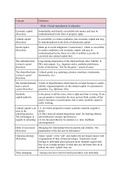
Concept Definition
Week 1 Social reproduction in education
Economic capital Immediately and directly convertible into money and may be
(Bourdieu) institutionalized in the form of property rights
Cultural capital Is convertible, in certain conditions, into economic capital and may
(Bourdieu) be institutionalized in the form of educational capital.
Social capital Made up of social obligations (‘connections’), which is convertible,
(Bourdieu) in certain conditions, into economic capital, and may be
institutionalized in the forms of a title of nobility. [can also be
converted into cultural capital tho]
The embodied state Long-lasting dispositions of the mind and body (also ‘habitus’ in
(cultural capital PB’s tech jargon). E.g., linguistic styles, aesthetic preferences,
Bourdieu) styles of interaction, ‘feel for the game’, ‘practical sense’.
The objectified state Cultural goods (e.g. paintings, pictures, machines, instruments,
(cultural capital dictionaries, etc.)
Bourdieu)
The institutionalized A form of objectification which must be set apart because it confers
state (cultural entirely original properties on the cultural capital it is presumed to
capital Bourdieu) guarantee. E.g. diplomas, titles
Symbolic Is the power to tell the story, what is right and what is wrong. If you
capital/authority can get people to internalize the story and not think outside of that
when it becomes a second nature, that is when symbolic capital is
really working.
Cultural capital is an (1) Are better prepared to master academic material (cognitive
asset in the skills)
schooling process. (2) Have more developed disposition/‘taste’ for learning abstract
The advantaged, in and intellectual concepts (preferences)
regards to schooling: (3) Are favoured directly by teachers (i.e. time, feedback,
encouragement)
Order of succession Managing the relationship between parents and children, “the
(Bourdieu) perpetuation of the line and its inheritance”
Charisma ideology Values “grade” or the “gift” and enables the privileged classes with
(Bourdieu) a legitimation of their cultural privileges. Transforms social
heritage to individual grace/personal merit. Students regard what
they do as a simple product of what they are; the better they do in
school, the more “gifted” they are
Three damaging - Saying your son is bad in French just makes it an individual
, influences on destiny out of what is only the product of an education and can still
children (Bourdieu) be corrected partly by educative action
- A child’s results are a direct function of the cultural
atmosphere of their family background
- Simply using a test score as the basis for premature definitive
conclusions while there is more to your child
- By stating that your son is bad, it intensifies the child’s sense that
he is this or that by nature → multiplies social inequalities of the
disadvantaged classes
Symbolic violence Non-physical violence manifested in power differences between
social groups
Rules of the game Understanding the cultural and social environment of a place
(F&L)
Class ceiling (F&L) Derived from glass ceiling → visible, durable barriers that lower
classes (middle and lower class) face in achieving the same
positions/rewards as higher class
Field Kind of like an arena, like in art, education, religion, etc. Each field
has its specific rules and practices
Week 2 From origin to education across countries
What does inequality Different potentials, e.g. naturally better at running.
of outcomes come
from? (lecture 2)
Where does Different opportunities, e.g. better running shoes → seen as unfair
inequality of as people are not given equal opportunities and can’t show their
opportunity come “true potential/skills”
from? (lecture 2)
Intersectionality At this point, we know what it is
(F&L)
Three drivers of 1. privileged backgrounds have higher and more prestigious
class pay gap (F&L) educational credentials
2. they are more likely to live in London and/or move to London
for work
3. they tend to sort into certain occupations and larger firms
Meritocratic ideal We accept inequality of outcomes because people “just have
(lecture 2) different potential” → but when it becomes too much then
eyebrows are raised
IEO (lecture 2) Inequality of Educational Opportunity
2 main ways parents 1. Providing more cognitive development opportunities (e.g.
Week 1 Social reproduction in education
Economic capital Immediately and directly convertible into money and may be
(Bourdieu) institutionalized in the form of property rights
Cultural capital Is convertible, in certain conditions, into economic capital and may
(Bourdieu) be institutionalized in the form of educational capital.
Social capital Made up of social obligations (‘connections’), which is convertible,
(Bourdieu) in certain conditions, into economic capital, and may be
institutionalized in the forms of a title of nobility. [can also be
converted into cultural capital tho]
The embodied state Long-lasting dispositions of the mind and body (also ‘habitus’ in
(cultural capital PB’s tech jargon). E.g., linguistic styles, aesthetic preferences,
Bourdieu) styles of interaction, ‘feel for the game’, ‘practical sense’.
The objectified state Cultural goods (e.g. paintings, pictures, machines, instruments,
(cultural capital dictionaries, etc.)
Bourdieu)
The institutionalized A form of objectification which must be set apart because it confers
state (cultural entirely original properties on the cultural capital it is presumed to
capital Bourdieu) guarantee. E.g. diplomas, titles
Symbolic Is the power to tell the story, what is right and what is wrong. If you
capital/authority can get people to internalize the story and not think outside of that
when it becomes a second nature, that is when symbolic capital is
really working.
Cultural capital is an (1) Are better prepared to master academic material (cognitive
asset in the skills)
schooling process. (2) Have more developed disposition/‘taste’ for learning abstract
The advantaged, in and intellectual concepts (preferences)
regards to schooling: (3) Are favoured directly by teachers (i.e. time, feedback,
encouragement)
Order of succession Managing the relationship between parents and children, “the
(Bourdieu) perpetuation of the line and its inheritance”
Charisma ideology Values “grade” or the “gift” and enables the privileged classes with
(Bourdieu) a legitimation of their cultural privileges. Transforms social
heritage to individual grace/personal merit. Students regard what
they do as a simple product of what they are; the better they do in
school, the more “gifted” they are
Three damaging - Saying your son is bad in French just makes it an individual
, influences on destiny out of what is only the product of an education and can still
children (Bourdieu) be corrected partly by educative action
- A child’s results are a direct function of the cultural
atmosphere of their family background
- Simply using a test score as the basis for premature definitive
conclusions while there is more to your child
- By stating that your son is bad, it intensifies the child’s sense that
he is this or that by nature → multiplies social inequalities of the
disadvantaged classes
Symbolic violence Non-physical violence manifested in power differences between
social groups
Rules of the game Understanding the cultural and social environment of a place
(F&L)
Class ceiling (F&L) Derived from glass ceiling → visible, durable barriers that lower
classes (middle and lower class) face in achieving the same
positions/rewards as higher class
Field Kind of like an arena, like in art, education, religion, etc. Each field
has its specific rules and practices
Week 2 From origin to education across countries
What does inequality Different potentials, e.g. naturally better at running.
of outcomes come
from? (lecture 2)
Where does Different opportunities, e.g. better running shoes → seen as unfair
inequality of as people are not given equal opportunities and can’t show their
opportunity come “true potential/skills”
from? (lecture 2)
Intersectionality At this point, we know what it is
(F&L)
Three drivers of 1. privileged backgrounds have higher and more prestigious
class pay gap (F&L) educational credentials
2. they are more likely to live in London and/or move to London
for work
3. they tend to sort into certain occupations and larger firms
Meritocratic ideal We accept inequality of outcomes because people “just have
(lecture 2) different potential” → but when it becomes too much then
eyebrows are raised
IEO (lecture 2) Inequality of Educational Opportunity
2 main ways parents 1. Providing more cognitive development opportunities (e.g.