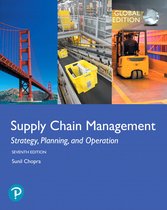
Supply Chain Management, 6e, Global Edition (Chopra/Meindl)
Chapter 11 Managing Economies of Scale in the Supply Chain: Cycle Inventory
11.1 True/False Questions
1) Cycle inventory exists because producing or purchasing in large lots allows a stage of the
supply chain to exploit economies of scale and increase cost.
Answer: FALSE
Diff: 2
Topic: 11.1 The Role of Cycle Inventory in a Supply Chain
AACSB: Analytical thinking
Objective: LO 11.1: Balance the appropriate costs to choose the optimal lot size and cycle
inventory in a supply chain.
2) Cycle inventory is the physical inventory in the supply chain due to either production or
purchases demanded by the customer.
Answer: TRUE
Diff: 2
Topic: 11.1 The Role of Cycle Inventory in a Supply Chain
AACSB: Analytical thinking
Objective: LO 11.1: Balance the appropriate costs to choose the optimal lot size and cycle
inventory in a supply chain.
3) Lot sizes and cycle inventory do not affect the flow time of material within the supply chain.
Answer: FALSE
Diff: 1
Topic: 11.1 The Role of Cycle Inventory in a Supply Chain
AACSB: Analytical thinking
Objective: LO 11.1: Balance the appropriate costs to choose the optimal lot size and cycle
inventory in a supply chain.
4) Average flow time resulting from cycle inventory = Cycle Inventory/Demand = Q/2D.
Answer: TRUE
Diff: 2
Topic: 11.1 The Role of Cycle Inventory in a Supply Chain
AACSB: Analytical thinking
Objective: LO 11.1: Balance the appropriate costs to choose the optimal lot size and cycle
inventory in a supply chain.
5) Cycle inventory is primarily held to take advantage of economies of scale and reduce profit
within the supply chain.
Answer: FALSE
Diff: 1
Topic: 11.1 The Role of Cycle Inventory in a Supply Chain
AACSB: Analytical thinking
Objective: LO 11.1: Balance the appropriate costs to choose the optimal lot size and cycle
inventory in a supply chain.
1
Copyright © 2016 Pearson Education, Ltd.
,6) Cycle inventory exists in a supply chain because different stages exploit economies of scale to
lower total cost.
Answer: TRUE
Diff: 1
Topic: 11.1 The Role of Cycle Inventory in a Supply Chain
AACSB: Analytical thinking
Objective: LO 11.1: Balance the appropriate costs to choose the optimal lot size and cycle
inventory in a supply chain.
7) The costs considered in lot sizing decisions include material cost, fixed ordering cost, and
manufacturing cost.
Answer: FALSE
Diff: 2
Topic: 11.2 Estimating Cycle Inventory-Related Costs in Practice
AACSB: Analytical thinking
Objective: LO 11.1: Balance the appropriate costs to choose the optimal lot size and cycle
inventory in a supply chain.
8) A firm is often better served by ordering a convenient lot size close to the economic order
quantity rather than the precise EOQ.
Answer: TRUE
Diff: 2
Topic: 11.3 Economies of Scale to Exploit Fixed Costs
AACSB: Analytical thinking
Objective: LO 11.1: Balance the appropriate costs to choose the optimal lot size and cycle
inventory in a supply chain.
9) To reduce the optimal lot size by a factor of k, the fixed order cost S must be reduced by a
factor of k.
Answer: FALSE
Diff: 2
Topic: 11.3 Economies of Scale to Exploit Fixed Costs
AACSB: Analytical thinking
Objective: LO 11.1: Balance the appropriate costs to choose the optimal lot size and cycle
inventory in a supply chain.
10) Aggregating across products, retailers, or suppliers in a single order allows for a reduction in
lot size for individual products because fixed ordering and transportation costs are now spread
across multiple products, retailers, or suppliers.
Answer: TRUE
Diff: 2
Topic: 11.3 Economies of Scale to Exploit Fixed Costs
AACSB: Analytical thinking
Objective: LO 11.1: Balance the appropriate costs to choose the optimal lot size and cycle
inventory in a supply chain.
2
Copyright © 2016 Pearson Education, Ltd.
, 11) A key to reducing cycle inventory is the reduction of lot size.
Answer: TRUE
Diff: 1
Topic: 11.3 Economies of Scale to Exploit Fixed Costs
AACSB: Analytical thinking
Objective: LO 11.1: Balance the appropriate costs to choose the optimal lot size and cycle
inventory in a supply chain.
12) Reduction of fixed cost may be achieved by aggregating lots across multiple products,
customers, or suppliers.
Answer: TRUE
Diff: 1
Topic: 11.3 Economies of Scale to Exploit Fixed Costs
AACSB: Analytical thinking
Objective: LO 11.1: Balance the appropriate costs to choose the optimal lot size and cycle
inventory in a supply chain.
13) A discount is volume-based if the pricing schedule offers discounts based on the quantity
ordered in a single lot.
Answer: FALSE
Diff: 3
Topic: 11.5 Economies of Scale to Exploit Quantity Discounts
AACSB: Analytical thinking
Objective: LO 11.2: Understand the impact of quantity discounts on lot size and cycle inventory.
14) Pricing schedules with all unit quantity discounts encourage retailers to increase the size of
their lots, which reduces the average inventory and flow time in a supply chain.
Answer: FALSE
Diff: 2
Topic: 11.5 Economies of Scale to Exploit Quantity Discounts
AACSB: Analytical thinking
Objective: LO 11.3: Devise appropriate discounting schemes for a supply chain.
15) Marginal unit quantity discounts have also been referred to as multi-block tariffs.
Answer: TRUE
Diff: 2
Topic: 11.5 Economies of Scale to Exploit Quantity Discounts
AACSB: Analytical thinking
Objective: LO 11.2: Understand the impact of quantity discounts on lot size and cycle inventory.
3
Copyright © 2016 Pearson Education, Ltd.
Chapter 11 Managing Economies of Scale in the Supply Chain: Cycle Inventory
11.1 True/False Questions
1) Cycle inventory exists because producing or purchasing in large lots allows a stage of the
supply chain to exploit economies of scale and increase cost.
Answer: FALSE
Diff: 2
Topic: 11.1 The Role of Cycle Inventory in a Supply Chain
AACSB: Analytical thinking
Objective: LO 11.1: Balance the appropriate costs to choose the optimal lot size and cycle
inventory in a supply chain.
2) Cycle inventory is the physical inventory in the supply chain due to either production or
purchases demanded by the customer.
Answer: TRUE
Diff: 2
Topic: 11.1 The Role of Cycle Inventory in a Supply Chain
AACSB: Analytical thinking
Objective: LO 11.1: Balance the appropriate costs to choose the optimal lot size and cycle
inventory in a supply chain.
3) Lot sizes and cycle inventory do not affect the flow time of material within the supply chain.
Answer: FALSE
Diff: 1
Topic: 11.1 The Role of Cycle Inventory in a Supply Chain
AACSB: Analytical thinking
Objective: LO 11.1: Balance the appropriate costs to choose the optimal lot size and cycle
inventory in a supply chain.
4) Average flow time resulting from cycle inventory = Cycle Inventory/Demand = Q/2D.
Answer: TRUE
Diff: 2
Topic: 11.1 The Role of Cycle Inventory in a Supply Chain
AACSB: Analytical thinking
Objective: LO 11.1: Balance the appropriate costs to choose the optimal lot size and cycle
inventory in a supply chain.
5) Cycle inventory is primarily held to take advantage of economies of scale and reduce profit
within the supply chain.
Answer: FALSE
Diff: 1
Topic: 11.1 The Role of Cycle Inventory in a Supply Chain
AACSB: Analytical thinking
Objective: LO 11.1: Balance the appropriate costs to choose the optimal lot size and cycle
inventory in a supply chain.
1
Copyright © 2016 Pearson Education, Ltd.
,6) Cycle inventory exists in a supply chain because different stages exploit economies of scale to
lower total cost.
Answer: TRUE
Diff: 1
Topic: 11.1 The Role of Cycle Inventory in a Supply Chain
AACSB: Analytical thinking
Objective: LO 11.1: Balance the appropriate costs to choose the optimal lot size and cycle
inventory in a supply chain.
7) The costs considered in lot sizing decisions include material cost, fixed ordering cost, and
manufacturing cost.
Answer: FALSE
Diff: 2
Topic: 11.2 Estimating Cycle Inventory-Related Costs in Practice
AACSB: Analytical thinking
Objective: LO 11.1: Balance the appropriate costs to choose the optimal lot size and cycle
inventory in a supply chain.
8) A firm is often better served by ordering a convenient lot size close to the economic order
quantity rather than the precise EOQ.
Answer: TRUE
Diff: 2
Topic: 11.3 Economies of Scale to Exploit Fixed Costs
AACSB: Analytical thinking
Objective: LO 11.1: Balance the appropriate costs to choose the optimal lot size and cycle
inventory in a supply chain.
9) To reduce the optimal lot size by a factor of k, the fixed order cost S must be reduced by a
factor of k.
Answer: FALSE
Diff: 2
Topic: 11.3 Economies of Scale to Exploit Fixed Costs
AACSB: Analytical thinking
Objective: LO 11.1: Balance the appropriate costs to choose the optimal lot size and cycle
inventory in a supply chain.
10) Aggregating across products, retailers, or suppliers in a single order allows for a reduction in
lot size for individual products because fixed ordering and transportation costs are now spread
across multiple products, retailers, or suppliers.
Answer: TRUE
Diff: 2
Topic: 11.3 Economies of Scale to Exploit Fixed Costs
AACSB: Analytical thinking
Objective: LO 11.1: Balance the appropriate costs to choose the optimal lot size and cycle
inventory in a supply chain.
2
Copyright © 2016 Pearson Education, Ltd.
, 11) A key to reducing cycle inventory is the reduction of lot size.
Answer: TRUE
Diff: 1
Topic: 11.3 Economies of Scale to Exploit Fixed Costs
AACSB: Analytical thinking
Objective: LO 11.1: Balance the appropriate costs to choose the optimal lot size and cycle
inventory in a supply chain.
12) Reduction of fixed cost may be achieved by aggregating lots across multiple products,
customers, or suppliers.
Answer: TRUE
Diff: 1
Topic: 11.3 Economies of Scale to Exploit Fixed Costs
AACSB: Analytical thinking
Objective: LO 11.1: Balance the appropriate costs to choose the optimal lot size and cycle
inventory in a supply chain.
13) A discount is volume-based if the pricing schedule offers discounts based on the quantity
ordered in a single lot.
Answer: FALSE
Diff: 3
Topic: 11.5 Economies of Scale to Exploit Quantity Discounts
AACSB: Analytical thinking
Objective: LO 11.2: Understand the impact of quantity discounts on lot size and cycle inventory.
14) Pricing schedules with all unit quantity discounts encourage retailers to increase the size of
their lots, which reduces the average inventory and flow time in a supply chain.
Answer: FALSE
Diff: 2
Topic: 11.5 Economies of Scale to Exploit Quantity Discounts
AACSB: Analytical thinking
Objective: LO 11.3: Devise appropriate discounting schemes for a supply chain.
15) Marginal unit quantity discounts have also been referred to as multi-block tariffs.
Answer: TRUE
Diff: 2
Topic: 11.5 Economies of Scale to Exploit Quantity Discounts
AACSB: Analytical thinking
Objective: LO 11.2: Understand the impact of quantity discounts on lot size and cycle inventory.
3
Copyright © 2016 Pearson Education, Ltd.