BUSINESS IB NOTES
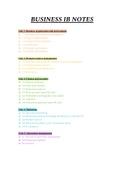
Unit 1: Business organisation and environment
❏ 1.1 Introduction to business management
❏ 1.2 Types of organisations
❏ 1.3 Organisational objectives
❏ 1.4 Stakeholders
❏ 1.5 External environment
❏ 1.6 Growth and evolution
Unit 2: Human resource management
❏ 2.1 Functions and evolution of human resource management
❏ 2.2 Organisational structure
❏ 2.3 Leadership and management
❏ 2.4 Motivation
Unit 3: Finance and accounts
❏ 3.1 Sources of finance
❏ 3.2 Costs and revenues
❏ 3.3 Break-even analysis
❏ 3.4 Final accounts (some HL only)
❏ 3.5 Profitability and liquidity ratio analysis
❏ 3.7 Cash flow
❏ 3.8 Investment appraisal (some HL only)
Unit 4: Marketing
❏ 4.1 The role of marketing
❏ 4.2 Marketing planning (including introduction to the four Ps)
❏ 4.4 Market research
❏ 4.5 The four Ps (product, price, promotion, place)
❏ 4.8 E-commerce
Unit 5: Operations management
❏ 5.1 The role of operations management
❏ 5.2 Production methods
❏ 5.4 Location
, 1
GENERAL:
Change: The adaptation of the organization to accommodate the external business environment
- Firms usually implement changes to survive, expand or remain competitive (due to
arising external influences [changes in the economy or industry])
Culture: reference to the aspects within a contextual environment which influences firms in many
ways. It can be classified into internal and external culture
- The difference in cultures is one of many factors that lead to product diversification
- Internal culture: the way the firm operates, influenced by their aims and objectives
- External culture: traditional beliefs and ideologies of a country or region
Ethics: the values and principles that influence how individuals, groups and societies behave
- Something can be unethical but still legal
- Business ethics: the values and principles that operate in the world of business (social
costs, social benefits
Globalization: the process of interaction and integration between the people, firms and
governments of different nations driven by international trade.
- Expansion (exporting; hiring overseas labour)
Innovation: incremental or radical improvement to a business idea, or generation of new ideas
- An innovative solution is usually one that is not in the market;s expectations, but still
meets the demands of the market
Strategy: the set of long-term planning decisions that organizations make in order to achieve a
common goal in the interest of the organization and/or specific stakeholders
- Set of decisions that aim to achieve business objectives.
, 2
Unit 3: Finance and accounts
3.1 Sources of finance
FINANCE AND ACCOUNTING DEPARTMENT tasks:
- Keeps track of company’s expenses: building rent; paperclips; electricity bill
- Allocate funds to HR; Marketing and operations departments of the business.
- Plan for the business’ financial future
Capital expenditure:
- Spending on a firm's fixed assets (smt a firm plans to keep for longer than a year)
- Eg: purchases of land; buildings or machines
- Normally funded using long-term sources of finance
Revenue expenditure:
- Spending on a firm’s general operating costs
- Day-today running costs of the firm
- Eg: paying wages/salaries to employees; paying suppliers; utility bills (gas;
electricity; water); repayments of debts (mortgages and loans); settling tax bills
with the gov.
- Insolvency: if a firm cannot pay its revenue expenditure, it will go out of business
quickly
- Funded through shot or medium term sources of finance
Sources of finance can be
- internal or external
- used in short-term (st); medium-term (mt); or long-term (lt)
Factors influencing the choice of funds:
- Purpose of the funds
- Cost of using them
- Size of business
- Amount required
- Flexibility required
- External env: economy
Unit 1: Business organisation and environment
❏ 1.1 Introduction to business management
❏ 1.2 Types of organisations
❏ 1.3 Organisational objectives
❏ 1.4 Stakeholders
❏ 1.5 External environment
❏ 1.6 Growth and evolution
Unit 2: Human resource management
❏ 2.1 Functions and evolution of human resource management
❏ 2.2 Organisational structure
❏ 2.3 Leadership and management
❏ 2.4 Motivation
Unit 3: Finance and accounts
❏ 3.1 Sources of finance
❏ 3.2 Costs and revenues
❏ 3.3 Break-even analysis
❏ 3.4 Final accounts (some HL only)
❏ 3.5 Profitability and liquidity ratio analysis
❏ 3.7 Cash flow
❏ 3.8 Investment appraisal (some HL only)
Unit 4: Marketing
❏ 4.1 The role of marketing
❏ 4.2 Marketing planning (including introduction to the four Ps)
❏ 4.4 Market research
❏ 4.5 The four Ps (product, price, promotion, place)
❏ 4.8 E-commerce
Unit 5: Operations management
❏ 5.1 The role of operations management
❏ 5.2 Production methods
❏ 5.4 Location
, 1
GENERAL:
Change: The adaptation of the organization to accommodate the external business environment
- Firms usually implement changes to survive, expand or remain competitive (due to
arising external influences [changes in the economy or industry])
Culture: reference to the aspects within a contextual environment which influences firms in many
ways. It can be classified into internal and external culture
- The difference in cultures is one of many factors that lead to product diversification
- Internal culture: the way the firm operates, influenced by their aims and objectives
- External culture: traditional beliefs and ideologies of a country or region
Ethics: the values and principles that influence how individuals, groups and societies behave
- Something can be unethical but still legal
- Business ethics: the values and principles that operate in the world of business (social
costs, social benefits
Globalization: the process of interaction and integration between the people, firms and
governments of different nations driven by international trade.
- Expansion (exporting; hiring overseas labour)
Innovation: incremental or radical improvement to a business idea, or generation of new ideas
- An innovative solution is usually one that is not in the market;s expectations, but still
meets the demands of the market
Strategy: the set of long-term planning decisions that organizations make in order to achieve a
common goal in the interest of the organization and/or specific stakeholders
- Set of decisions that aim to achieve business objectives.
, 2
Unit 3: Finance and accounts
3.1 Sources of finance
FINANCE AND ACCOUNTING DEPARTMENT tasks:
- Keeps track of company’s expenses: building rent; paperclips; electricity bill
- Allocate funds to HR; Marketing and operations departments of the business.
- Plan for the business’ financial future
Capital expenditure:
- Spending on a firm's fixed assets (smt a firm plans to keep for longer than a year)
- Eg: purchases of land; buildings or machines
- Normally funded using long-term sources of finance
Revenue expenditure:
- Spending on a firm’s general operating costs
- Day-today running costs of the firm
- Eg: paying wages/salaries to employees; paying suppliers; utility bills (gas;
electricity; water); repayments of debts (mortgages and loans); settling tax bills
with the gov.
- Insolvency: if a firm cannot pay its revenue expenditure, it will go out of business
quickly
- Funded through shot or medium term sources of finance
Sources of finance can be
- internal or external
- used in short-term (st); medium-term (mt); or long-term (lt)
Factors influencing the choice of funds:
- Purpose of the funds
- Cost of using them
- Size of business
- Amount required
- Flexibility required
- External env: economy