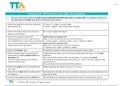
Assignment B - PPP Grammar Lesson Table: First Conditional
✓ NB: Look at the model provided and make sure you understand what MFP refer to here. See Units 2 and 7. For example, in number 4 in
the table below, we do NOT mean 'What is the function of the lesson'!!!
1. What is the target form of the first conditional 1st clause – If + Subject + present simple,
(both clauses)? (F) 2nd clause – Subject + future simple (will + infinitive)
2. What is the model sentence you will elicit to If it is sunny I will go to the beach.
begin your presentation?
3. What are the negative and question Model sentence in negative form:
(interrogative) forms of your model sentence? Form: If it isn’t sunny tomorrow I won’t go to the beach.
(You might find there is more than one possibility, If + auxiliary negative + infinitive, subject + won’t + infinitive (+ object)
but you only need to show one negative and one Model sentence in question form:
question, then analyse the forms.) Form: If it is sunny tomorrow, will I go to the beach?
If + infinitive, will + subject + infinitive (+ object)
4. What is the function? (M) To talk about a situation in the future and a consequent result or action.
5. What do students need to know about the In affirmative form stress is put on the present simple in the first clause. i.e. If it sunny
pronunciation, including sentence stress and tomorrow,
intonation? (P) And in the second clause the stress is on the object. i.e. I will go to the beach.
(Think only about how the model sentence Very often we contract the pronoun with will. E.g. I’ll – you’ll – we’ll etc. in place of I will,
would normally be said.) you will, we will.
Stress can be put on the words If and will for emphasis.
6. What is the context I will use to introduce the Talking about what we will do if it rains or if it is sunny.
form? (M)
7. How will I try to elicit the first conditional from By showing them the video of rain on an umbrella, and pictures of a sunny beach and a rain
the students? cloud and umbrella.
8. How will I encourage students to analyse the We will explore the construction using the model sentence, and any others, (see iii)
© 2020 The TEFL Academy. All rights reserved. 1
✓ NB: Look at the model provided and make sure you understand what MFP refer to here. See Units 2 and 7. For example, in number 4 in
the table below, we do NOT mean 'What is the function of the lesson'!!!
1. What is the target form of the first conditional 1st clause – If + Subject + present simple,
(both clauses)? (F) 2nd clause – Subject + future simple (will + infinitive)
2. What is the model sentence you will elicit to If it is sunny I will go to the beach.
begin your presentation?
3. What are the negative and question Model sentence in negative form:
(interrogative) forms of your model sentence? Form: If it isn’t sunny tomorrow I won’t go to the beach.
(You might find there is more than one possibility, If + auxiliary negative + infinitive, subject + won’t + infinitive (+ object)
but you only need to show one negative and one Model sentence in question form:
question, then analyse the forms.) Form: If it is sunny tomorrow, will I go to the beach?
If + infinitive, will + subject + infinitive (+ object)
4. What is the function? (M) To talk about a situation in the future and a consequent result or action.
5. What do students need to know about the In affirmative form stress is put on the present simple in the first clause. i.e. If it sunny
pronunciation, including sentence stress and tomorrow,
intonation? (P) And in the second clause the stress is on the object. i.e. I will go to the beach.
(Think only about how the model sentence Very often we contract the pronoun with will. E.g. I’ll – you’ll – we’ll etc. in place of I will,
would normally be said.) you will, we will.
Stress can be put on the words If and will for emphasis.
6. What is the context I will use to introduce the Talking about what we will do if it rains or if it is sunny.
form? (M)
7. How will I try to elicit the first conditional from By showing them the video of rain on an umbrella, and pictures of a sunny beach and a rain
the students? cloud and umbrella.
8. How will I encourage students to analyse the We will explore the construction using the model sentence, and any others, (see iii)
© 2020 The TEFL Academy. All rights reserved. 1