Electrode Potentials and Electrochemical Cells
20.1 The Electrochemical Series:
20.1 The electrochemical series
- Any redox reaction is the combination of 2 half
equations. 20.2 predicting the direction of redox reactions
- The reversible reaction arrow indicates that either 20.3 electrochemical cells
reduction or oxidation can take place.
- Whether oxidation or reduction takes place depends on the other half equation that is being used.
- Standard electrode potential 𝐸 ! ~ The standard electrode potential is the emf of a half-cell connected
to a standard hydrogen half-cell, under standard conditions or 298K, solution concentration of
1.00moldm-3 and a pressure of 100kPa.
- Emf (electromotive force) ~ the potential
difference/voltage between 2 half cells
- A half-cell contains the chemical species present in a
redox half-equation.
- Electricity flows when two half cells are connected
together.
- It is not possible to measure the voltage for an
individual half-cell. It is only possible to measure the
difference in voltage between two half cells. To do
this, one half cell is used (the hydrogen cell which has
a potential of 0.00V).
- The Standard Hydrogen Electrode:
2H+(aq) + 2e- ⇌ H2(g)
H+(aq) + e- ⇌ ½H2(g)
𝐸 ! = 0.00V
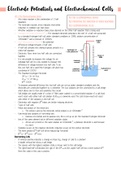
- To measure potential difference the two half cells are set up under standard conditions and the
electrodes are connected together by a voltmeter. The two solutions are the connected by a salt bridge
which allows ions to flow and completes the circuit.
- Salt bridges are usually made of a strip of filter paper soaked in a concentrated solution of a salt that
won’t react with either half cell solution. KNO3(aq) is commonly used. The salt chosen must not react
with either of the solutions in the half cell.
- Electrodes with negative 𝐸 ! values are better reducing electrons.
- Types of half cells:
- Metal and solution of the metal ions
o The metal is used as the electrode, metal solution is at 1.00moldm-3
- Non-metal and solutions of non-metal ions
o Gaseous non-metals and its aqueous ions, this is set up as per the standard hydrogen electrode
- Ions of the same element but in different oxidation states
o All ions are present in the same solution at 1.00moldm-3, a platinum electrode is used because
it is inert.
- Oxidation occurs at the negative electrode; reduction occurs at the positive electrode.
- The more positive 𝐸 ! half-cell will be reduced (go forwards).
- 𝐸 ! cell = 𝐸 ! reduced - 𝐸 ! oxidised
Representing Cells:
- A vertical solid line indicates a change in phase (e.g., change of solid to a solution)
- A double vertical line shows a salt bridge.
- The species with the highest oxidation state is shown next to the salt bridge.
- The right-hand half-cell dictates the sign of the 𝐸 ! cell as the copper half-cell has a more positive 𝐸 !
then the value in this case is positive.
20.1 The Electrochemical Series:
20.1 The electrochemical series
- Any redox reaction is the combination of 2 half
equations. 20.2 predicting the direction of redox reactions
- The reversible reaction arrow indicates that either 20.3 electrochemical cells
reduction or oxidation can take place.
- Whether oxidation or reduction takes place depends on the other half equation that is being used.
- Standard electrode potential 𝐸 ! ~ The standard electrode potential is the emf of a half-cell connected
to a standard hydrogen half-cell, under standard conditions or 298K, solution concentration of
1.00moldm-3 and a pressure of 100kPa.
- Emf (electromotive force) ~ the potential
difference/voltage between 2 half cells
- A half-cell contains the chemical species present in a
redox half-equation.
- Electricity flows when two half cells are connected
together.
- It is not possible to measure the voltage for an
individual half-cell. It is only possible to measure the
difference in voltage between two half cells. To do
this, one half cell is used (the hydrogen cell which has
a potential of 0.00V).
- The Standard Hydrogen Electrode:
2H+(aq) + 2e- ⇌ H2(g)
H+(aq) + e- ⇌ ½H2(g)
𝐸 ! = 0.00V
- To measure potential difference the two half cells are set up under standard conditions and the
electrodes are connected together by a voltmeter. The two solutions are the connected by a salt bridge
which allows ions to flow and completes the circuit.
- Salt bridges are usually made of a strip of filter paper soaked in a concentrated solution of a salt that
won’t react with either half cell solution. KNO3(aq) is commonly used. The salt chosen must not react
with either of the solutions in the half cell.
- Electrodes with negative 𝐸 ! values are better reducing electrons.
- Types of half cells:
- Metal and solution of the metal ions
o The metal is used as the electrode, metal solution is at 1.00moldm-3
- Non-metal and solutions of non-metal ions
o Gaseous non-metals and its aqueous ions, this is set up as per the standard hydrogen electrode
- Ions of the same element but in different oxidation states
o All ions are present in the same solution at 1.00moldm-3, a platinum electrode is used because
it is inert.
- Oxidation occurs at the negative electrode; reduction occurs at the positive electrode.
- The more positive 𝐸 ! half-cell will be reduced (go forwards).
- 𝐸 ! cell = 𝐸 ! reduced - 𝐸 ! oxidised
Representing Cells:
- A vertical solid line indicates a change in phase (e.g., change of solid to a solution)
- A double vertical line shows a salt bridge.
- The species with the highest oxidation state is shown next to the salt bridge.
- The right-hand half-cell dictates the sign of the 𝐸 ! cell as the copper half-cell has a more positive 𝐸 !
then the value in this case is positive.