NURS 3093 Study Guide for Pathophysiology Test 1_2020 | Complete Guide
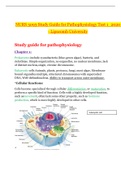
NURS 3093 Study Guide for Pathophysiology Test 1_2020 - Lipscomb University Study guide for pathophysiology Chapter 1: Prokaryotes include cyanobacteria (blue-green algae), bacteria, and rickettsiae. Simple organization, no organelles, no nuclear membrane, lack of distinct nucleus, single, circular chromosome. Eukaryotic cells Animals, plants, protozoa, fungi, most algae, Membrane bound organelles multiple, structured chromosomes with supercoiled DNA, Well-defined nucleus, Ability to transport across outer membrane. *Cellular functions: Cells become specialized through cellular differentiation, or maturation, to perform a specific kind of function. Cells with a highly developed function, such as movement, often lack some other property, such as hormone production, which is more highly developed in other cells. *Plasma membrane proteins and their functions *The nucleus* This is involved in cell division and contains our genetic information. Within the nucleus we find: ---Nucleolus- Dense RNA protein –and ---Histones – DNA- binding proteins, cause coiling. The Nucleus contains loosely arranged chromatin. In the chromatin we have the DNA. The primary functions of the nucleus are cell division and control of genetic information The chromatin aggregates into discrete bands (Chromosomes) during cell division (Mitosis). Genetic information is transcribed into ribonucleic acid (RNA), which can be processed into messenger, transport, and ribosomal RNAs and introduced into the cytoplasm, where it directs cellular activities. Most of the processing of RNA occurs in the nucleolus. Ribosomes *Cytoplasmic organelles* • Synthesized in nucleus • RNA protein complexes • Functions for cellular protein synthesis Rough ER • Set of membranes lined with ribosomes • Produce proteins • Sends proteins to Golgi apparatus Smooth ER • Set of membranes without ribosomes • Produces biochemicals other than proteins • Can transport materials through the cell. Mitochondria 1. Generates energy (ATP) • Electron transport chain • Oxidative phosphorylation • Krebs cycle (Citric Acid Cycle) 2. Cellular energy metabolism (Contain metabolic machinery needed for cellular energy metabolism) • Homeostasis • pH control • Osmotic regulation Golgi complex • Modifies, sorts and stores proteins for secretion • Emits secretory vesicles • Network of smooth membranes and vesicles • This is like the shipping and processing department Lysosome • Membrane bound packet of digestive enzymes • Phagocytosis of foreign substances • Autophagocytosis of worn out cytoplasm or organelles • Peroxisomes- similar function but contains oxidative enzymes. Mitochondrial dysfunction *Cell-to-cell interactions* • Cellular receptors are located on the cell membrane. • Ligands- smaller proteins that bind to receptors. Ligand is just an ion. Binding site – region of protein that interacts with ligand • Depends on bonds/attractions • Binding leads to activation or inhibition signaling or pathway - - - -
Document information
- Uploaded on
- September 27, 2021
- Number of pages
- 67
- Written in
- 2021/2022
- Type
- Other
- Person
- Unknown