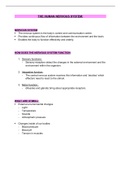
THE HUMAN NERVOUS SYSTEM:
NERVOUS SYSTEM:
The nervous system is the body’s control and communication centre.
Provides continuous flow of information between the environment and the brain.
Enables the body to function effectively and orderly.
HOW DOES THE NERVOUS SYSTEM FUNCTION:
1. Sensory functions:
- Sensory receptors detect the changes in the external environment and the
environment within the organism.
2. Integrative function:
- The central nervous system receives this information and ‘decides’ which
effectors need to react to the stimuli.
3. Motor function:
- (Muscles and glands) bring about appropriate receptors.
WHAT ARE STIMULI:
External environmental changes
- Light
- Temperature
- Sounds
- Atmospheric pressure
Changes inside of our bodies:
- Blood pressure
- Blood pH
- Tension in muscles
, STRUCTURE OF NEURONS:
Have long, thin fibers of cytoplasm stretching out from the cell body.
These fibers make it possible to carry messages in the form of NERVE
IMPULSES from one part of the body to the next.
The fibers are known at Axons or Dendrites
These cells cannot undergo mitosis, they last a lifetime with good nutrition.
They have a very high metabolic rate which means they need a continuous
source of oxygen and glucose.
Classified into the following
- Sensory neurons
- Motor neurons
- Connector neurons
1. SENSORY NEURONS:
Afferent neurons
Carry impulses from receptors towards the central nervous system (CNS)
Nearly all sensory neurons have their cell bodies located in the ganglion
outside the central nervous system.
This makes them UNIPOLAR
GANGLION= collection of nerve cells outside the CNS.
Structure:
Axon and dendrite are myelinated.
One fiber attached to cell body
Impulses carried away from receptors to CNS
Impulses bring about sensations
2. MOTOR NEURONS:
Carry impulses from the CNS to effectors to ensure appropriate response
Neurons are MULTIPOLAR
Cell bodies located in grey matter of CNS
Structure:
Axon is myelinated
Many fibers attached to cell body
Impulses carried away from CNS to effectors
Impulses bring about active response.
3. CONNECTOR:
(inter-neurons)
NERVOUS SYSTEM:
The nervous system is the body’s control and communication centre.
Provides continuous flow of information between the environment and the brain.
Enables the body to function effectively and orderly.
HOW DOES THE NERVOUS SYSTEM FUNCTION:
1. Sensory functions:
- Sensory receptors detect the changes in the external environment and the
environment within the organism.
2. Integrative function:
- The central nervous system receives this information and ‘decides’ which
effectors need to react to the stimuli.
3. Motor function:
- (Muscles and glands) bring about appropriate receptors.
WHAT ARE STIMULI:
External environmental changes
- Light
- Temperature
- Sounds
- Atmospheric pressure
Changes inside of our bodies:
- Blood pressure
- Blood pH
- Tension in muscles
, STRUCTURE OF NEURONS:
Have long, thin fibers of cytoplasm stretching out from the cell body.
These fibers make it possible to carry messages in the form of NERVE
IMPULSES from one part of the body to the next.
The fibers are known at Axons or Dendrites
These cells cannot undergo mitosis, they last a lifetime with good nutrition.
They have a very high metabolic rate which means they need a continuous
source of oxygen and glucose.
Classified into the following
- Sensory neurons
- Motor neurons
- Connector neurons
1. SENSORY NEURONS:
Afferent neurons
Carry impulses from receptors towards the central nervous system (CNS)
Nearly all sensory neurons have their cell bodies located in the ganglion
outside the central nervous system.
This makes them UNIPOLAR
GANGLION= collection of nerve cells outside the CNS.
Structure:
Axon and dendrite are myelinated.
One fiber attached to cell body
Impulses carried away from receptors to CNS
Impulses bring about sensations
2. MOTOR NEURONS:
Carry impulses from the CNS to effectors to ensure appropriate response
Neurons are MULTIPOLAR
Cell bodies located in grey matter of CNS
Structure:
Axon is myelinated
Many fibers attached to cell body
Impulses carried away from CNS to effectors
Impulses bring about active response.
3. CONNECTOR:
(inter-neurons)