LIFE AT MOLECULAR, CELLULAR AND TISSUE LEVEL:
THE DIVERSITY OF LIFE:
The viruses, bacteria, protists, and fungi are considered to have evolved very
early in history before animals and plants.
This is because they:
- Are a hugely diverse group.
- Found in all the planet’s environments.
- Occur is vast numbers.
- Vary in size, micro-organisms (invisible to eye), macro-organisms (visible to
eye)
- Either acellular or eukaryotes.
- Can for colonies.
PATHOGENIC AND NON-PATHOGENIC MICRO-ORGANISMS:
Pathogenic = disease causing.
Non-pathogenic = harmless.
Pathogens are often called germs.
, VIRUSES:
CHARACTERISTICS OF VIRUSES:
Viruses are extremely small (microscopic)
Either active (virus) or dormant (virion)
Not really living organisms as they do not exhibit the seven life processes.
Viruses are obligate intracellular organisms as they only survive in other cells.
Viruses can only reproduce inside a living cell.
Always associated with diseases.
They can remain in a dormant state.
Can be different shapes.
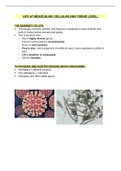
SHAPES OF VIRUSES:
Polyhedral (cubical)
- The capsid has twenty triangular
sides.
- E.g., adenovirus
Helical (spiral)
- The capsid resembles a coiled spiral.
- E.g., tobacco virus.
Complex (tadpole like)
- Has a head, sheath, and tail fibers.
- E.g., bacteriophage.
STRUCTURE OF VIRUSES:
A virus is acellular, it does not have a nucleus, cytoplasm, or organelles.
Consists of a core of DNA or RNA.
The nucleic acid is surrounded by a protein
coat called a capsid.
In some viruses it is enclosed by an envelope
of a lipid bilayer that protects the host from
BACTERIA:
, CHARACTERISTICS OF BACTERIA:
Bacteria is the most diverse and abundant group of organisms on earth.
Bacteria practically inhabit all environments, they are found in water, soil, air
and in animals’ gastrointestinal tracts.
Most of them are useful but some can cause diseases.
Bacteria are unicellular and are of the smallest organisms, they can be
observed through a light microscope and range in size from one to ten
micrometers.
Bacteria can exist singly, in chains (streptococcus) or in clumps
(staphylococcus)
They reproduce by binary fission. (a process whereby bacteria asexually
reproduce by dividing into two with identical DNA)
In unfavorable conditions they can become dormant.
SHAPES OF BACTERIA:
Cocci:
- Spherical bacteria
Bacilli:
- Rod-shaped bacteria
Spiralla:
- Spiral shaped bacteria
Vibrios:
- Comma-shaped bacteria
STRUCTURE OF BACTERIA:
Bacteria are unicellular and carry out living functions.
THE DIVERSITY OF LIFE:
The viruses, bacteria, protists, and fungi are considered to have evolved very
early in history before animals and plants.
This is because they:
- Are a hugely diverse group.
- Found in all the planet’s environments.
- Occur is vast numbers.
- Vary in size, micro-organisms (invisible to eye), macro-organisms (visible to
eye)
- Either acellular or eukaryotes.
- Can for colonies.
PATHOGENIC AND NON-PATHOGENIC MICRO-ORGANISMS:
Pathogenic = disease causing.
Non-pathogenic = harmless.
Pathogens are often called germs.
, VIRUSES:
CHARACTERISTICS OF VIRUSES:
Viruses are extremely small (microscopic)
Either active (virus) or dormant (virion)
Not really living organisms as they do not exhibit the seven life processes.
Viruses are obligate intracellular organisms as they only survive in other cells.
Viruses can only reproduce inside a living cell.
Always associated with diseases.
They can remain in a dormant state.
Can be different shapes.
SHAPES OF VIRUSES:
Polyhedral (cubical)
- The capsid has twenty triangular
sides.
- E.g., adenovirus
Helical (spiral)
- The capsid resembles a coiled spiral.
- E.g., tobacco virus.
Complex (tadpole like)
- Has a head, sheath, and tail fibers.
- E.g., bacteriophage.
STRUCTURE OF VIRUSES:
A virus is acellular, it does not have a nucleus, cytoplasm, or organelles.
Consists of a core of DNA or RNA.
The nucleic acid is surrounded by a protein
coat called a capsid.
In some viruses it is enclosed by an envelope
of a lipid bilayer that protects the host from
BACTERIA:
, CHARACTERISTICS OF BACTERIA:
Bacteria is the most diverse and abundant group of organisms on earth.
Bacteria practically inhabit all environments, they are found in water, soil, air
and in animals’ gastrointestinal tracts.
Most of them are useful but some can cause diseases.
Bacteria are unicellular and are of the smallest organisms, they can be
observed through a light microscope and range in size from one to ten
micrometers.
Bacteria can exist singly, in chains (streptococcus) or in clumps
(staphylococcus)
They reproduce by binary fission. (a process whereby bacteria asexually
reproduce by dividing into two with identical DNA)
In unfavorable conditions they can become dormant.
SHAPES OF BACTERIA:
Cocci:
- Spherical bacteria
Bacilli:
- Rod-shaped bacteria
Spiralla:
- Spiral shaped bacteria
Vibrios:
- Comma-shaped bacteria
STRUCTURE OF BACTERIA:
Bacteria are unicellular and carry out living functions.