Week 5 Reading:
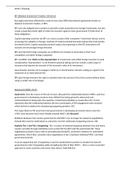
BIT (Bilateral Investment Treaties): (All direct)
Key legal protections afforded by a web of more than 2800 international agreements known as
bilateral investment treaties, or BITs.
BITs not only obligate host countries to provide certain protections for foreign investments, but also
create a powerful private right of action for investors against a host government if it falls short of
those obligations.
Capital exporting countries see BITs as a way to protect their companies’ investment abroad, and to
encourage the adoption in foreign countries of market-oriented domestic policies that treat private
investment fairly. Capital importing countries expect that agreeing to offer BIT protections will
reassure and encourage foreign investors.
BITs provide that foreign companies are entitled to be treated as favourably as their local
competitors and other foreign companies.
BITs establish clear limits on the expropriation of investments and entitle foreign investors to seek
compensation. Expropriation” is not limited to physical takings and can include a wide range of
measures that deprive the investor of the economic value of its investment.
Governments promise not to engage in arbitrary or discriminatory decision making in regard to the
treatment of an international firm.
BITs give foreign investors the right to transfer funds into and out of the host country without delay
using a market rate of exchange.
Ramamurti (2001) 23-27:
Good intro: Over the course of the last 10 years (decade) the relationship between MNE’s and host
governments in developing countries have shifted from being primarily adversarial and
confrontational to being quite the opposite, instead being labelled as cooperative (ID). Vernon
expressed that the relationship between the two counterparts of FDI engagement were strained
which led him to address the obsolescing bargaining problem. (ID)
The major block to FDI came from host governments in developing economies whom since the
1990’s have become much more friendly towards MNC’s (ID) Because?
Relations between host country governments and MNC’s can no longer be viewed as negotiations
instead they must be understood as a dynamic, two-tier multi-party bargaining process. (ID)
Explains Tier 1 and Tier 2 bargaining: Tier 1 consists of bilateral bargaining between host and home
country normally through institutions such as the IMF the WTO and the world bank (ID). These
negotiations produce macro rules or principles governing FDI, anchored in bilateral or multilateral
agreements, which then constrain micro negotiations in tier 2 between individual MNC’s and host
governments (D:24).
It can be argued that tier-1 bargaining is used by industrialised countries to weaken the hand of
governments in tier 2 bargaining while strengthening that of their MNC’s – this is a more successful
approach in some countries and sectors than others. (half D/ID:24)
BIT (Bilateral Investment Treaties): (All direct)
Key legal protections afforded by a web of more than 2800 international agreements known as
bilateral investment treaties, or BITs.
BITs not only obligate host countries to provide certain protections for foreign investments, but also
create a powerful private right of action for investors against a host government if it falls short of
those obligations.
Capital exporting countries see BITs as a way to protect their companies’ investment abroad, and to
encourage the adoption in foreign countries of market-oriented domestic policies that treat private
investment fairly. Capital importing countries expect that agreeing to offer BIT protections will
reassure and encourage foreign investors.
BITs provide that foreign companies are entitled to be treated as favourably as their local
competitors and other foreign companies.
BITs establish clear limits on the expropriation of investments and entitle foreign investors to seek
compensation. Expropriation” is not limited to physical takings and can include a wide range of
measures that deprive the investor of the economic value of its investment.
Governments promise not to engage in arbitrary or discriminatory decision making in regard to the
treatment of an international firm.
BITs give foreign investors the right to transfer funds into and out of the host country without delay
using a market rate of exchange.
Ramamurti (2001) 23-27:
Good intro: Over the course of the last 10 years (decade) the relationship between MNE’s and host
governments in developing countries have shifted from being primarily adversarial and
confrontational to being quite the opposite, instead being labelled as cooperative (ID). Vernon
expressed that the relationship between the two counterparts of FDI engagement were strained
which led him to address the obsolescing bargaining problem. (ID)
The major block to FDI came from host governments in developing economies whom since the
1990’s have become much more friendly towards MNC’s (ID) Because?
Relations between host country governments and MNC’s can no longer be viewed as negotiations
instead they must be understood as a dynamic, two-tier multi-party bargaining process. (ID)
Explains Tier 1 and Tier 2 bargaining: Tier 1 consists of bilateral bargaining between host and home
country normally through institutions such as the IMF the WTO and the world bank (ID). These
negotiations produce macro rules or principles governing FDI, anchored in bilateral or multilateral
agreements, which then constrain micro negotiations in tier 2 between individual MNC’s and host
governments (D:24).
It can be argued that tier-1 bargaining is used by industrialised countries to weaken the hand of
governments in tier 2 bargaining while strengthening that of their MNC’s – this is a more successful
approach in some countries and sectors than others. (half D/ID:24)