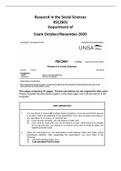
Research in the Social Sciences
RSC2601
Department of
Exam October/November 2020
, QUESTION 1
Ego involvement as a possible error in scientific inquiry is guarded against by
researchers …
(a) doing a thorough literature review.
(b) involving a sufficiently large sample of observations.
(c) rigorously testing hypotheses.
(d) sharing research results with fellow scientists.
(1) (a)
(2) (a) (b)
(3) (a) (b) (c)
(4) (c) (d)
Answer:
Refer to the study guide page 10:
1.3.4 Ego involvement in understanding
We are personally, as well as intellectually, involved in our search for knowledge. Our
understanding of events and conditions is usually psychologically significant to us. In countless
ways, we link our understanding of how things are to the image of ourselves that we present to
others. Because of this link, any disproof of this understanding tends to make us look gullible,
stupid and generally not okay. So we commit ourselves more firmly to our understanding of how
things are and in the process create a large barrier to further inquiry.
Science guards against ego involvement by testing hypotheses in a systematic manner (explained
in study unit 2). This enables us to collect information rigorously, information which we can then
consider objectively. Making the research public in the form of a report (explained in study unit
10) also allows other scientists to evaluate our research, thereby exposing any personal bias or
ego involvement we may have brought to our work.
QUESTION 2
Which one of the following statements is INCORRECT regarding norms of scientific
research?
(1) Research results must be made available so that the scientific community can review and
criticise them.
(2) The purpose of organised scepticism is to ensure that scientific knowledge can be subjected
to close examination.
(3) In evaluating research reports reviewers should rely both on the stature of the researcher and
the scientific merit of the research.
(4) Scientists are slow to reject a theory even when new evidence invalidates it, but
RSC2601
Department of
Exam October/November 2020
, QUESTION 1
Ego involvement as a possible error in scientific inquiry is guarded against by
researchers …
(a) doing a thorough literature review.
(b) involving a sufficiently large sample of observations.
(c) rigorously testing hypotheses.
(d) sharing research results with fellow scientists.
(1) (a)
(2) (a) (b)
(3) (a) (b) (c)
(4) (c) (d)
Answer:
Refer to the study guide page 10:
1.3.4 Ego involvement in understanding
We are personally, as well as intellectually, involved in our search for knowledge. Our
understanding of events and conditions is usually psychologically significant to us. In countless
ways, we link our understanding of how things are to the image of ourselves that we present to
others. Because of this link, any disproof of this understanding tends to make us look gullible,
stupid and generally not okay. So we commit ourselves more firmly to our understanding of how
things are and in the process create a large barrier to further inquiry.
Science guards against ego involvement by testing hypotheses in a systematic manner (explained
in study unit 2). This enables us to collect information rigorously, information which we can then
consider objectively. Making the research public in the form of a report (explained in study unit
10) also allows other scientists to evaluate our research, thereby exposing any personal bias or
ego involvement we may have brought to our work.
QUESTION 2
Which one of the following statements is INCORRECT regarding norms of scientific
research?
(1) Research results must be made available so that the scientific community can review and
criticise them.
(2) The purpose of organised scepticism is to ensure that scientific knowledge can be subjected
to close examination.
(3) In evaluating research reports reviewers should rely both on the stature of the researcher and
the scientific merit of the research.
(4) Scientists are slow to reject a theory even when new evidence invalidates it, but