Skeleton Overview
Learning Outcomes
● List the types of long bones in the veterinary species and the sections of a
long bone
● Recognise osteology terminology including parts of a long bone and joint
● Describe the types of bone tissue
5 categories of bones in veterinary species:
1) Flat bones
● E.g. scapula
2) Long bones
● E.g. femur
3) Short bones
● E.g. carpals and tarsals
4) Sesamoid bone
● E.g. patella
5) Irregular bones
● E.g. pelvis
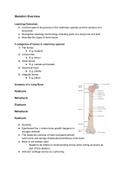
Anatomy of a Long Bone
Epiphysis
Metaphysis
Diaphysis
Metaphysis
Epiphysis
● Dynamic
● Epiphyseal line = where bone growth happens in
younger animals
● The diaphysis consists of hard (compact/cortical)
outer bone and spongy (trabecular/cancellous) inner bone
● Bone is not entirely solid
○ Needs to be hollow to resist bending forces when acting as levers as
part of the skeleton
● Articular cartilage serves as cushioning
, Femoral Head
● Surrounded by articular head
● Elongated
● Greater trochanter
● Condyles (2 at opposite ends of the femur, smooth to glide over the knee)
Osteology Terminology
● Fossa - a depression or hollow in a bone
● Foramen - a natural opening
● Tubercle - a small, rounded protrusion/eminence that serves as an
attachment for skeletal muscles
● Intertubercular groove - a groove separating the greater and lesser
tubercles of the humerus
● Head
● Neck
● Tuberosity - a moderate prominence where muscles and connective tissues
attach
● Condyle - the round prominence at the end of a bone, most often part of a
joint
● Epicondyle - a rounded eminence on a bone that lies on a condyle
● Spine - a short, thornlike process of a bone
● Notch - a v-like depression in the margin or edge of a flat area
Bone Tissue
1. Cortical bone (compact bone)
● Aka compact bone
● Hard bone that surrounds the outside
of long bone
● Prevents bone from bending
● Small purple dots = bone cells
● Pink = bony matrix
○ Made up of collagen fibers (organic components)
○ Mineral components = calcium
2. Trabecular bone (cancellous bone)
● Aka spongy bone
● Bone in the central region of
bone
Learning Outcomes
● List the types of long bones in the veterinary species and the sections of a
long bone
● Recognise osteology terminology including parts of a long bone and joint
● Describe the types of bone tissue
5 categories of bones in veterinary species:
1) Flat bones
● E.g. scapula
2) Long bones
● E.g. femur
3) Short bones
● E.g. carpals and tarsals
4) Sesamoid bone
● E.g. patella
5) Irregular bones
● E.g. pelvis
Anatomy of a Long Bone
Epiphysis
Metaphysis
Diaphysis
Metaphysis
Epiphysis
● Dynamic
● Epiphyseal line = where bone growth happens in
younger animals
● The diaphysis consists of hard (compact/cortical)
outer bone and spongy (trabecular/cancellous) inner bone
● Bone is not entirely solid
○ Needs to be hollow to resist bending forces when acting as levers as
part of the skeleton
● Articular cartilage serves as cushioning
, Femoral Head
● Surrounded by articular head
● Elongated
● Greater trochanter
● Condyles (2 at opposite ends of the femur, smooth to glide over the knee)
Osteology Terminology
● Fossa - a depression or hollow in a bone
● Foramen - a natural opening
● Tubercle - a small, rounded protrusion/eminence that serves as an
attachment for skeletal muscles
● Intertubercular groove - a groove separating the greater and lesser
tubercles of the humerus
● Head
● Neck
● Tuberosity - a moderate prominence where muscles and connective tissues
attach
● Condyle - the round prominence at the end of a bone, most often part of a
joint
● Epicondyle - a rounded eminence on a bone that lies on a condyle
● Spine - a short, thornlike process of a bone
● Notch - a v-like depression in the margin or edge of a flat area
Bone Tissue
1. Cortical bone (compact bone)
● Aka compact bone
● Hard bone that surrounds the outside
of long bone
● Prevents bone from bending
● Small purple dots = bone cells
● Pink = bony matrix
○ Made up of collagen fibers (organic components)
○ Mineral components = calcium
2. Trabecular bone (cancellous bone)
● Aka spongy bone
● Bone in the central region of
bone