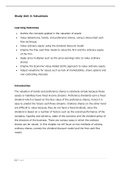
Study Unit 4: Valuations
Learning Outcomes
Outline the concepts applied in the valuation of assets
Value debentures, bonds, and preference shares, using a discounted cash
flow technique
Value ordinary equity using the dividend discount model
Employ the free cash flow model to value the firm and the ordinary equity
of the firm
Apply price multiples such as the price-earnings ratio to value ordinary
shares
Employ the Economic Value Added (EVA) approach to value ordinary equity
Adjust valuations for issues such as lack of marketability, share options and
non-controlling interests
Introduction
The valuation of bonds and preference shares is relatively simple because these
assets or liabilities have fixed income streams. Preference dividends earn a fixed
dividend which is based on the face value of the preference shares, hence it is
easy to predict the future cash flows streams. Ordinary shares on the other hand
are difficult to value because they do not have a fixed dividend, since the
dividend is based on a number of factors such as the overall performance of the
company, liquidity and solvency, state of the economy and the dividend policy of
the directors of the business. There are various ways in which the ordinary
shares can be valued. In this chapter we will focus on two methods of valuing
ordinary shares, namely the dividend discount model and the free cash flow
model.
1|Page
, 4.1 What are the fundamental building blocks of a valuation?
The following are among the myths of valuations:
The valuation is quantitative and therefore correct
The valuation is objective
The valuation has precision
The valuation is valid over an extended time period
Only the answer matters
The valuation of investments is mainly based on the future cash flows that are
expected to be received from the investment. Risk factors are also to be
considered in the valuation of investments. Effectively the valuation of
investments is determined to a larger extent by the following factors:
a. The amount of each future cash flow
b. The timing of such cash flows
c. The riskiness of future cash flows
d. The required rate of return
4.2 The Effect of Risk and Return on Valuations
There is a relationship between risk and return, and depending on the type of
the asset. Some assets have a positive relationship between risk and return,
meaning that the higher the risk the higher the return. Therefore, this means
that there is an impact on the value of the expected future cash flows.
4.3 The Effect of Timing of Cash Flows on the Value of Assets
The timing of cash flows can be such that it can be at the beginning or at the
end of each investment period. This means that the coupon payments or
receipts can occur in advance or in arrears. The timing of the cash flows can
thus have a significant impact on the valuation of bonds and preference shares.
2|Page
Learning Outcomes
Outline the concepts applied in the valuation of assets
Value debentures, bonds, and preference shares, using a discounted cash
flow technique
Value ordinary equity using the dividend discount model
Employ the free cash flow model to value the firm and the ordinary equity
of the firm
Apply price multiples such as the price-earnings ratio to value ordinary
shares
Employ the Economic Value Added (EVA) approach to value ordinary equity
Adjust valuations for issues such as lack of marketability, share options and
non-controlling interests
Introduction
The valuation of bonds and preference shares is relatively simple because these
assets or liabilities have fixed income streams. Preference dividends earn a fixed
dividend which is based on the face value of the preference shares, hence it is
easy to predict the future cash flows streams. Ordinary shares on the other hand
are difficult to value because they do not have a fixed dividend, since the
dividend is based on a number of factors such as the overall performance of the
company, liquidity and solvency, state of the economy and the dividend policy of
the directors of the business. There are various ways in which the ordinary
shares can be valued. In this chapter we will focus on two methods of valuing
ordinary shares, namely the dividend discount model and the free cash flow
model.
1|Page
, 4.1 What are the fundamental building blocks of a valuation?
The following are among the myths of valuations:
The valuation is quantitative and therefore correct
The valuation is objective
The valuation has precision
The valuation is valid over an extended time period
Only the answer matters
The valuation of investments is mainly based on the future cash flows that are
expected to be received from the investment. Risk factors are also to be
considered in the valuation of investments. Effectively the valuation of
investments is determined to a larger extent by the following factors:
a. The amount of each future cash flow
b. The timing of such cash flows
c. The riskiness of future cash flows
d. The required rate of return
4.2 The Effect of Risk and Return on Valuations
There is a relationship between risk and return, and depending on the type of
the asset. Some assets have a positive relationship between risk and return,
meaning that the higher the risk the higher the return. Therefore, this means
that there is an impact on the value of the expected future cash flows.
4.3 The Effect of Timing of Cash Flows on the Value of Assets
The timing of cash flows can be such that it can be at the beginning or at the
end of each investment period. This means that the coupon payments or
receipts can occur in advance or in arrears. The timing of the cash flows can
thus have a significant impact on the valuation of bonds and preference shares.
2|Page