Tema 3. Series numéricas.
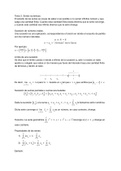
El estudio de las series se ocupa de saber si es posible o no sumar infinitos número y que
salga una cantidad finita. Cuando esta cantidad finita exista diremos que la serie converge,
y cuando esta cantidad sea infinita diremos que la serie diverge.
Sucesión de números reales.
Una sucesión es una aplicación, correspondencia o función en donde el conjunto de partida
son los número naturales.
𝑎: 𝑛: 𝑁 → 𝑅
𝑛 → 𝑎𝑛 = "𝑓ó𝑟𝑚𝑢𝑙𝑎" 𝑒𝑛𝑡𝑟𝑒 𝑙𝑙𝑎𝑣𝑒𝑠
Por ejemplo:
𝑛→ { } = {2,
𝑛+1
𝑛
3
2
,
4
3
,
5
4
,...,
𝑛+1
𝑛 }
Límite de una sucesión.
Se dice que el límite cuando n tiende a infinito de la sucesión an sale l si existe un radio
epsilon (ε) elegido que rodea a l de manera que fuera del intervalo haya una cantidad finita
de términos y dentro el resto.
|
Es decir, lim 𝑎𝑛 = 𝑙 si para ∀ε > 0existe un 𝑛0tal que 𝑛 > 𝑛0que verifica que 𝑎𝑛 − 𝑙 < ε.
𝑛→∞
|
Sucesión de sumas parciales o sumas acumuladas.
{ } { } {
𝑆𝑛 = 𝑆1, 𝑆2, 𝑆3,..., 𝑆𝑛 = 𝑎1, 𝑎1 + 𝑎2, 𝑎1 + 𝑎2 + 𝑎3,..., 𝑎1 + 𝑎2 + 𝑎3 +... + 𝑎𝑛}
∞
{ }
Dada la sucesión 𝑎𝑛 , a la suma 𝑎1 + 𝑎2 + 𝑎3 +... + 𝑎𝑛 = ∑ 𝑎𝑛le llamamos serie numérica.
𝑛=1
∞
Dicha serie converge si lim 𝑆𝑛 = ∑ 𝑎𝑛es un número, en caso contrario, diverge.
𝑛→∞ 𝑛=1
∞
𝑛 2 𝑛
Teorema. La serie geométrica ∑ 𝑟 = 1 + 𝑟 + 𝑟 +... + 𝑟 converge si |𝑟| < 1, y diverge en
𝑛=0
caso contrario.
Propiedades de las series:
∞ ∞
1) ∑ 𝑘𝑎𝑛 = 𝑘 · ∑ 𝑎𝑛
𝑛=1 𝑛=1
∞ ∞ ∞
2) ( )
∑ 𝑎𝑛 + 𝑏𝑛 = ∑ 𝑎𝑛 + ∑ 𝑏𝑛
𝑛=1 𝑛=1 𝑛=1
Ejemplo:
El estudio de las series se ocupa de saber si es posible o no sumar infinitos número y que
salga una cantidad finita. Cuando esta cantidad finita exista diremos que la serie converge,
y cuando esta cantidad sea infinita diremos que la serie diverge.
Sucesión de números reales.
Una sucesión es una aplicación, correspondencia o función en donde el conjunto de partida
son los número naturales.
𝑎: 𝑛: 𝑁 → 𝑅
𝑛 → 𝑎𝑛 = "𝑓ó𝑟𝑚𝑢𝑙𝑎" 𝑒𝑛𝑡𝑟𝑒 𝑙𝑙𝑎𝑣𝑒𝑠
Por ejemplo:
𝑛→ { } = {2,
𝑛+1
𝑛
3
2
,
4
3
,
5
4
,...,
𝑛+1
𝑛 }
Límite de una sucesión.
Se dice que el límite cuando n tiende a infinito de la sucesión an sale l si existe un radio
epsilon (ε) elegido que rodea a l de manera que fuera del intervalo haya una cantidad finita
de términos y dentro el resto.
|
Es decir, lim 𝑎𝑛 = 𝑙 si para ∀ε > 0existe un 𝑛0tal que 𝑛 > 𝑛0que verifica que 𝑎𝑛 − 𝑙 < ε.
𝑛→∞
|
Sucesión de sumas parciales o sumas acumuladas.
{ } { } {
𝑆𝑛 = 𝑆1, 𝑆2, 𝑆3,..., 𝑆𝑛 = 𝑎1, 𝑎1 + 𝑎2, 𝑎1 + 𝑎2 + 𝑎3,..., 𝑎1 + 𝑎2 + 𝑎3 +... + 𝑎𝑛}
∞
{ }
Dada la sucesión 𝑎𝑛 , a la suma 𝑎1 + 𝑎2 + 𝑎3 +... + 𝑎𝑛 = ∑ 𝑎𝑛le llamamos serie numérica.
𝑛=1
∞
Dicha serie converge si lim 𝑆𝑛 = ∑ 𝑎𝑛es un número, en caso contrario, diverge.
𝑛→∞ 𝑛=1
∞
𝑛 2 𝑛
Teorema. La serie geométrica ∑ 𝑟 = 1 + 𝑟 + 𝑟 +... + 𝑟 converge si |𝑟| < 1, y diverge en
𝑛=0
caso contrario.
Propiedades de las series:
∞ ∞
1) ∑ 𝑘𝑎𝑛 = 𝑘 · ∑ 𝑎𝑛
𝑛=1 𝑛=1
∞ ∞ ∞
2) ( )
∑ 𝑎𝑛 + 𝑏𝑛 = ∑ 𝑎𝑛 + ∑ 𝑏𝑛
𝑛=1 𝑛=1 𝑛=1
Ejemplo: