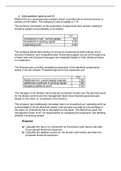
1. Extra question: (same as sem 7):
Watford Plc is a manufacturing company which currently has an annual turnover in
excess of £40 million. The company’s cost of capital is 11%.
The summary information of the Automotive Components (AC) division relating to
divisional assets and profitability is as follows:
£m
Investment in non - current assets 8.3
Investment in working capital 4.75
Operating profit 3.55
The company allows each division to act as an autonomous profit making unit to
improve motivation and competitiveness. Divisional budgets are set at the beginning
of each year and divisional managers are rewarded based on their divisional return
on investment.
The Directors are currently considering expansion of the electrical components
facility in the AC division. Projected figures for this expansion are:
£m
Additional non- current assets required 2.65
Additional investment in working capital 1.25
Budgeted additional profit 0.45
The manager of AC division has produced successful results over the past few years
for his division and he and his management team have received good bonuses
based on the return on investment in the division.
The company has traditionally calculated return on investment as “operating profit as
a percentage of all net divisional assets” and bonuses are paid as a percentage of
the return on investment that is calculated on this basis. The Board has given the
management team of AC full responsibility for assessing the expansion and deciding
whether it should go ahead.
Required:
a) Calculate the return on investment for the division both before and after
the proposed divisional expansion.
b) Calculate the residual income for the division both before and after the
proposed divisional expansion.
, ANSWER:
a/
Before expansion Additions After proposed
expansion
GBPm GBPm GBPm
Investment in non- Provided (table 1) Provided (table 2) =Before expansion
current assets + additions
Investment in Provided (table 1) Provided (table 2) =Before expansion
working capital + additions
Net divisional SUM of above SUM of above
assets
Operating profit Provided (table 1) Provided (table 2) =before expansion
+ additions
ROI = (operating profit = (operating profit
above / net above/ net
divisional assets divisional assets
above) *100 above) *100
b/
Before expansion After proposed expansion
GBPm GBPm
Operating profit above
Imputed interest on net = net divisional assets just cal. * % cost of capital
divisional assets
Residual income = operating profit – imputed interst on net divisional
assets
c/ (Sem 7) Using return on investment as a performance measure, determine
whether the divisional manager will be happy to accept the proposed expansion.
Explain how your answer would differ if residual income was used as a performance
measure instead of return on investment.
→ Using ROI the divisional manager would not be happy to accept the proposed
expansion plan. The ROI would reduce if the expansion went ahead indicating a
deterioration in the divisions performance and because bonuses are paid as a
percentage on this basis, the manager would receive a lower bonus.
If RI was used the manager would be happy to accept the proposed expansion. This
is because the RI would increase as a result of the expansion. This indicates an
improvement in the division’s performance and so the manager would receive a
higher bonus.
d/ (Sem7) EVA is often considered a good mechanism for controlling managers’
behaviour to act in the organisations’ interests. However, EVA is not a perfect
solution. Briefly discuss this proposition.
→ (may use essay for Lec 4 Performance Measurement)
Watford Plc is a manufacturing company which currently has an annual turnover in
excess of £40 million. The company’s cost of capital is 11%.
The summary information of the Automotive Components (AC) division relating to
divisional assets and profitability is as follows:
£m
Investment in non - current assets 8.3
Investment in working capital 4.75
Operating profit 3.55
The company allows each division to act as an autonomous profit making unit to
improve motivation and competitiveness. Divisional budgets are set at the beginning
of each year and divisional managers are rewarded based on their divisional return
on investment.
The Directors are currently considering expansion of the electrical components
facility in the AC division. Projected figures for this expansion are:
£m
Additional non- current assets required 2.65
Additional investment in working capital 1.25
Budgeted additional profit 0.45
The manager of AC division has produced successful results over the past few years
for his division and he and his management team have received good bonuses
based on the return on investment in the division.
The company has traditionally calculated return on investment as “operating profit as
a percentage of all net divisional assets” and bonuses are paid as a percentage of
the return on investment that is calculated on this basis. The Board has given the
management team of AC full responsibility for assessing the expansion and deciding
whether it should go ahead.
Required:
a) Calculate the return on investment for the division both before and after
the proposed divisional expansion.
b) Calculate the residual income for the division both before and after the
proposed divisional expansion.
, ANSWER:
a/
Before expansion Additions After proposed
expansion
GBPm GBPm GBPm
Investment in non- Provided (table 1) Provided (table 2) =Before expansion
current assets + additions
Investment in Provided (table 1) Provided (table 2) =Before expansion
working capital + additions
Net divisional SUM of above SUM of above
assets
Operating profit Provided (table 1) Provided (table 2) =before expansion
+ additions
ROI = (operating profit = (operating profit
above / net above/ net
divisional assets divisional assets
above) *100 above) *100
b/
Before expansion After proposed expansion
GBPm GBPm
Operating profit above
Imputed interest on net = net divisional assets just cal. * % cost of capital
divisional assets
Residual income = operating profit – imputed interst on net divisional
assets
c/ (Sem 7) Using return on investment as a performance measure, determine
whether the divisional manager will be happy to accept the proposed expansion.
Explain how your answer would differ if residual income was used as a performance
measure instead of return on investment.
→ Using ROI the divisional manager would not be happy to accept the proposed
expansion plan. The ROI would reduce if the expansion went ahead indicating a
deterioration in the divisions performance and because bonuses are paid as a
percentage on this basis, the manager would receive a lower bonus.
If RI was used the manager would be happy to accept the proposed expansion. This
is because the RI would increase as a result of the expansion. This indicates an
improvement in the division’s performance and so the manager would receive a
higher bonus.
d/ (Sem7) EVA is often considered a good mechanism for controlling managers’
behaviour to act in the organisations’ interests. However, EVA is not a perfect
solution. Briefly discuss this proposition.
→ (may use essay for Lec 4 Performance Measurement)