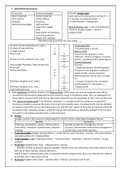
A. Manufacturing accounts:
Prime cost Factory overheads Calculate closing stock:
Direct materials Indirect materials open stock of finished goods x markup % = x
Direct labour Indirect labour x + increase in unrealised profit = y
Royalties Insurance y x 100/%markup = closing stock
Manufacturing wages Light and heat
Supervisor’s wages Total production cost = Cost of manufacture
Rent + Work in progress (open) – Work in
Depreciation of machinery progress (end)
Cost of manufacture
Repairs and renewals
Manufacturing account for the year ended ____
Inventory of raw materials as at _open_ X Unrealised profit
Purchase of raw materials x = Finished goods x 20/120
Carriage inwards x Balance sheet
Returns out (x) X Current assets: Inventory = Raw
X materials + Work in progress + Finished
Inventory of raw materials as at _end_ (X) goods (- unrealised profit/ whole figure)
X Income Statement
Direct wages/ Royalties/ Other prime costs X Revenue
Prime cost X – [Opening Inventory (finished goods) +
Factory overheads X Production cost of goods completed (+
X factory profit) - Closing Inventory
X X (finished goods)- returns out + carriage
X in]
Working in progress as at _begin_ X – increase in provision for unrealised
X profit (expense) / + decrease in ___
Working in progress as at _end_ (x) + factory profit
Total production cost X
How inventories should be valued on the balance sheet: at the lower cost and net realisable value (IAS 2),
unrealised profit should be deducted from the inventory value in the balance sheet. This is an application of
the prudence concept (IAS1) and ensures that assets and profit are not overstated so that a true and fair view.
Why adjust unrealised profit in the financial statement: In accordance with the prudence concept/IAS2,
inventories should be valued at the lower of cost and net realisable value. Unrealised profit must be adjusted
so inventory and profit are not overstated and a true and fair view is given of the value of inventory and profit.
According to the realisation concept - profit has not yet been achieved so cannot be included in the accounts.
This profit is not realised until the stock is sold at this price.
B. Budget:
Budget control is the process of using budgets to monitor actual results against budgeted figures
Benefits Limitations
Planning, coordination, control, communication, Benefits exceed cost of budgetary control,
motivation, evaluation of performance, decision- accuracy, demotivation, disfunctional management,
making set too easy, may restrict activities
1. Trade Receivables budget: opening debtors + credit sales (no cash included) – receipts – discounts allowed –
bad debts written off = closing debtors
2. Trade Payables budget: Opening creditors + Credit purchases – Payments – Discount received = Closing
creditors
3. Production budget(units): Sales – Opening stock + Closing
Benefits: identify production capacity available, schedule resources effectively, meet sales demand, make
best use of spare capacity, improve efficiency
Useful if there is communication and co-ordination between departments, eg so raw materials are ordered
as needed, Just-in-time stock control
4. Purchases budget (units): (sales – opening stock + closing) x purchases cost of each
, 5. Labour budget: Labour hours available – (Production in units x Labour hours per unit) = surplus/ shortfall
of labour hours
Maximum number of workers with hours available = total hours per year or period / hours per year or
period per employee
Benefits: co-ordinate between production department and human resources department on the amount
of staff needed control of labour hours and production, to control costs and stock levels needed for
production plan control the amount of cash paid for labour
6. Cash budget: Receipts (Capital introduced + debtors) – Payments (NCA+ stock+ creditors+ expenses+
drawings) = Net cash flow + Bank balance begin = Bank balance end
Benefits: plan future expenditure; control costs and revenues to ensure that either a bank overdraft is
avoided or a bank overdraft/loan can be arranged in advance; reschedule payments where necessary to
avoid bank borrowing; coordinate the activities of the various sections of the business; communicate the
overall aims of the business to the various sections and to check that the cash will be available to meet their
needs; identify any possible cash surpluses in advance and take steps to invest the surplus on a short-term
basis
7. Master budget: preparation of forecast financial statements
C.
Marginal costing: Marginal cost = Variable cost
Revenue X Absorbtion:
Variable costs: Direct materials X Quantity = (profit + fixed cost)/(selling price – direct
Direct labour (x) cost)
Closing inventory X Mark-up = profit/(direct costs + fixed costs)
X Total production cost = quantity x (materials/labour per
Fixed production overheads X unit x price + overheads)
Cost of sales (x) OAR= (overheads – apportionment)/ machine or labour
Profit x hours ( the more intensive one) = £/hour
Apportionment: appor of B = (overheads A + appor 3% D) x 1% B C A
A 1% 2%
D 3%
(in)Direct costs Costs that can/cannot be identified directly with each unit of output
Variable costs Costs vary directly with output or activity
Semi-variable Costs which combine a fixed and variable element
costs eg: telephone bill with fixed rental and charge per unit
Fixed costs Costs remain fixed over a range of output levels
Marginal cost Cost of producing one extra unit of output
Contribution Difference between sales income and the variable costs of the units sold in a period
Break-even is the point at which no profit or loss is made where total revenue equals total costs. Break-
even is where total contribution = fixed costs.
= total fixed Break-even is a management tool: are enough units being sold to cover costs? is
cost / (selling contribution per unit enough to cover fixed costs or should variable costs be lowered or selling
price – price raised? once break-even is passed profit is made, whereas below break-even a loss is
variable cost made. sets targets which can motivate the workforce
per unit) Strengths of breakeven analysis
Focuses entrepreneur on how long it will take before a start-up reaches profitability Helps
entrepreneur understand the viability of a business proposition, and also those who will lend
money to, or invest in the business
Margin of safety calculation shows how much a sales forecast can prove over-optimistic before
losses are incurred
Helps entrepreneur understand the level of risk involved in a start-up
Illustrates the importance of a start-up keeping fixed costs down to a minimum (higher fixed
costs = higher break-even output)
Calculations are quick and easy – great for giving quick estimates
Limitations of breakeven analysis
Unrealistic assumptions – products are not sold at the same price at different levels of output;
fixed costs do vary when output changes
Prime cost Factory overheads Calculate closing stock:
Direct materials Indirect materials open stock of finished goods x markup % = x
Direct labour Indirect labour x + increase in unrealised profit = y
Royalties Insurance y x 100/%markup = closing stock
Manufacturing wages Light and heat
Supervisor’s wages Total production cost = Cost of manufacture
Rent + Work in progress (open) – Work in
Depreciation of machinery progress (end)
Cost of manufacture
Repairs and renewals
Manufacturing account for the year ended ____
Inventory of raw materials as at _open_ X Unrealised profit
Purchase of raw materials x = Finished goods x 20/120
Carriage inwards x Balance sheet
Returns out (x) X Current assets: Inventory = Raw
X materials + Work in progress + Finished
Inventory of raw materials as at _end_ (X) goods (- unrealised profit/ whole figure)
X Income Statement
Direct wages/ Royalties/ Other prime costs X Revenue
Prime cost X – [Opening Inventory (finished goods) +
Factory overheads X Production cost of goods completed (+
X factory profit) - Closing Inventory
X X (finished goods)- returns out + carriage
X in]
Working in progress as at _begin_ X – increase in provision for unrealised
X profit (expense) / + decrease in ___
Working in progress as at _end_ (x) + factory profit
Total production cost X
How inventories should be valued on the balance sheet: at the lower cost and net realisable value (IAS 2),
unrealised profit should be deducted from the inventory value in the balance sheet. This is an application of
the prudence concept (IAS1) and ensures that assets and profit are not overstated so that a true and fair view.
Why adjust unrealised profit in the financial statement: In accordance with the prudence concept/IAS2,
inventories should be valued at the lower of cost and net realisable value. Unrealised profit must be adjusted
so inventory and profit are not overstated and a true and fair view is given of the value of inventory and profit.
According to the realisation concept - profit has not yet been achieved so cannot be included in the accounts.
This profit is not realised until the stock is sold at this price.
B. Budget:
Budget control is the process of using budgets to monitor actual results against budgeted figures
Benefits Limitations
Planning, coordination, control, communication, Benefits exceed cost of budgetary control,
motivation, evaluation of performance, decision- accuracy, demotivation, disfunctional management,
making set too easy, may restrict activities
1. Trade Receivables budget: opening debtors + credit sales (no cash included) – receipts – discounts allowed –
bad debts written off = closing debtors
2. Trade Payables budget: Opening creditors + Credit purchases – Payments – Discount received = Closing
creditors
3. Production budget(units): Sales – Opening stock + Closing
Benefits: identify production capacity available, schedule resources effectively, meet sales demand, make
best use of spare capacity, improve efficiency
Useful if there is communication and co-ordination between departments, eg so raw materials are ordered
as needed, Just-in-time stock control
4. Purchases budget (units): (sales – opening stock + closing) x purchases cost of each
, 5. Labour budget: Labour hours available – (Production in units x Labour hours per unit) = surplus/ shortfall
of labour hours
Maximum number of workers with hours available = total hours per year or period / hours per year or
period per employee
Benefits: co-ordinate between production department and human resources department on the amount
of staff needed control of labour hours and production, to control costs and stock levels needed for
production plan control the amount of cash paid for labour
6. Cash budget: Receipts (Capital introduced + debtors) – Payments (NCA+ stock+ creditors+ expenses+
drawings) = Net cash flow + Bank balance begin = Bank balance end
Benefits: plan future expenditure; control costs and revenues to ensure that either a bank overdraft is
avoided or a bank overdraft/loan can be arranged in advance; reschedule payments where necessary to
avoid bank borrowing; coordinate the activities of the various sections of the business; communicate the
overall aims of the business to the various sections and to check that the cash will be available to meet their
needs; identify any possible cash surpluses in advance and take steps to invest the surplus on a short-term
basis
7. Master budget: preparation of forecast financial statements
C.
Marginal costing: Marginal cost = Variable cost
Revenue X Absorbtion:
Variable costs: Direct materials X Quantity = (profit + fixed cost)/(selling price – direct
Direct labour (x) cost)
Closing inventory X Mark-up = profit/(direct costs + fixed costs)
X Total production cost = quantity x (materials/labour per
Fixed production overheads X unit x price + overheads)
Cost of sales (x) OAR= (overheads – apportionment)/ machine or labour
Profit x hours ( the more intensive one) = £/hour
Apportionment: appor of B = (overheads A + appor 3% D) x 1% B C A
A 1% 2%
D 3%
(in)Direct costs Costs that can/cannot be identified directly with each unit of output
Variable costs Costs vary directly with output or activity
Semi-variable Costs which combine a fixed and variable element
costs eg: telephone bill with fixed rental and charge per unit
Fixed costs Costs remain fixed over a range of output levels
Marginal cost Cost of producing one extra unit of output
Contribution Difference between sales income and the variable costs of the units sold in a period
Break-even is the point at which no profit or loss is made where total revenue equals total costs. Break-
even is where total contribution = fixed costs.
= total fixed Break-even is a management tool: are enough units being sold to cover costs? is
cost / (selling contribution per unit enough to cover fixed costs or should variable costs be lowered or selling
price – price raised? once break-even is passed profit is made, whereas below break-even a loss is
variable cost made. sets targets which can motivate the workforce
per unit) Strengths of breakeven analysis
Focuses entrepreneur on how long it will take before a start-up reaches profitability Helps
entrepreneur understand the viability of a business proposition, and also those who will lend
money to, or invest in the business
Margin of safety calculation shows how much a sales forecast can prove over-optimistic before
losses are incurred
Helps entrepreneur understand the level of risk involved in a start-up
Illustrates the importance of a start-up keeping fixed costs down to a minimum (higher fixed
costs = higher break-even output)
Calculations are quick and easy – great for giving quick estimates
Limitations of breakeven analysis
Unrealistic assumptions – products are not sold at the same price at different levels of output;
fixed costs do vary when output changes