Teacher Language
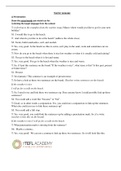
a) Presentation
Show the actual words you would use for:
i) eliciting the target language from the context
T: (referring to the examples from the warmer stage) Marco where would you like to go for your next
holiday?
S1: I would like to go to the beach.
T: And what do you like to do at the beach? (address the whole class)
S2: Swim, build sandcastles, surf, and snorkel.
T: Yes, very good. At the beach we like to swim, surf, play in the sand, swim and sometimes eat ice
cream.
T: Now do you go to the beach when there is nice hot weather or when it is usually cold and raining?
S3: You go to the beach when it is hot and sunny.
T: Yes, very good. You go to the beach when the weather is nice and warm.
T: So, if I put this sentence on the board “If the weather is nice”, what tense is this? Is this past, present
or future tense?
S1: Present.
T: Yes fantastic! This sentence is an example of present tense.
T: So have a look at these two sentences on the board. (Teacher writes sentences on the board)
If the weather is nice
I will go for a walk on the beach.
T: So, I need to try and link these two sentences up. Does anyone know I could possibly link up these
sentences?
S4: You could add a word like “because” or “but”.
T: Good, so in other words a conjunction. Yes, you could use a conjunction to link up the sentences.
What else could you use to link these sentences up?
S5: You could add a full stop.
T: Yes, very good, you could link the sentences up by adding a punctuation mark. So, if a write:
(teacher writes this on the board)
If the weather is nice I will go for a walk on the beach.
T: What punctuation mark is missing from the sentence?
S6: Maybe a comma...
T: Yes, very good! We can use a comma to link up these two sentences. So it will look like this:
a) Presentation
Show the actual words you would use for:
i) eliciting the target language from the context
T: (referring to the examples from the warmer stage) Marco where would you like to go for your next
holiday?
S1: I would like to go to the beach.
T: And what do you like to do at the beach? (address the whole class)
S2: Swim, build sandcastles, surf, and snorkel.
T: Yes, very good. At the beach we like to swim, surf, play in the sand, swim and sometimes eat ice
cream.
T: Now do you go to the beach when there is nice hot weather or when it is usually cold and raining?
S3: You go to the beach when it is hot and sunny.
T: Yes, very good. You go to the beach when the weather is nice and warm.
T: So, if I put this sentence on the board “If the weather is nice”, what tense is this? Is this past, present
or future tense?
S1: Present.
T: Yes fantastic! This sentence is an example of present tense.
T: So have a look at these two sentences on the board. (Teacher writes sentences on the board)
If the weather is nice
I will go for a walk on the beach.
T: So, I need to try and link these two sentences up. Does anyone know I could possibly link up these
sentences?
S4: You could add a word like “because” or “but”.
T: Good, so in other words a conjunction. Yes, you could use a conjunction to link up the sentences.
What else could you use to link these sentences up?
S5: You could add a full stop.
T: Yes, very good, you could link the sentences up by adding a punctuation mark. So, if a write:
(teacher writes this on the board)
If the weather is nice I will go for a walk on the beach.
T: What punctuation mark is missing from the sentence?
S6: Maybe a comma...
T: Yes, very good! We can use a comma to link up these two sentences. So it will look like this: