Imperatives
An imperative is part of a direct command, where someone orders someone else to do
something. It is often followed by a vocative:
‘da mihi pecuniam, serve!’ - ’give me the money, slave!’
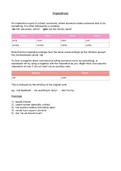
Carry! Warn! Drag! Listen!
porta mone trahe audi
portate monete trahite audite
Note that the imperative endings have the same vowel endings as the infinitive (except
the 3rd declension plural -ite)
To form a negative direct command (ie telling someone not to do something), is
expressed not by using a negative with the imperative as you. Might think, but uses the
imperative of nolo (‘I do not want’) as an auxiliary verb.
Singular Plural
noli nolite
This is followed by the infinitive of the original verb:
eg - noli festinare! - be unwilling to hurry! - don’t hurry!
Exercises
1) tacete omnes!
2) urbem fortiter defendite, milites!
3) noli auxilium talibus hominibus dare!
4) vende hunc equum, domine!
5) duc me ad ducem tuum!
An imperative is part of a direct command, where someone orders someone else to do
something. It is often followed by a vocative:
‘da mihi pecuniam, serve!’ - ’give me the money, slave!’
Carry! Warn! Drag! Listen!
porta mone trahe audi
portate monete trahite audite
Note that the imperative endings have the same vowel endings as the infinitive (except
the 3rd declension plural -ite)
To form a negative direct command (ie telling someone not to do something), is
expressed not by using a negative with the imperative as you. Might think, but uses the
imperative of nolo (‘I do not want’) as an auxiliary verb.
Singular Plural
noli nolite
This is followed by the infinitive of the original verb:
eg - noli festinare! - be unwilling to hurry! - don’t hurry!
Exercises
1) tacete omnes!
2) urbem fortiter defendite, milites!
3) noli auxilium talibus hominibus dare!
4) vende hunc equum, domine!
5) duc me ad ducem tuum!