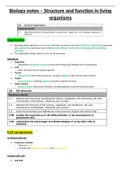
Biology notes – Structure and function in living
organisms
Organisation
Although some organisms are so simple that they can exist as one cell (unicellular), multicellular organisms
are organised in a particular way in order to allow efficient systems for exchanging and transporting
materials.
The organisation allows them to carry out life processes.
Definitions
Organelles
specialised subcellular structures found within living cells (detailed in the next section)
Cells
basic structural unit of a living organism,
Tissues
group of cells with similar structures, working together to perform the same function
Organs
group of tissues, working together to perform specific functions
Organ systems
group of organs with similar functions, working together to perform body functions
Cell components
In animal cells only
Temporary Vacuole
These are small
can help with digestion, excretion and water removal
In plant cells only
Cell Wall
, Made of cellulose
rigid outer coating that gives support to the cell and keeps it turgid (is permeable)
Chloroplast
Contain a green pigment-chlorophyll- which absorbs sunlight.
Photosynthesis occurs here
makes food for plant
not in root.
Permanent Vacuole
This contains cell sap which is a store for ions and molecules.
Stops the cell from collapsing inwards.
In everything
Cytoplasm
Contains water, dissolved substances and supports other organelles
most chemical reactions occur here.
Cell surface membrane
Thin skin that surrounds the cell and controls what goes in and out (selectively permeable)
Nucleus
Contains chromosomes which carry the genetic material
Controls the activity of the cell (by controlling which proteins are made)
Mitochondrion
Aerobic respiration occurs
energy for cell
Ribosomes
These are where protein synthesis take place
Stem Cells
Stem cells are undifferentiated/specialised cells that are capable of differentiating and becoming
specialised as an embryo grows.
The differentiation of these cells is controlled by genes.
When a single cell egg is fertilised by a sperm cell the cell splits by mitosis and an embryo is created from
totipotent cells.
Types of stem cell: (DONT NEED)
Embryonic:
Totipotent- can differentiate into all cells
Pluripotent – can differentiate into most cells
Adult:
Multipotent- can differentiate into many cells
IPSC:
These are “induced Pluripotent Stem Cells” and are created by taking a skin cell and putting is through
reverse differentiation.
They can treat degenerative diseases as the stem cells will produce fresh specialised cells.
,Specialised cells and differentiation
Definitions
Specialised cells
Cells which have develop certain characteristics in order to perform particular functions.
They become specialized through differentiation
Differentiation
a process that involves the cell gaining new sub-cellular structures in order for It to be suited to its role.
Cells can either differentiate once early on or have the ability to differentiate their whole life (stem
cells).
In animals, most cells only differentiate once, but in plants many cells retain the ability.
Examples of specialised cells
Sperm cells:
Streamlined head and long tail to aid swimming
Many mitochondria (where respiration happens) which supply the energy to allow the cell to move
The acrosome (top of the head) has digestive enzymes which break down the outer layers of membrane
of the egg cell
, Carbohydrates, proteins and lipids
Are all made up of carbon (C), hydrogen (H) and oxygen (O). Proteins also contain nitrogen (N).
A molecule that contains carbon is an organic molecule
Carbohydrates
Made out of elements C H O, carbon, hydrogen, oxygen
Insoluble and good energy stores
Carbohydrates provide energy. There are two types - simple and complex.
Simple carbohydrates e.g. sugars are a fast-acting source of energy,
complex carbohydrates are a source of slow-release energy, E.g rice and pasta.
Monomer Dimer Polymer
Monosaccharide Disaccharide Polysaccharide
fructose, glucose Maltose Starch, Cellulose
Protein
Made out of elements C H O N, Carbon, hydrogen, Oxygen, Nitrogen
Structure determines function
used for the growth and repair of cells
can be used as a source of energy if carbohydrate and fat reserves are low.
Monomer Dimer Polymer
Amino acid Dipeptide Polypeptide
joined by a peptide bond Hormones, enzymes
organisms
Organisation
Although some organisms are so simple that they can exist as one cell (unicellular), multicellular organisms
are organised in a particular way in order to allow efficient systems for exchanging and transporting
materials.
The organisation allows them to carry out life processes.
Definitions
Organelles
specialised subcellular structures found within living cells (detailed in the next section)
Cells
basic structural unit of a living organism,
Tissues
group of cells with similar structures, working together to perform the same function
Organs
group of tissues, working together to perform specific functions
Organ systems
group of organs with similar functions, working together to perform body functions
Cell components
In animal cells only
Temporary Vacuole
These are small
can help with digestion, excretion and water removal
In plant cells only
Cell Wall
, Made of cellulose
rigid outer coating that gives support to the cell and keeps it turgid (is permeable)
Chloroplast
Contain a green pigment-chlorophyll- which absorbs sunlight.
Photosynthesis occurs here
makes food for plant
not in root.
Permanent Vacuole
This contains cell sap which is a store for ions and molecules.
Stops the cell from collapsing inwards.
In everything
Cytoplasm
Contains water, dissolved substances and supports other organelles
most chemical reactions occur here.
Cell surface membrane
Thin skin that surrounds the cell and controls what goes in and out (selectively permeable)
Nucleus
Contains chromosomes which carry the genetic material
Controls the activity of the cell (by controlling which proteins are made)
Mitochondrion
Aerobic respiration occurs
energy for cell
Ribosomes
These are where protein synthesis take place
Stem Cells
Stem cells are undifferentiated/specialised cells that are capable of differentiating and becoming
specialised as an embryo grows.
The differentiation of these cells is controlled by genes.
When a single cell egg is fertilised by a sperm cell the cell splits by mitosis and an embryo is created from
totipotent cells.
Types of stem cell: (DONT NEED)
Embryonic:
Totipotent- can differentiate into all cells
Pluripotent – can differentiate into most cells
Adult:
Multipotent- can differentiate into many cells
IPSC:
These are “induced Pluripotent Stem Cells” and are created by taking a skin cell and putting is through
reverse differentiation.
They can treat degenerative diseases as the stem cells will produce fresh specialised cells.
,Specialised cells and differentiation
Definitions
Specialised cells
Cells which have develop certain characteristics in order to perform particular functions.
They become specialized through differentiation
Differentiation
a process that involves the cell gaining new sub-cellular structures in order for It to be suited to its role.
Cells can either differentiate once early on or have the ability to differentiate their whole life (stem
cells).
In animals, most cells only differentiate once, but in plants many cells retain the ability.
Examples of specialised cells
Sperm cells:
Streamlined head and long tail to aid swimming
Many mitochondria (where respiration happens) which supply the energy to allow the cell to move
The acrosome (top of the head) has digestive enzymes which break down the outer layers of membrane
of the egg cell
, Carbohydrates, proteins and lipids
Are all made up of carbon (C), hydrogen (H) and oxygen (O). Proteins also contain nitrogen (N).
A molecule that contains carbon is an organic molecule
Carbohydrates
Made out of elements C H O, carbon, hydrogen, oxygen
Insoluble and good energy stores
Carbohydrates provide energy. There are two types - simple and complex.
Simple carbohydrates e.g. sugars are a fast-acting source of energy,
complex carbohydrates are a source of slow-release energy, E.g rice and pasta.
Monomer Dimer Polymer
Monosaccharide Disaccharide Polysaccharide
fructose, glucose Maltose Starch, Cellulose
Protein
Made out of elements C H O N, Carbon, hydrogen, Oxygen, Nitrogen
Structure determines function
used for the growth and repair of cells
can be used as a source of energy if carbohydrate and fat reserves are low.
Monomer Dimer Polymer
Amino acid Dipeptide Polypeptide
joined by a peptide bond Hormones, enzymes