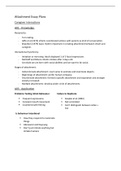
Attachment Essay Plans
Caregiver interactions
A01 - Knowledge
Reciprocity:
- Turn-taking
- Jaffe et al (1973) infants coordinated actions with parents as kind of conversation.
- Brazelton (1979) basic rhythm important in creating attachment between infant and
caregiver.
Interactional Synchrony:
- Imitation or mirroring. Adult displayed 1 of 3 facial expressions
- Meltzoff and Moore infants imitate after 3 days old.
- Conclude we are born with social abilities and we want to be social.
Stages of attachment:
- Indiscriminate attachment: react same to animate and inanimate objects.
- Beginnings of attachment: prefer human company.
- Discriminate attachment: formed a specific attachment and separation and stranger
anxiety increased.
- Multiple attachments: develop wider circle of attachments.
A03 - Application
Problems Testing infant Behaviour Failure to Replicate
Frequent expressions Koepke at al (1983)
Constant mouth movement Not controlled
Countered with filming Can’t distinguish between video +
live
Is behaviour intentional
How they respond to inanimate
things
Abravanet and Deyoung
Don’t just imitate anything but
imitate humans
, Animal Studies
AO1
Lorenz (1935):
- one group hatched with mother; another group hatched in front of Lorenz.
- when placed with original mother, they returned straight to Lorenz.
- imprinting irreversible, animals mated with same thing they attached with.
Harlow (1959)
- 2 wire mothers, different heads, one cloth covered one not. One mother had feeding
bottle.
- All monkeys spent most time with cloth mother (17-18 hrs), only briefly going to wire
mother for food (2-3 hours).
- Monkeys developed abnormally, if spent time with other monkeys they’d recover.
A03
Research support Confounding variable (Harlow)
Guiton (1966) Two different heads
Chicks had predisposition to Independent variable
attach Lowers internal validity
Critical window
Animal Studies
Generalising to humans difficult
Animals have conscious decision
But supported by Schafer and
Emerson
Caregiver interactions
A01 - Knowledge
Reciprocity:
- Turn-taking
- Jaffe et al (1973) infants coordinated actions with parents as kind of conversation.
- Brazelton (1979) basic rhythm important in creating attachment between infant and
caregiver.
Interactional Synchrony:
- Imitation or mirroring. Adult displayed 1 of 3 facial expressions
- Meltzoff and Moore infants imitate after 3 days old.
- Conclude we are born with social abilities and we want to be social.
Stages of attachment:
- Indiscriminate attachment: react same to animate and inanimate objects.
- Beginnings of attachment: prefer human company.
- Discriminate attachment: formed a specific attachment and separation and stranger
anxiety increased.
- Multiple attachments: develop wider circle of attachments.
A03 - Application
Problems Testing infant Behaviour Failure to Replicate
Frequent expressions Koepke at al (1983)
Constant mouth movement Not controlled
Countered with filming Can’t distinguish between video +
live
Is behaviour intentional
How they respond to inanimate
things
Abravanet and Deyoung
Don’t just imitate anything but
imitate humans
, Animal Studies
AO1
Lorenz (1935):
- one group hatched with mother; another group hatched in front of Lorenz.
- when placed with original mother, they returned straight to Lorenz.
- imprinting irreversible, animals mated with same thing they attached with.
Harlow (1959)
- 2 wire mothers, different heads, one cloth covered one not. One mother had feeding
bottle.
- All monkeys spent most time with cloth mother (17-18 hrs), only briefly going to wire
mother for food (2-3 hours).
- Monkeys developed abnormally, if spent time with other monkeys they’d recover.
A03
Research support Confounding variable (Harlow)
Guiton (1966) Two different heads
Chicks had predisposition to Independent variable
attach Lowers internal validity
Critical window
Animal Studies
Generalising to humans difficult
Animals have conscious decision
But supported by Schafer and
Emerson