UNIT 3: BIODIVERSITY
Biodiversity is important because it allows systems to adapt to changing circumstances
Genetic diversity: sum of all of the different forms of genes present in a particular
species
Species diversity: variety of species and the relative abundance of the species in a given
area
Ecosystem diversity: diverse range of habitats, various organisms in the habitats and the
relationships that connect them
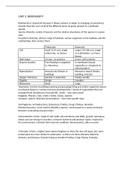
Prokaryote Eukaryote
Cell Small (1-10 um), single Larger (10-100 um), single
celled only, no tissues or multicellular, can have
tissues
DNA shape Circular, no proteins Linear, with proteins
Enzyme location Free floating in cytoplasm In membrane bound
ie: ribosomes organelles or cytoplasm ie:
mitochondrion
Reproduction Asexual only (fission or Asexual or sexual (fission,
budding) budding, meiosis)
Oxygen Tolerance Aerobic or anaerobic Mostly aerobic
Flagella Simple Complex
Ribosomes Small Large
Taxonomy: involves classifying (naming and grouping) living and extinct organisms based
on physical features. Carolus Linnaeus developed the 7 levels of organization that are
arranged from broadest to most specific. Levels – taxa (one taxon)
Kingdom, Phylum, Class, Order, Family, Genus, Species
Linnaeus’ system: binomial nomenclature – two most specific taxa
Six Kingdoms: Archaebacteria, Eubacteria, Protista, Fungi, Plantae, Animalia
Dichotomous Key: a tool used to identify a species’ name based on a series of choices
between contrasting characteristics
Characteristics of Life: made of cells (with cell membrane and DNA), growth, reproduce,
obtain and use energy to function, consume nutrients and produce waste, respond to
the environment, maintain their internal conditions (homeostasis), able to evolve
3 Domains of Life: a higher taxon above kingdom to show the two cell types, but some
prokaryotes are more similar to eukaryotes, so there are three domains: Bacteria,
Archaea, and Eukarya. Domain Eukarya includes Protista, Fungi, Planta, Animalia
, Clade: each evolutionary branch in a phylogenetic tree
Cladistics: method to determine the sequence of branches in a phylogenetic tree
Derived Characters: homologous structures common to all organisms in a clade
Cladogram: phylogenetic diagram that specifies the derived characters of clades
Viruses:
Structure: a virion (virus particle) is much smaller than a cell, and is made of:
A capsid (protective protein coat), nucleic acid (DNA or RNA), some have a membrane
envelope outside the capsid (membrane comes from the host’s cell ie: HIV), some have
a capsid with a tail section and tail fibers that help attach to and puncture a host’s cell
wall ie: bacteriophages
Classified by:
Types of genetic information – DNA or RNA, double or single stranded, which
determines their method of infection
Shape – polyhedron, helical, rod, complex, enveloped
Host organism – ie: bacteriophage
Types of diseases caused ie: HIV -> immunodeficiency, rhinovirus -> sinus infection
Reproduction Cycle: either lytic or lysogenic (can include a lytic cycle within)
Step 1: Attachment – phage attaches to the cell surface of a bacterium
Step 2: Entry – phage DNA enters the bacterial cell
Step 3: Replication – phage DNA is replicated, phage proteins are synthesized
Step 4: Assembly – phage components are assembled into mature viruses
Step 5: Release – the bacterial cell lyses and releases many phages that can then infect
other cells
The lysogenic cycle: step 1, 2
Step 3: Integration – phage DNA integrates into host DNA, and becomes a prophage
Step 4: Replication – prophage DNA replicated when bacteria replicates
Cells with prophage DNA have 3 options:
1.Stay dormant and get duplicated when the infected cell divides into 2 daughter cells
2.Environmental triggers may cause the prophage DNA to separate from the host DNA
then enter the lytic cell cycle
3. Produce virion particles that exit the cell through the process of budding, thereby
gaining an envelope made up of the host cell’s membrane
Viruses are not living, although they can evolve – RNA viruses evolve the fastest
Evolutionary origin: 3 theories:
Formed independently in the primordial soup along with the first cell
Evolved from stripped down parasite organisms that invade other cells (degenerate
cells)
Bits of their host DNA that broke off and became infectious particles (vagrant DNA)
Viruses appear to have originated several times – all three theories apply
Biodiversity is important because it allows systems to adapt to changing circumstances
Genetic diversity: sum of all of the different forms of genes present in a particular
species
Species diversity: variety of species and the relative abundance of the species in a given
area
Ecosystem diversity: diverse range of habitats, various organisms in the habitats and the
relationships that connect them
Prokaryote Eukaryote
Cell Small (1-10 um), single Larger (10-100 um), single
celled only, no tissues or multicellular, can have
tissues
DNA shape Circular, no proteins Linear, with proteins
Enzyme location Free floating in cytoplasm In membrane bound
ie: ribosomes organelles or cytoplasm ie:
mitochondrion
Reproduction Asexual only (fission or Asexual or sexual (fission,
budding) budding, meiosis)
Oxygen Tolerance Aerobic or anaerobic Mostly aerobic
Flagella Simple Complex
Ribosomes Small Large
Taxonomy: involves classifying (naming and grouping) living and extinct organisms based
on physical features. Carolus Linnaeus developed the 7 levels of organization that are
arranged from broadest to most specific. Levels – taxa (one taxon)
Kingdom, Phylum, Class, Order, Family, Genus, Species
Linnaeus’ system: binomial nomenclature – two most specific taxa
Six Kingdoms: Archaebacteria, Eubacteria, Protista, Fungi, Plantae, Animalia
Dichotomous Key: a tool used to identify a species’ name based on a series of choices
between contrasting characteristics
Characteristics of Life: made of cells (with cell membrane and DNA), growth, reproduce,
obtain and use energy to function, consume nutrients and produce waste, respond to
the environment, maintain their internal conditions (homeostasis), able to evolve
3 Domains of Life: a higher taxon above kingdom to show the two cell types, but some
prokaryotes are more similar to eukaryotes, so there are three domains: Bacteria,
Archaea, and Eukarya. Domain Eukarya includes Protista, Fungi, Planta, Animalia
, Clade: each evolutionary branch in a phylogenetic tree
Cladistics: method to determine the sequence of branches in a phylogenetic tree
Derived Characters: homologous structures common to all organisms in a clade
Cladogram: phylogenetic diagram that specifies the derived characters of clades
Viruses:
Structure: a virion (virus particle) is much smaller than a cell, and is made of:
A capsid (protective protein coat), nucleic acid (DNA or RNA), some have a membrane
envelope outside the capsid (membrane comes from the host’s cell ie: HIV), some have
a capsid with a tail section and tail fibers that help attach to and puncture a host’s cell
wall ie: bacteriophages
Classified by:
Types of genetic information – DNA or RNA, double or single stranded, which
determines their method of infection
Shape – polyhedron, helical, rod, complex, enveloped
Host organism – ie: bacteriophage
Types of diseases caused ie: HIV -> immunodeficiency, rhinovirus -> sinus infection
Reproduction Cycle: either lytic or lysogenic (can include a lytic cycle within)
Step 1: Attachment – phage attaches to the cell surface of a bacterium
Step 2: Entry – phage DNA enters the bacterial cell
Step 3: Replication – phage DNA is replicated, phage proteins are synthesized
Step 4: Assembly – phage components are assembled into mature viruses
Step 5: Release – the bacterial cell lyses and releases many phages that can then infect
other cells
The lysogenic cycle: step 1, 2
Step 3: Integration – phage DNA integrates into host DNA, and becomes a prophage
Step 4: Replication – prophage DNA replicated when bacteria replicates
Cells with prophage DNA have 3 options:
1.Stay dormant and get duplicated when the infected cell divides into 2 daughter cells
2.Environmental triggers may cause the prophage DNA to separate from the host DNA
then enter the lytic cell cycle
3. Produce virion particles that exit the cell through the process of budding, thereby
gaining an envelope made up of the host cell’s membrane
Viruses are not living, although they can evolve – RNA viruses evolve the fastest
Evolutionary origin: 3 theories:
Formed independently in the primordial soup along with the first cell
Evolved from stripped down parasite organisms that invade other cells (degenerate
cells)
Bits of their host DNA that broke off and became infectious particles (vagrant DNA)
Viruses appear to have originated several times – all three theories apply