
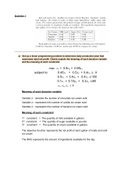
Question 1
____________________________________________________________________________
a) Set up a linear programming problem to determine daily production plan that
maximises total net profit. Clearly explain the meaning of each decision variable
and the meaning of each constraint.
max x1 + 0.9x2 + 0.95x3
subject to 0.45x1 + 0.5x2 + 0.4x3 ≤ X
…………………..0.5x1 + 0.4x2 + 0.4x3 ≤150
………….. 0.1x1 + 0.15x2 + 0.2x3 ≤60
x1, x2, x3 ≥ 0
Meaning of each decision variable
Variable x1 denotes the number of chocolate ice cream sold
Variable x2 represents the number of vanilla ice cream sold
Variable x3 represents the number of banana ice cream sold
Meaning of each constraint
1st constraint = The quantity of milk available in gallons
2nd constraint = The quantity of sugar available in pounds
3rd constraint = The quantity of cream available in gallons
The objective function represents the net profit of each gallon of made and sold
ice-cream.
The RHS represents the amount of ingredients available for the day.
, b) An experienced manager believes that the best plan would be to produce only two
types of ice cream, not to make the chocolate ice cream at all, and not to use all
available milk. Determine the basic variables. Provided that 20 gallons of milk is
not used, apply the transformation matrix technique to setup a linear equation that
determines X, the number of gallons of milk initially available. Demonstrate that X
= 200. Restore the complete simplex tableau and explain why it is associated with
an optimal solution.
According to the question, the chocolate ice-cream (x1) is not used, however the remaining two
variables x2, (vanilla) and x3, (banana) are basic, along with s1, considering that the milk is not
all used.
The linear programming problem as stated in the question is;
max 0.90x2 + 0.95x3
subject to 0.50x2 + 0.40x3 ≤ X -20
0.40x2 + 0.40x3 ≤150
0.15x2 + 0.20x3 ≤60
x2, x3 ≥ 0
The first simplex tableau is shown below;
,However, the complete simplex tableau to this question is shown below;
max 0.90x2 + 0.95x3
subject to 0.50x2 + 0.40x3 ≤ 200
0.40x2 + 0.40x3 ≤150
0.15x2 + 0.20x3 ≤60
x2, x3 ≥ 0
Adding the slack variables
max 0.90x2 + 0.95x3
subject to …... 0.50x2 + 0.40x3 + s1 = 200
…………………….. 0.40x2 + 0.40x3 + s2 = 150
…………… …...0.15x2 + 0.20x3 + s3 = 60
x2, x3, s1, s2, s3 ≥ 0
The matrix of the constraint coefficients is given by,
0.5 0.4 1 0 0
A0 = 0.4 0.4 0 1 0
0.15 0.2 0 0 1
The first simplex tableau:
, The first iteration: x3 enters and s3 leaves.
The entering variable isx3 because the positive maximum, Cj-Zj is 0.95.
The leaving basis variable is s3.
Therefore the pivot element is 0.2.
Changing the pivot row:
New Pivot Row = Old Pivot Row / Pivot Element
s3 (New) row = Old s3 ÷ 0.2
The s1 row:
s1 (New) row = s1 (old) row - 0.4 s3 (New) row
The s2 row:
s2 (New) row = s2 (old) row - 0.4 s3 (New) row
The second iteration: x2 enters and s2 leaves.
The entering variable is x2 because the positive maximum, Cj-Zj is 0.1875.
____________________________________________________________________________
a) Set up a linear programming problem to determine daily production plan that
maximises total net profit. Clearly explain the meaning of each decision variable
and the meaning of each constraint.
max x1 + 0.9x2 + 0.95x3
subject to 0.45x1 + 0.5x2 + 0.4x3 ≤ X
…………………..0.5x1 + 0.4x2 + 0.4x3 ≤150
………….. 0.1x1 + 0.15x2 + 0.2x3 ≤60
x1, x2, x3 ≥ 0
Meaning of each decision variable
Variable x1 denotes the number of chocolate ice cream sold
Variable x2 represents the number of vanilla ice cream sold
Variable x3 represents the number of banana ice cream sold
Meaning of each constraint
1st constraint = The quantity of milk available in gallons
2nd constraint = The quantity of sugar available in pounds
3rd constraint = The quantity of cream available in gallons
The objective function represents the net profit of each gallon of made and sold
ice-cream.
The RHS represents the amount of ingredients available for the day.
, b) An experienced manager believes that the best plan would be to produce only two
types of ice cream, not to make the chocolate ice cream at all, and not to use all
available milk. Determine the basic variables. Provided that 20 gallons of milk is
not used, apply the transformation matrix technique to setup a linear equation that
determines X, the number of gallons of milk initially available. Demonstrate that X
= 200. Restore the complete simplex tableau and explain why it is associated with
an optimal solution.
According to the question, the chocolate ice-cream (x1) is not used, however the remaining two
variables x2, (vanilla) and x3, (banana) are basic, along with s1, considering that the milk is not
all used.
The linear programming problem as stated in the question is;
max 0.90x2 + 0.95x3
subject to 0.50x2 + 0.40x3 ≤ X -20
0.40x2 + 0.40x3 ≤150
0.15x2 + 0.20x3 ≤60
x2, x3 ≥ 0
The first simplex tableau is shown below;
,However, the complete simplex tableau to this question is shown below;
max 0.90x2 + 0.95x3
subject to 0.50x2 + 0.40x3 ≤ 200
0.40x2 + 0.40x3 ≤150
0.15x2 + 0.20x3 ≤60
x2, x3 ≥ 0
Adding the slack variables
max 0.90x2 + 0.95x3
subject to …... 0.50x2 + 0.40x3 + s1 = 200
…………………….. 0.40x2 + 0.40x3 + s2 = 150
…………… …...0.15x2 + 0.20x3 + s3 = 60
x2, x3, s1, s2, s3 ≥ 0
The matrix of the constraint coefficients is given by,
0.5 0.4 1 0 0
A0 = 0.4 0.4 0 1 0
0.15 0.2 0 0 1
The first simplex tableau:
, The first iteration: x3 enters and s3 leaves.
The entering variable isx3 because the positive maximum, Cj-Zj is 0.95.
The leaving basis variable is s3.
Therefore the pivot element is 0.2.
Changing the pivot row:
New Pivot Row = Old Pivot Row / Pivot Element
s3 (New) row = Old s3 ÷ 0.2
The s1 row:
s1 (New) row = s1 (old) row - 0.4 s3 (New) row
The s2 row:
s2 (New) row = s2 (old) row - 0.4 s3 (New) row
The second iteration: x2 enters and s2 leaves.
The entering variable is x2 because the positive maximum, Cj-Zj is 0.1875.


