
NURS 3320-Chapter 23 ASSESSMENT Prep
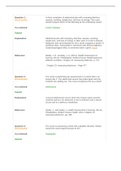
NURS 3320-Chapter 23 ASSESSMENT Prep Question 1: (see full question) A client complains of abdominal pain with cramping diarrhea, nausea, vomiting, weight loss, and loss of energy. The nurse should suspect which of the following as the underlying cause? You selected: Crohn's disease Correct Explanation: Abdominal pain with cramping, diarrhea, nausea, vomiting, weight loss, and lack of energy is often seen in Crohn’s disease. Epigastric pain accompanied by tarry stools suggests a gastric or duodenal ulcer. Pancreatitis is worsened with alcohol ingestion. Gastroesophageal reflux is worsened when supine. (less) Reference: Weber, J. R., & Kelley, J. H. (2014). Health Assessment in Nursing, 5th ed. Philadelphia: Wolters Kluwer Health/Lippincott Williams & Wilkins, Chapter 23: Assessing Abdomen, p. 477. Chapter 23: Assessing Abdomen - Page 477 Question 2: (see full question) The nurse is performing an assessment on a client that is on postop day 2. The abdominal wound has pulled apart and the contents are spilling out. The nurse recognizes this as a what? You selected: Dehiscence Correct Explanation: A wound dehiscence occurs when the incision opens and the contents spill out. An absecess is due to infection and a hernia occurs due to a defect or weakness. Reference: Weber, J., and Kelley, J. Health Assessment in Nursing, 5th ed., Philadelphia: Wolters Kluwer Health, 2014, Chapter 23: Assessing Abdomen, pg. 486. Question 3: (see full question) The nurse is assessing a client with a bladder disorder. Where would the nurse expect the pain to be? You selected: Suprapubic Correct Explanation: Bladder disorders may cause suprapubic pain. Reference: Weber, J. R., & Kelley, J. H. (2014). Health Assessment in Nursing, 5th ed. Philadelphia: Wolters Kluwer Health/Lippincott Williams & Wilkins, Chapter 23: Assessing Abdomen, p. 481. Chapter 23: Assessing Abdomen - Page 481 Question 4: (see full question) To assess an adult client for possible appendicitis and a positive psoas sign, the nurse should You selected: raise the client’s right leg from the hip. Correct Explanation: Assess for psoas sign by asking the client to lie on the left side. Hyperextend the right leg of the client. Reference: Weber, J. R., & Kelley, J. H. (2014). Health Assessment in Nursing, 5th ed. Philadelphia: Wolters Kluwer Health/Lippincott Williams & Wilkins, Chapter 23: Assessing Abdomen, p. 499. Chapter 23: Assessing Abdomen - Page 499 Question 5: (see full question) A client complains of a sudden onset of pain in the back. On questioning the client further, the nurse learns that the cause of the pain is acute pancreatitis. The nurse recognizes that this type of pain is which of the following? You selected: Radiated pain Incorrect Correct response: Referred pain Explanation: Pancreatic inflammation, or pancreatitis, may be felt in the back. This is called “referred” pain because the pain is not felt at its source. This is not radiated pain, which extends continuously to the tissues surrounding the source, nor is it localized pain, which remains only in one small area. It is not chronic pain, as it results from acute pancreatitis. (less) Reference: Weber, J.R., & Kelley, J.H. Health Assessment in Nursing, 5th ed., Philadelphia: Wolters Kluwer Health/Lippincott Williams & Wilkins, 2014, Chapter 23: Assessing Abdomen, p. 477. Chapter 23: Assessing Abdomen - Page 477 Question 1: (see full question) The linea alba is located where? You selected: Middle of the ventral abdominal wall Correct Explanation: Four layers of large, flat muscles form the ventral abdominal wall and are joined at the midline by a tendinous seam, the linea alba. The other options are distracters to the question. (less) Reference: Weber, J., & Kelley, J. H. (2014). Health Assessment in Nursing, 5th ed. Philadelphia: Wolters Kluwer Health/Lippincott Williams & Wilkins, Chapter 23: Assessing Abdomen, p. 473. Chapter 23: Assessing Abdomen - Page 473 Question 2: (see full question) A nurse is instructing a client who suffers from peptic ulcer disease about the causes of this condition. Which of the following should the nurse mention as a common bacterial cause? You selected: Helicobacter pylori Correct Explanation: Often the bacterium Helicobacter pylori (H. pylori) is active in causing the ulcer. Although usually present in the mucous, on occasion the H. pylori disrupt the mucous lining and inflame the organ lining. The other bacteria listed are not associated with peptic ulcer disease. (less) Reference: Weber, J.R., & Kelley, J.H. Health Assessment in Nursing, 5th ed., Philadelphia: Wolters Kluwer Health/Lippincott Williams & Wilkins, 2014, Chapter 23: Assessing Abdomen, p. 482. Chapter 23: Assessing Abdomen - Page 482 Question 3: (see full question) A nurse is inspecting the abdomen of a young, fit client who has well-defined abdominal muscles. The nurse recognizes the vertical line that appears in the center of the client's abdomen as which of the following? You selected: Linea alba Correct Explanation: The joining of the muscle fibers and aponeuroses at the midline of the abdomen forms a white line called the linea alba, which extends vertically from the xiphoid process of the sternum to the symphysis pubis. The abdomen includes three layers of muscle extending from the back, around the flanks, to the front. The outermost layer is the external abdominal oblique; the middle layer is the internal abdominal oblique; and the innermost layer is the transverse abdominis. A thin, shiny, serous membrane called the peritoneum lines the abdominal cavity (parietal peritoneum) and also provides a protective covering for most of the internal abdominal organs (visceral peritoneum). (less) Reference: Weber, J.R., & Kelley, J.H. Health Assessment in Nursing, 5th ed., Philadelphia: Wolte
Document information
- Uploaded on
- August 25, 2021
- Number of pages
- 22
- Written in
- 2021/2022
- Type
- Exam (elaborations)
- Contains
- Questions & answers


