Chapter 2 - Movement In and Out of Cells
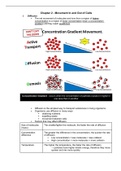
I. Diffusion
The net movement of molecules and ions from a region of higher
concentration to a region of lower concentration down a concentration
gradient until they reach equilibrium
Concentration Gradient - occurs when the concentration of particles (solute) in higher in
one area than in another
Diffusion is the simplest way to transport substances in living organisms
Organisms use diffusion in many ways
obtaining nutrients
expelling waste
movement between cells
Factors that may affect diffusion
Size of molecules The smaller/lighter the molecule, the faster the rate of diffusion
(mass)
Concentration The greater the difference in the concentration, the quicker the rate
difference of diffusion
Low concentration = less molecules = less collision
High concentration = more molecules = more collision
Temperature The higher the temperature, the faster the rate of diffusion
→ particles have higher kinetic energy, therefore they move
quicker and mix more quickly
, Real-life examples
Oxygen diffuse across from the
alveoli to the blood vessels in the
lungs
Water molecules diffuse out of
the plant leaves into the air
→ Transpiration
Carbon dioxide diffuses into the
plant leaf during photosynthesis
Oxygen diffuses out of the plant
leaf during photosynthesis
I. Diffusion
The net movement of molecules and ions from a region of higher
concentration to a region of lower concentration down a concentration
gradient until they reach equilibrium
Concentration Gradient - occurs when the concentration of particles (solute) in higher in
one area than in another
Diffusion is the simplest way to transport substances in living organisms
Organisms use diffusion in many ways
obtaining nutrients
expelling waste
movement between cells
Factors that may affect diffusion
Size of molecules The smaller/lighter the molecule, the faster the rate of diffusion
(mass)
Concentration The greater the difference in the concentration, the quicker the rate
difference of diffusion
Low concentration = less molecules = less collision
High concentration = more molecules = more collision
Temperature The higher the temperature, the faster the rate of diffusion
→ particles have higher kinetic energy, therefore they move
quicker and mix more quickly
, Real-life examples
Oxygen diffuse across from the
alveoli to the blood vessels in the
lungs
Water molecules diffuse out of
the plant leaves into the air
→ Transpiration
Carbon dioxide diffuses into the
plant leaf during photosynthesis
Oxygen diffuses out of the plant
leaf during photosynthesis