Chapter 1 - Cells
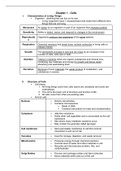
I. Characteristics of Living Things
Organism - anything that can live on its own
o Living organisms have 7 characteristics that make them different from
things that are not living
Movement An action by an organism or part of an organism that changes position
Sensitivity Ability to detect, sense, and respond to changes in the environment
Reproductio Organisms produce new organisms of the same species
n
Respiration Chemical reactions that break down nutrient molecules in living cells to
release energy
Growth The permanent increase in size and dry mass by an increase in the
number of cells, cells size or both
Nutrition Taking in nutrients which are organic substances and mineral ions,
containing raw materials and energy for growth and tissue repair,
absorbing and assimilating them
Excretion Removal of toxic materials, the waste product of metabolism, and
substances in excess
II. Structure of Cells
Cell theory
1. All living things come from cells (some are unicellular and some are
multicellular)
2. The cell is the basic unit of structure and function of life
3. All cells come from other pre-existing cells
Animal cells
Nucleus Directs cell activities
Contains chromosomes
Made of DNA
Contains instructions for traits and characteristics
Cytoplasm Jelly-like substance
Holds other cell organelles and is surrounded by the cell
membrane
Site where many metabolic reactions occur
May contain tiny granules called glycogen
Cell membrane Semi-permeable membrane of cell that controls
movement in and out of cell
Vacuoles Used for storage, digestion, and waste removal
Mitochondria Produces energy through chemical reactions
Controls level of water and other materials in cell
Recycles and decomposes proteins, fats, and
carbohydrates
Golgi Bodies Process and package protein and lipid molecules
Move materials within and out of the cell
I. Characteristics of Living Things
Organism - anything that can live on its own
o Living organisms have 7 characteristics that make them different from
things that are not living
Movement An action by an organism or part of an organism that changes position
Sensitivity Ability to detect, sense, and respond to changes in the environment
Reproductio Organisms produce new organisms of the same species
n
Respiration Chemical reactions that break down nutrient molecules in living cells to
release energy
Growth The permanent increase in size and dry mass by an increase in the
number of cells, cells size or both
Nutrition Taking in nutrients which are organic substances and mineral ions,
containing raw materials and energy for growth and tissue repair,
absorbing and assimilating them
Excretion Removal of toxic materials, the waste product of metabolism, and
substances in excess
II. Structure of Cells
Cell theory
1. All living things come from cells (some are unicellular and some are
multicellular)
2. The cell is the basic unit of structure and function of life
3. All cells come from other pre-existing cells
Animal cells
Nucleus Directs cell activities
Contains chromosomes
Made of DNA
Contains instructions for traits and characteristics
Cytoplasm Jelly-like substance
Holds other cell organelles and is surrounded by the cell
membrane
Site where many metabolic reactions occur
May contain tiny granules called glycogen
Cell membrane Semi-permeable membrane of cell that controls
movement in and out of cell
Vacuoles Used for storage, digestion, and waste removal
Mitochondria Produces energy through chemical reactions
Controls level of water and other materials in cell
Recycles and decomposes proteins, fats, and
carbohydrates
Golgi Bodies Process and package protein and lipid molecules
Move materials within and out of the cell