
Chapter 16 - Transfer of Sound Energy Through
Vibrations
I. Sound and Sound Waves
Sound is generated when something vibrates, squashing the air
→ Vibration of Matter
This causes a wave in the direction of propagation
o Direction of propagation: The axis which the wave travels along
Sound waves are longitudinal waves carried by compressions and rarefactions of
the air (or other medium)
o Compression: Squashed part of the air with higher pressure
o Rarefraction: Stretched part of the air with lower pressure
II. Sound and Mediums
Sound has to have a medium to travel through (solid/liquid/gas) → Cannot travel
through a vacuum
Speed of sound depends on the type, pressure, and temperature of the medium it is
traveling through
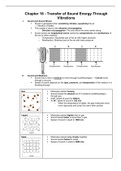
Gas Molecules packed loosely
Sound travels the slowest out of 3 mediums (solid/liquid/gas)
through gas
At 0°, speed of sound is 330m/s
At 20°, speed of sound is 343 m/s
o When the temperature is higher, the gas molecules move
more vigorously and bump into each other quicker
Liquid Molecules packed tighter than in gas
Sound travels faster in liquid than in gas
Speed of sound in liquid is 1500 m/s
Solid Molecules packed very closely together
Sound travels fastest in solids
Speed of sound in solids is 5000 m/s
, III. Calculate Speed
Mach Number: When an aircraft travels faster than the speed of sound, the speed is
measured using the Mach number
o Mach 1: 343 m/s or 1240 km/h
o Mach 2: 686 m/s or 2480 km/h
o Fastest aircraft flew at 3529.6 km/h (930 m/s) → Mach 2.85
Formula:
Speed (m/s) = Distance (m) / Time (s)
o Speed of Sound (Table)
Medium Speed
Gas (0°) 330 m/s
Gas (20°) 343 m/s
Liquid 1500 m/s
Solid 5000+ m/s
o *echo: speed travels 2x the distance
IV. The Ear
3 main parts:
Outer Consists of the pinna and the external auditory canal
(external) ear o Pinna: The cartilage of the ear, acts as a funnel to capture the
sound
Transmission of sound vibrations through the outer ear occurs mainly
through air
Vibrations
I. Sound and Sound Waves
Sound is generated when something vibrates, squashing the air
→ Vibration of Matter
This causes a wave in the direction of propagation
o Direction of propagation: The axis which the wave travels along
Sound waves are longitudinal waves carried by compressions and rarefactions of
the air (or other medium)
o Compression: Squashed part of the air with higher pressure
o Rarefraction: Stretched part of the air with lower pressure
II. Sound and Mediums
Sound has to have a medium to travel through (solid/liquid/gas) → Cannot travel
through a vacuum
Speed of sound depends on the type, pressure, and temperature of the medium it is
traveling through
Gas Molecules packed loosely
Sound travels the slowest out of 3 mediums (solid/liquid/gas)
through gas
At 0°, speed of sound is 330m/s
At 20°, speed of sound is 343 m/s
o When the temperature is higher, the gas molecules move
more vigorously and bump into each other quicker
Liquid Molecules packed tighter than in gas
Sound travels faster in liquid than in gas
Speed of sound in liquid is 1500 m/s
Solid Molecules packed very closely together
Sound travels fastest in solids
Speed of sound in solids is 5000 m/s
, III. Calculate Speed
Mach Number: When an aircraft travels faster than the speed of sound, the speed is
measured using the Mach number
o Mach 1: 343 m/s or 1240 km/h
o Mach 2: 686 m/s or 2480 km/h
o Fastest aircraft flew at 3529.6 km/h (930 m/s) → Mach 2.85
Formula:
Speed (m/s) = Distance (m) / Time (s)
o Speed of Sound (Table)
Medium Speed
Gas (0°) 330 m/s
Gas (20°) 343 m/s
Liquid 1500 m/s
Solid 5000+ m/s
o *echo: speed travels 2x the distance
IV. The Ear
3 main parts:
Outer Consists of the pinna and the external auditory canal
(external) ear o Pinna: The cartilage of the ear, acts as a funnel to capture the
sound
Transmission of sound vibrations through the outer ear occurs mainly
through air



