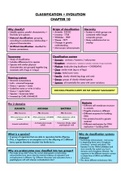
CLASSIFICATION + EVOLUTION
CHAPTER 10
Why classify? Origin of classification Hierarchy
• Identify species, predict characteristics + • Aristotle - 350 BC • System in which groups are
find links b/w species • Linnaeus - 1758 contained within larger
• Natural classification: grouping • Whittaker - 1989 composite groups
according to evolutionary relationships + • Woese - 1977 • Many subdivisions but no
physical characteristics • Changes in genetic overlap
• Artificial classification: classified for understanding
• Microscopic advancements
human convenience
Taxonomy Classification system
• Study of classification • Domain : archaea / bacteria / eukaryotae
• Includes differences b/w species • Kingdom : archaebacteria / eubacteria / plantae / Animalia / fungi / protoctista
• Species with similar physical
• Phylum: body plan (eg backbone = CHORDATA)
characteristics are grouped together (eg
mammals with 2 legs or 4 legs) • Class: similar traits (eg no of legs)
• Order: herbi/carni vores
• Family: closely related (eg dogs and cats)
Naming system
• Genus: groups of closely related species
• Binomial nomenclature
• Latin - universal language • Species: all essentially the same with some variations
• Genus + species = name
• Underline name or write in italics
• Genus = capital letter DID KING PRAWN CURRY OR FAT GREASY SAUSAGES?
• Species = lowercase letter
• Invented by CARL LINNAEUS
Bacteria
The 3 domains
• Different cell membrane structure
EUKARYA ARCHAEA BACTERIA to animals
• Flagella structure is different
- 80s ribosomes - 70s ribosomes - 70s ribosomes • Different enzymes for building
- RNA polymerase with 12 - RNA polymerase with 8-10 - RNA polymerase with 5
RNA
proteins proteins proteins • No proteins bound to genetic
material
- Archaebacteria (single - Eubacteria (Single celled,
- Animals (multicellular)
celled) peptidoglycan wall)
• Different mechanisms for DNA
replication + building RNA
What is a species? Why do classification systems
• A group of organisms that are able to reproduce fertile offspring change?
• Thus, a loganberry is an exception as it is the offspring of 2 different • Technology advancements - microscopy
berry species therefore shouldn’t be fertile but is. • In beginning there were 2 kingdoms
(Linnaeus) - animals and plants. This
became 5 in the 1960s (whittaker) and
more recently the system now has 3
Why are prokaryotae now classified into two groups? domains and 6 kingdoms (Woese). The
• The single group didn’t show the correct phylogenetic as technology organisms in the different domains contain
advancements have shown that the chemical makeup of eubacteria and a unique form of rRNA and different
archaebacteria is different. Eg. Different ribosomes and eubacteria have a ribosomes.
peptidoglycan cell wall whereas archaebacteria don’t • This shows different evolutionary links
, The 6 kingdoms
PROKARYOTAE PROTOCTISTA FUNGI PLANTAE ANIMALIA
Species belonging to Cats, lizards, birds, insects,
Bacteria ( Staph aureus and Roses, ferns, mosses,
EXAMPLES paramecium and amoeba (eg Mushrooms, moulds, yeast molluscs, worms, sponges
Bacillus anthracis) trees, grasses
plasmodium - malaria) and anemones
EUKARYOTE/
PROKARYOTE Prokaryote Eukaryote Eukaryote Eukaryote Eukaryote
UNICELLULAR/
MULTICELLULAR Unicellular Mainly unicellular Unicellular or multicellular Multicellular Multicellular
No nucleus or membrane bound Nucleus and other membrane Nucleus and other
Nucleus and other Nucleus and other
organelles - ring of naked DNA bound organelles and a cell membrane bound
NUCLEUS + membrane bound membrane bound organelles
(no histones) wall mainly composed of organelles including
ORGANELLES organelles, some have (no cell walls), no
Small ribosomes, peptidoglycan chitin. Body or mycelium chloroplasts and a
chloroplasts chloroplasts
cell wall made of threads or hyphae cellulose cell wall
Some are sessile (can’t Move with aid of cilia,
Most don’t move but
move), others move by cilia, No mechanisms for flagella or contractile
MOVEMENT Most move using flagellum gametes can move
flagella or amoeboid locomotion proteins (eg muscular
through cilia or flagella
mechanisms organs)
No visible feeding mechanism - Autotrophic - make
Saprophytes - extracellular Heterotrophic - food
FOOD nutrients absorbed through cell Autotrophic or heterotrophic their own food through
digestion acquired by ingestion
wall or made internally by or both - some are parasitic photosynthesis
Stored as glycogen Stored as glycogen
photosynthesis Stored as starch
Phylogenetics
• Study of Natural classification
evolutionary links • Uses many characteristics
and how closely • Reflects evolutionary links
different species • Lots of info
are related • May change with tech
• Appear together on advancements
evolutionary tree
• Organisms placed
in groups according
to evolutionary
Artificial classification
history Phylogenetic trees
• Uses few characteristics
• Uses anatomy,
• Doesn’t reflect evolutionary • Show evolutionary relationships between organisms
physiology, fossil
links over time
records and bio-
• Limited info • The closer the branches, the more closely related they
chemical analysis
• Stable / non changing are
of DNA and
proteins
CHAPTER 10
Why classify? Origin of classification Hierarchy
• Identify species, predict characteristics + • Aristotle - 350 BC • System in which groups are
find links b/w species • Linnaeus - 1758 contained within larger
• Natural classification: grouping • Whittaker - 1989 composite groups
according to evolutionary relationships + • Woese - 1977 • Many subdivisions but no
physical characteristics • Changes in genetic overlap
• Artificial classification: classified for understanding
• Microscopic advancements
human convenience
Taxonomy Classification system
• Study of classification • Domain : archaea / bacteria / eukaryotae
• Includes differences b/w species • Kingdom : archaebacteria / eubacteria / plantae / Animalia / fungi / protoctista
• Species with similar physical
• Phylum: body plan (eg backbone = CHORDATA)
characteristics are grouped together (eg
mammals with 2 legs or 4 legs) • Class: similar traits (eg no of legs)
• Order: herbi/carni vores
• Family: closely related (eg dogs and cats)
Naming system
• Genus: groups of closely related species
• Binomial nomenclature
• Latin - universal language • Species: all essentially the same with some variations
• Genus + species = name
• Underline name or write in italics
• Genus = capital letter DID KING PRAWN CURRY OR FAT GREASY SAUSAGES?
• Species = lowercase letter
• Invented by CARL LINNAEUS
Bacteria
The 3 domains
• Different cell membrane structure
EUKARYA ARCHAEA BACTERIA to animals
• Flagella structure is different
- 80s ribosomes - 70s ribosomes - 70s ribosomes • Different enzymes for building
- RNA polymerase with 12 - RNA polymerase with 8-10 - RNA polymerase with 5
RNA
proteins proteins proteins • No proteins bound to genetic
material
- Archaebacteria (single - Eubacteria (Single celled,
- Animals (multicellular)
celled) peptidoglycan wall)
• Different mechanisms for DNA
replication + building RNA
What is a species? Why do classification systems
• A group of organisms that are able to reproduce fertile offspring change?
• Thus, a loganberry is an exception as it is the offspring of 2 different • Technology advancements - microscopy
berry species therefore shouldn’t be fertile but is. • In beginning there were 2 kingdoms
(Linnaeus) - animals and plants. This
became 5 in the 1960s (whittaker) and
more recently the system now has 3
Why are prokaryotae now classified into two groups? domains and 6 kingdoms (Woese). The
• The single group didn’t show the correct phylogenetic as technology organisms in the different domains contain
advancements have shown that the chemical makeup of eubacteria and a unique form of rRNA and different
archaebacteria is different. Eg. Different ribosomes and eubacteria have a ribosomes.
peptidoglycan cell wall whereas archaebacteria don’t • This shows different evolutionary links
, The 6 kingdoms
PROKARYOTAE PROTOCTISTA FUNGI PLANTAE ANIMALIA
Species belonging to Cats, lizards, birds, insects,
Bacteria ( Staph aureus and Roses, ferns, mosses,
EXAMPLES paramecium and amoeba (eg Mushrooms, moulds, yeast molluscs, worms, sponges
Bacillus anthracis) trees, grasses
plasmodium - malaria) and anemones
EUKARYOTE/
PROKARYOTE Prokaryote Eukaryote Eukaryote Eukaryote Eukaryote
UNICELLULAR/
MULTICELLULAR Unicellular Mainly unicellular Unicellular or multicellular Multicellular Multicellular
No nucleus or membrane bound Nucleus and other membrane Nucleus and other
Nucleus and other Nucleus and other
organelles - ring of naked DNA bound organelles and a cell membrane bound
NUCLEUS + membrane bound membrane bound organelles
(no histones) wall mainly composed of organelles including
ORGANELLES organelles, some have (no cell walls), no
Small ribosomes, peptidoglycan chitin. Body or mycelium chloroplasts and a
chloroplasts chloroplasts
cell wall made of threads or hyphae cellulose cell wall
Some are sessile (can’t Move with aid of cilia,
Most don’t move but
move), others move by cilia, No mechanisms for flagella or contractile
MOVEMENT Most move using flagellum gametes can move
flagella or amoeboid locomotion proteins (eg muscular
through cilia or flagella
mechanisms organs)
No visible feeding mechanism - Autotrophic - make
Saprophytes - extracellular Heterotrophic - food
FOOD nutrients absorbed through cell Autotrophic or heterotrophic their own food through
digestion acquired by ingestion
wall or made internally by or both - some are parasitic photosynthesis
Stored as glycogen Stored as glycogen
photosynthesis Stored as starch
Phylogenetics
• Study of Natural classification
evolutionary links • Uses many characteristics
and how closely • Reflects evolutionary links
different species • Lots of info
are related • May change with tech
• Appear together on advancements
evolutionary tree
• Organisms placed
in groups according
to evolutionary
Artificial classification
history Phylogenetic trees
• Uses few characteristics
• Uses anatomy,
• Doesn’t reflect evolutionary • Show evolutionary relationships between organisms
physiology, fossil
links over time
records and bio-
• Limited info • The closer the branches, the more closely related they
chemical analysis
• Stable / non changing are
of DNA and
proteins