Chapter 1 Introduction to labor economics
Labor economics: Study how labor markets work.
3 leading actors:
- Workers: Act to maximize well-being and tend to supply more time and more effort to those
activities that have a higher payoff. Labor supply curve is often upward sloping. The higher
the wage that is being offered, the larger the labor supplied.
- Firms: Act to maximize profits. The firm’s demand for labor is a derived demand, a demand
derived from the desires of consumers. Downward-sloping labor demand curve shows the
relationship between the price of labor and how many workers firms are willing to hire.
Intersection between labor supply and demand curve show equilibrium.
- Government: Government regulations help set the ground rules that guide exchanges in the
labor market.
Positive economics: Addresses the relatively narrow “What is?” (for example What is the impact of
the minimum wage on unemployment?) questions. Addresses questions that can, in principle, be
answered with the tools of economics, without interjecting any value judgment as to whether the
particular outcome is desirable or harmful.
Normative economics: Addresses the much broader “What should be?” questions. These answers
require value judgments about the type of society we wish to live in.
A good theory of the labor market should have realistic assumptions, should not be clumsy or overly
complex, and should provide empirical implications that can be tested with real-world data.
Regression analysis:
log w = α + βs
The average log wage Dependent variable
Average years of schooling Independent variable
β= Change in log wage / Change in years of schooling
The slope gives the change in the log wage associated with a one-year increase in average schooling,
ceteris paribus. The objective of regression is to find the best line that goes through the scatter
diagram. We use standard errors to calculate the margin of error of our estimated regression
coefficients.
Statistical significance: T statistic = Absolute value of regression coefficient / Standard error of
regression coefficient.
Mathematical appendix 1
An individual has a utility function where is consumption of goods measured in dollars and
is hours of leisure.
Budget constraint is given by where T is total hours available in the time period.
W is the wage rate and V is other income.
The above equation can be rewritten as:
Maximizing by Lagrangian:
, (
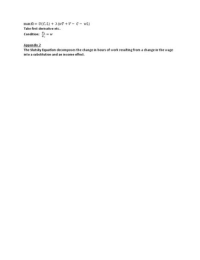
Take first derivative etc..
Condition:
Appendix 2
The Slutsky Equation decomposes the change in hours of work resulting from a change in the wage
into a substitution and an income effect.
, Chapter 2 Labor supply
Unemployment rate is widely regarded as a measure of the overall health of the U.S. economy.
The CPS classifies all persons aged 16 or older into one of three categories:
- The employed: A job with pay for at least 1 hour or worked at least 15 hours on a nonpaid
job.
- The unemployed: A worker must either be on a temporary layoff form a job or have no job
but be actively looking for work in the four-week period prior to the reference week.
- Out of labor force.
Labor force: A person participates in the labor force if he or she is either employed or unemployed.
LF = E + U
Labor participation rate: Gives the fraction of the population (P) that is in the labor force and is
defined by Labor Force participation rate = LF/P
Employment rate: Gives the fraction of the population that is employed, or Employment rate = E/P.
Unemployment rate: Gives the fraction of labor force participants who are unemployed = U/LF
Hidden unemployment: Because it is so hard to find work, many laid-off workers have become
discouraged with their futile job search activity, dropped out of the labor market, and stopped being
counted as unemployed. Therefore hidden unemployment should be added to the pool of
unemployed workers so that the unemployment problem is significantly worse than it appeared form
the BLS data.
Neoclassical model of labor-leisure choice: This model isolated the factors that determine whether a
particular person works and, if so, how many hours she chooses to work. The representative person
in our model receives satisfaction both from the consumption of goods (C) and for the consumption
of leisure (L).
U = f(C,L)
The utility function transforms the person’s consumption of goods and leisure into an index U that
measures the individual’s level of satisfaction or happiness.
Utility function: All point along this curve yield the same level of utility.
4 important properties of an indifference curve:
- Indifference curves are downward sloping.
- Higher indifference curves indicate higher levels of utility.
- Indifference curves do not intersect.
- Indifference curves are convex to the origin. (diminishing marginal rate of substitution)
Marginal utility of leisure (MUL): Defined as the change in utility resulting from an additional hour
devoted to leisure activities, holding constant the amount of goods consumed.
The slope of the indifference curve measures the rate at which a person is willing to give up some
leisure time in return for additional consumption, while holding utility constant the absolute value
of the slope of an indifference curve is also called the Marginal rate of substitution (MRS).
= (- MUL/MUC)
Economic models stress the impact of variables that are much more easily observable – such as
wages and incomes – on the labor supply decision.
Non-labor income: V
Labor economics: Study how labor markets work.
3 leading actors:
- Workers: Act to maximize well-being and tend to supply more time and more effort to those
activities that have a higher payoff. Labor supply curve is often upward sloping. The higher
the wage that is being offered, the larger the labor supplied.
- Firms: Act to maximize profits. The firm’s demand for labor is a derived demand, a demand
derived from the desires of consumers. Downward-sloping labor demand curve shows the
relationship between the price of labor and how many workers firms are willing to hire.
Intersection between labor supply and demand curve show equilibrium.
- Government: Government regulations help set the ground rules that guide exchanges in the
labor market.
Positive economics: Addresses the relatively narrow “What is?” (for example What is the impact of
the minimum wage on unemployment?) questions. Addresses questions that can, in principle, be
answered with the tools of economics, without interjecting any value judgment as to whether the
particular outcome is desirable or harmful.
Normative economics: Addresses the much broader “What should be?” questions. These answers
require value judgments about the type of society we wish to live in.
A good theory of the labor market should have realistic assumptions, should not be clumsy or overly
complex, and should provide empirical implications that can be tested with real-world data.
Regression analysis:
log w = α + βs
The average log wage Dependent variable
Average years of schooling Independent variable
β= Change in log wage / Change in years of schooling
The slope gives the change in the log wage associated with a one-year increase in average schooling,
ceteris paribus. The objective of regression is to find the best line that goes through the scatter
diagram. We use standard errors to calculate the margin of error of our estimated regression
coefficients.
Statistical significance: T statistic = Absolute value of regression coefficient / Standard error of
regression coefficient.
Mathematical appendix 1
An individual has a utility function where is consumption of goods measured in dollars and
is hours of leisure.
Budget constraint is given by where T is total hours available in the time period.
W is the wage rate and V is other income.
The above equation can be rewritten as:
Maximizing by Lagrangian:
, (
Take first derivative etc..
Condition:
Appendix 2
The Slutsky Equation decomposes the change in hours of work resulting from a change in the wage
into a substitution and an income effect.
, Chapter 2 Labor supply
Unemployment rate is widely regarded as a measure of the overall health of the U.S. economy.
The CPS classifies all persons aged 16 or older into one of three categories:
- The employed: A job with pay for at least 1 hour or worked at least 15 hours on a nonpaid
job.
- The unemployed: A worker must either be on a temporary layoff form a job or have no job
but be actively looking for work in the four-week period prior to the reference week.
- Out of labor force.
Labor force: A person participates in the labor force if he or she is either employed or unemployed.
LF = E + U
Labor participation rate: Gives the fraction of the population (P) that is in the labor force and is
defined by Labor Force participation rate = LF/P
Employment rate: Gives the fraction of the population that is employed, or Employment rate = E/P.
Unemployment rate: Gives the fraction of labor force participants who are unemployed = U/LF
Hidden unemployment: Because it is so hard to find work, many laid-off workers have become
discouraged with their futile job search activity, dropped out of the labor market, and stopped being
counted as unemployed. Therefore hidden unemployment should be added to the pool of
unemployed workers so that the unemployment problem is significantly worse than it appeared form
the BLS data.
Neoclassical model of labor-leisure choice: This model isolated the factors that determine whether a
particular person works and, if so, how many hours she chooses to work. The representative person
in our model receives satisfaction both from the consumption of goods (C) and for the consumption
of leisure (L).
U = f(C,L)
The utility function transforms the person’s consumption of goods and leisure into an index U that
measures the individual’s level of satisfaction or happiness.
Utility function: All point along this curve yield the same level of utility.
4 important properties of an indifference curve:
- Indifference curves are downward sloping.
- Higher indifference curves indicate higher levels of utility.
- Indifference curves do not intersect.
- Indifference curves are convex to the origin. (diminishing marginal rate of substitution)
Marginal utility of leisure (MUL): Defined as the change in utility resulting from an additional hour
devoted to leisure activities, holding constant the amount of goods consumed.
The slope of the indifference curve measures the rate at which a person is willing to give up some
leisure time in return for additional consumption, while holding utility constant the absolute value
of the slope of an indifference curve is also called the Marginal rate of substitution (MRS).
= (- MUL/MUC)
Economic models stress the impact of variables that are much more easily observable – such as
wages and incomes – on the labor supply decision.
Non-labor income: V